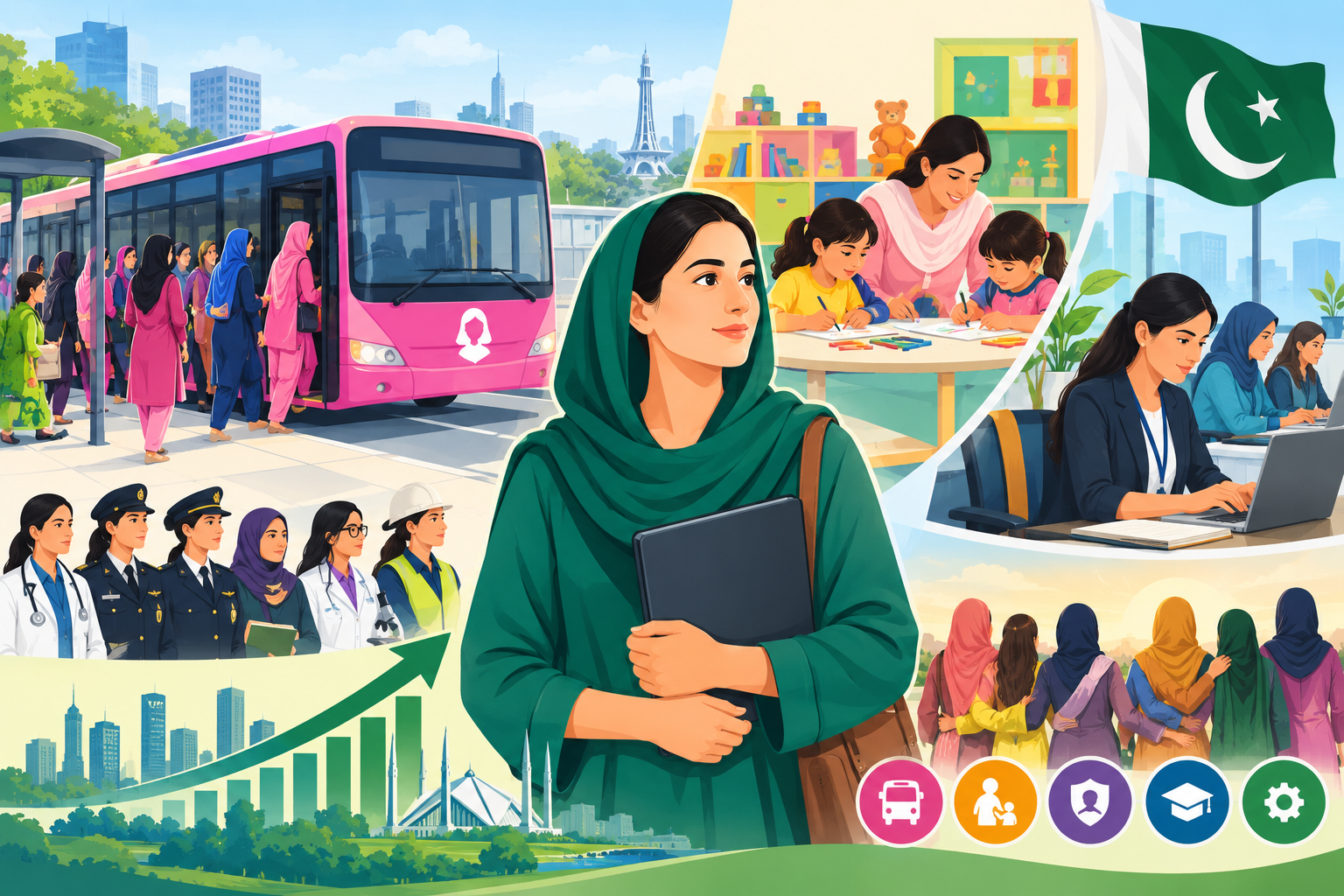
Every morning in Pakistan, millions of women make an economic calculation before the formal economy begins. Is transport viable? Is childcare available? Will the wage cover the cost of working? When the answer is no, Pakistan loses income, productivity, skills, tax revenue, and growth.
Indeed, Pakistan’s female labor force participation is not a side issue in development policy. It is one of the country’s largest economic assets. Trade agreements can open markets, but they cannot compensate for an economy that keeps millions of capable women outside formal employment. Therefore, women’s work should be treated not merely as empowerment, but as a national economic strategy.
The World Bank reported that only 32 percent of working-age women in South Asia were in the labor force in 2023, compared with 77 percent of men. It has also reported that more than 400 million working-age women in the region remain outside the labor force. In Pakistan, World Bank data places female labor force participation at roughly one-quarter of women aged 15 and above. This should change how Pakistan thinks about growth and competitiveness at home.
The issue, however, should not be misread as a rejection of women’s participation by Pakistan’s society or state. Pakistan’s history tells a different story. Women were present in the Pakistan Movement, organizing, fundraising, writing, speaking, and giving political strength to the demand for a homeland.
Fatima Jinnah remains one of the most respected figures in public life. Begum Ra’ana Liaquat Ali Khan helped shape women’s civic participation in the early years of the state. Since then, Pakistani women have served as prime minister, speaker of the National Assembly, ministers, diplomats, judges, parliamentarians, journalists, doctors, teachers, bankers, entrepreneurs, athletes, police officers, engineers, scientists, pilots, and technology professionals.
This record matters. Pakistan is not starting from zero. The country has constitutional guarantees, legal protections, reserved seats for women in legislatures, and a public memory that honors women’s national service. Since the inception of Pakistan, women are visible in every arena of life: in universities, hospitals, courts, media houses, startups, sports arenas, public administration, and the armed forces. The question is not whether Pakistani women can contribute. They already do. The question is whether the economy has built enough systems to convert that talent into a secure, formal workforce.
In this regard, the first policy priority is viable transport. In Pakistan, mobility is often the first barrier between women and work. A job that cannot be reached easily is not a real opportunity. Pakistan should scale gender-responsive transport in cities, towns, and industrial zones, with reliable schedules, trained staff, and last-mile links.
Pakistan has already begun experimenting with this model, with mixed but instructive results. Sindh, Islamabad, Gilgit-Baltistan, and, most recently, Balochistan have launched women-only “Pink Bus” services directly subsidized by the government, and these have grown steadily. Islamabad’s service alone now runs 22 buses and serves more than 4,000 women daily.
But where the model was left to private operators or one-time donor funding, it has failed. Khyber Pakhtunkhwa’s pink buses, launched in 2019 with Japanese and United Nations support, were shut down within a year after no operator would run them without a profit guarantee; Punjab’s earliest version in Lahore met a similar fate.
The pattern is consistent. Pink Bus succeeds where it is funded as public infrastructure, and collapses where it is treated as a one-off donation or a commercially self-sustaining venture. If Pakistan wants transport reform to move the needle on female labor force participation nationally, the lesson from its own provinces is that these services need durable public financing and a plan to reach rural and peri-urban routes, not just flagship routes in provincial capitals.
Beyond transport, the second priority is childcare. Low female employment is often explained through culture, social preference, or family norms. These factors matter, but they do not tell the whole story. The World Bank’s work on Pakistan has noted that employer-provided transport and childcare facilities can encourage female participation. Therefore, Pakistan should treat childcare as an economic infrastructure.
The third priority is workplace safety. Pakistan already has a strong legal framework: The Protection against Harassment of Women at the Workplace Act, 2010; its 2022 amendment; and the Enforcement of Women’s Property Rights Act, 2020. These laws recognize dignity, property, safety, complaint mechanisms, and speedy redress. This is an inclusive foundation worth appreciating.
It is notable that Pakistan’s development debate often looks outward for creditors, investors, trade partners, and global markets. Those relationships matter, but one of the country’s largest growth opportunities lies inside its own transport routes, workplaces, and industrial zones and in the full participation of its female workforce. The problem is not that Pakistani women lack ability, ambition, or acceptance. The problem is structural, where too many systems still make participation costly, unsafe, or unsustainable.
That is why the solution is within reach. Pakistan does not need to import a social revolution. It needs practical reforms that match the inclusive promise present in its constitution, history, institutions, and society. Safe mobility, childcare, workplace protections, flexible work, skill learning, and employer incentives can turn female participation into national advantage.
Furthermore, this is not something unique to Pakistan; it is a defining feature of South Asian economies. Across the region, from India to Bangladesh to Sri Lanka, women’s labor is systematically underused relative to their education and skill levels. This is a pattern economists increasingly describe as one of the world’s largest untapped growth reserves.
Pakistan’s task is not to catch up to a regional standard of success; it is to help write one. World Bank data already credit Pakistan, alongside Bangladesh and the Maldives, with some of the steepest gains in female labor force participation anywhere in South Asia over the past three decades, proof that the region’s low starting point is a floor to build from, not a ceiling.
Ultimately, Pakistan’s story has never been written by men alone. From the Pakistan Movement to parliament, hospitals, classrooms, laboratories, courts, newsrooms, farms, factories, and sports fields, women have helped build the country. Female participation is not a privilege to be granted; it is a pillar of growth. The task is to make Pakistan’s economy worthy of their contribution. The country’s biggest economic opportunity may not be waiting abroad, it may be waiting at home in the millions of skilled and talented women ready to contribute if the right structures allow them to work with dignity, safety, and continuity.
Ammara Rauf
Ammara Rauf is a Linguistics and Literature graduate from the National University of Modern Languages (NUML). Her areas of interest include languages, culture, history, politics, translation, and interpretation. She is particularly interested in exploring how language shapes identity, public discourse, cultural understanding, and regional narratives. Her work engages with South Asian society, history, and contemporary political questions through a scholarly and interdisciplinary lens.