For decades, the world’s energy security rested on a comfortable assumption: that oil and gas would keep flowing through a handful of narrow waterways and a few large refineries, and that no one would dare to interrupt them. In 2026, that assumption has been broken from three directions at once. The damage is more than the sum of its parts.
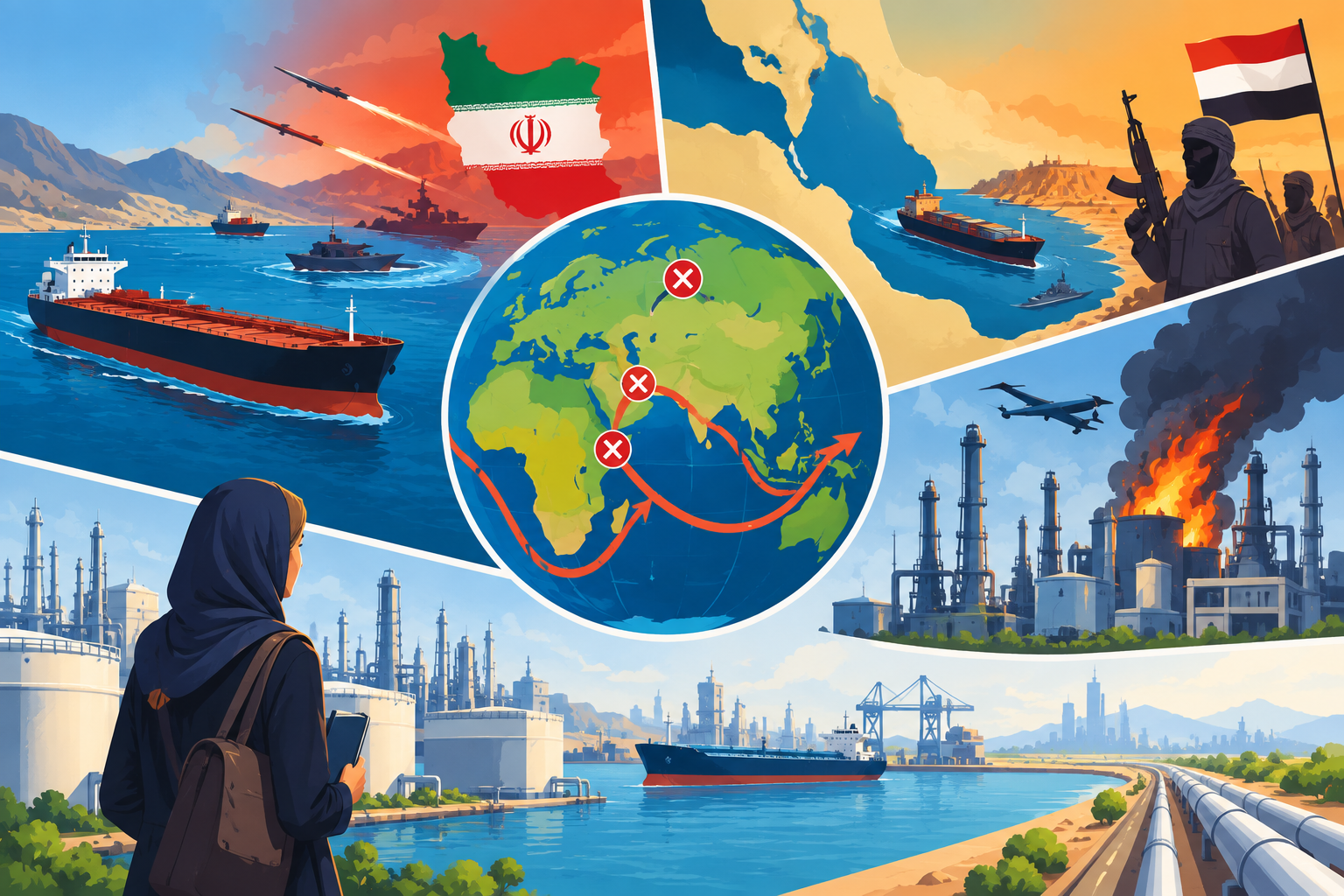
The first disruption came from the Strait of Hormuz. In late February 2026, the United States and Israel launched an unprovoked offensive against Iran. In response, along with other kinetic actions, Iran closed the Strait of Hormuz. Tehran used drones, ballistic missiles, and small attack boats against vessels trying to transit the Strait. Consequently, insurance became unavailable or prohibitively expensive. Likewise, the seafarers stopped sailing, and the strait was effectively closed.
The scale of the loss from the closure of the strait is hard to overstate. For instance, in 2025, about 20 million barrels per day, roughly a quarter of global oil, moved through the strait, including around 34 percent of global crude trade. In the first quarter of 2026, flows fell almost 30 percent year on year to 14.6 million barrels per day. The International Energy Agency estimates that crude supply is downed by more than 14 million barrels per day, since the closure of the Strait. The Agency termed the crisis the largest supply disruption in the history of the global oil market.
However, what made the shock survivable, so far, was a workaround. Riyadh ran its East-West Pipeline at its full capacity of 7 million barrels per day, carrying crude overland to the Red Sea, until recently. The Saudi bypass was a major reason prices have not breached the $200 mark Iran threatened. But the bypass has now become the target. Two months after the Houthis declared a naval blockade on Saudi Arabia, they seized the port city of Mokha and several islands near the Bab el-Mandeb Strait in the first half of September, extending their hold over Yemen’s Red Sea coastline. Around the same time, Iraq-based militias badly damaged the East-West Pipeline itself. The lesson is uncomfortable: a pipeline that avoids one chokepoint merely relocates the problem. Every tanker leaving Yanbu for Asia must pass through Bab el-Mandeb, which leaves an estimated 70 to 75 percent of Saudi oil exports from Yanbu exposed to Houthi disruption. Saudi Arabia is left with two bad options. It can rely on fraught “dark crossings” of Hormuz and run Iranian fire, or it can accept a steep fall in oil revenues. It has already begun canceling shipments to Europe, an early sign of which option it is drifting toward.
Clara Gillispie, an energy analyst at the Council on Foreign Relations, has put her finger on what is really at stake. She noted that it is not only the volume of oil that transits Bab el-Mandeb but the loss of guaranteed safe passage, which would mean a further contraction of viable oil and liquefied natural gas trade routes. The numbers are revealing in this regard. A combined Hormuz and Bab el-Mandeb disruption puts an estimated $10 billion of daily trade at risk and threatens somewhere between a fifth and a quarter of global oil supply.
The third pressure comes from a different direction and is no less consequential. Ukraine’s campaign of deep drone strikes on Russian refineries has intensified sharply over the past 18 months. In the first eight months of 2026, a Russian refinery was hit on average once every three days. Russia, with 32 major refineries and about 6.5 million barrels per day of installed capacity, was long the world’s third-largest producer of refined products. In June 2026, its refinery output fell to 3.8 million barrels per day, its lowest level in more than two decades and roughly 30 percent below a year earlier.
The consequences are increasingly evident in the diesel market, a commodity of critical importance to the global economy. Russian diesel production has fallen by nearly 30 percent, prompting Moscow to restrict fuel exports to safeguard domestic supplies. At the same time, global seaborne exports of gasoil and diesel have declined by 10 percent year-on-year. The contraction has been particularly sharp in August, when combined diesel exports from Russia and the Middle East were 75 percent lower than during the same month a year earlier.
Diesel is the real story. Crude oil dominates the headlines, but the deeper vulnerability lies in middle distillates: diesel and jet fuel in particular. They move freight, run farm machinery, power construction, generate backup electricity, and supply military logistics. Refining capacity for them is concentrated, and spare capacity is thin. When Gulf exports and Russian output fall together, there is little slack left in the system.
Taken together, these developments point towards a fundamental change in the nature of energy insecurity. The central problem is increasingly not simply scarcity of resources but insecurity of connectivity. Oil may exist underground, refineries may possess sufficient capacity, and consumers may have the financial means to purchase energy—but if ships cannot pass through strategic waterways, pipelines are damaged, or refineries are repeatedly attacked, physical availability becomes irrelevant.
The economic consequences could be substantial. Higher oil and gas prices would feed directly into transportation and electricity costs and indirectly into food prices, manufacturing, and inflation. Developing economies, including Pakistan, that rely heavily on imported energy would face particular pressure on foreign-exchange reserves and current-account balances.
There is also a wider strategic implication. Repeated attacks on energy infrastructure are encouraging states to rethink the principle of efficiency on which much of globalisation has been built. For decades, economies sought cheaper and faster supply chains, often accepting geographical concentration in return. The emerging environment may instead reward redundancy, diversification and strategic reserves. Countries will increasingly seek multiple suppliers, alternative pipelines, additional storage and domestic refining capacity—not necessarily because these options are economically optimal in normal times, but because they provide insurance during crises.
The three shocks therefore represent more than three separate episodes of geopolitical instability. They reveal how vulnerable the modern energy system becomes when several layers of the supply chain are disrupted simultaneously. Hormuz threatens the principal artery of Gulf energy exports; Bab el-Mandeb threatens an alternative maritime corridor linking the Middle East with Europe and Asia; and the Russia-Ukraine conflict demonstrates that even energy infrastructure inside a major producing state can become part of the battlefield.
The lesson for governments and energy markets is consequently clear: energy security can no longer be measured simply by how much oil and gas a country possesses or can purchase. It must also be measured by how many secure routes exist between producer and consumer.

Azhar Zeeshan
Azhar Zeeshan is a Reseacher at the Centre for Aerospace and Security Studies (CASS), Lahore.