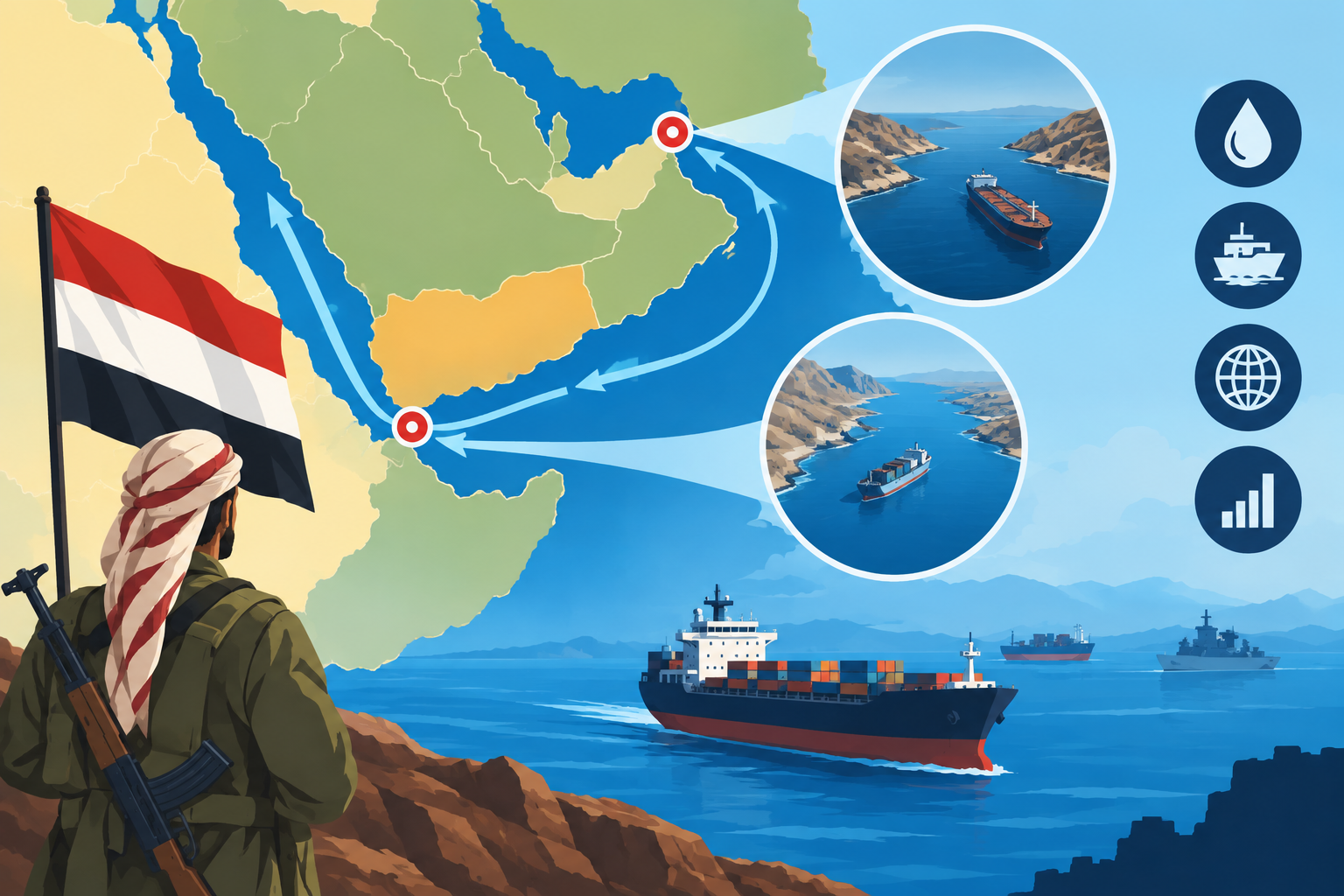
The Houthi forces were seen waving their flag atop Perim Island on September 11, which divides the waters of Bab-el-Mandeb into two channels that can be used for navigation. They had already captured the port town of Mokha a day before that. By the end of the weekend, they managed to control the Hanish Islands as well as Yemen’s entire coast on the Red Sea.
It is worth mentioning that the Energy Ministry of Saudi Arabia also reported that it had shut down the East–West pipeline due to repeated attacks on it – that was the only way to transport Saudi crude without using the Strait of Hormuz. For the first time in the history, a single, continuous web of allied actors held real leverage simultaneously over the Fundamentally important chokepoints in the Gulf.
“Now the Iranians don’t only control Hormuz and the Strait of Hormuz, but they control the other most strategic chokepoint in the Middle East,” said Farea Al-Muslimi, a research fellow at Chatham House. According to Chatham House, it is the most consequential territorial shift in Yemen in years. However, this description does not do justice to what really occurred. This was not a blockade; it was a takeover of the chokepoint itself.
The Mechanics of a Double Squeeze
For months, Saudi Arabia’s response to a closed Hormuz has been a simple one: bypass it through Yanbu via the Red Sea. Both ends of this detour have now been sealed off. The pipeline feeding it is closed. The waterway into which it feeds is under unfriendly control. There is no plan C for Riyadh.
What makes the change disconcerting is not only the logistics involved. It is the actors behind it. The Houthis have been waging their own war against Saudi Arabia for almost ten years, predating even the ongoing war with Iran.
Their progress aligned with Iranian interests but was not simply dictated from Iran. Here, an independent non-state actor, engaged in its own civil war, has managed to grab a lever that was once reserved only for nations and their navies.
But even so, the situation is not a complete failure. Traffic through Bab-el-Mandeb went from 35 ship movements a day before the offensive to 25, and then recovered back to 45, which is actually higher than the average prior to the crisis. Market response was quicker than the political response.
This does not mean that the resilience of the system means it is safe. Rather, it is an indication of a very specific and conditional exception than anything else, as the Houthis themselves have said quite clearly that the route is open to all ships except those that are linked to Saudi Arabia. The strait has not been closed but has been made selectively closed.
The Strategic Response That Never Materialized
During the start of the attacks, Saudi Arabia’s Crown Prince Mohammed bin Salman apparently called the president Trump twice in a single day asking him to bomb the Houthis’ positions.
Trump refused. For now, the vessels can still transit via Bab-el-Mandeb, while the Trump has claimed that the Houthis have informed him that they don’t want a fight.
However, there’s no need for the Houthis to block the strait today. The power that the Houthis have over the strait is a card that Tehran plays. As a CNN op-ed warned, “And Washington should never again mistake quiet for peace.”
That constraint is significant beyond its initial seeming importance. This month’s coverage found the Houthi advance part of a broader trend, of America’s inability to defeat Iran, and inability to adequately defend its Arab allies, evident all the way from Yemen to a deepening Saudi–Emirati rift over Algeria.
The nation that once spent years boarding ships under the guise of securing free passage of sea lanes is now the nation finding it difficult to secure its own, along with those of its allies which have built their energy strategy on U.S. security.
The diplomatic route, on the other hand, has reached an impasse instead of evolving. Negotiations between Washington and Tehran had already been at an impasse before this attack and seem completely at a standstill now. A dangerous new front has opened, and its political implications might endure longer than its economic ones.
And that is the more profound message behind all those oil prices graphs. Choke points were contested in the past by way of navies providing protection against other nation-states.
What the straits of Bab-el-Mandeb have shown is that a non-state entity, which has been holding a grudge for ten years and armed with missiles from Iran, can gain control of a choke point, hold it selectively, and see the biggest and mightiest navy of the world bowing down to the cost of contesting it.
The next chokepoint conflict does not require the involvement of a nation-state to begin. It only requires an armed organization with coastal access and a motive.

Tabia Aziz
Tabia Aziz is a student at the Department of International Relations,
Government College University Lahore (GCUL).

Muhammad Mahad Samija
Muhammad Mahad Samija is a scholar at the Department of Political Science, Government College University Lahore (GCUL). He is also a former research intern at the Maritime Center of Excellence (MCE), Pakistan Navy War College Lahore.