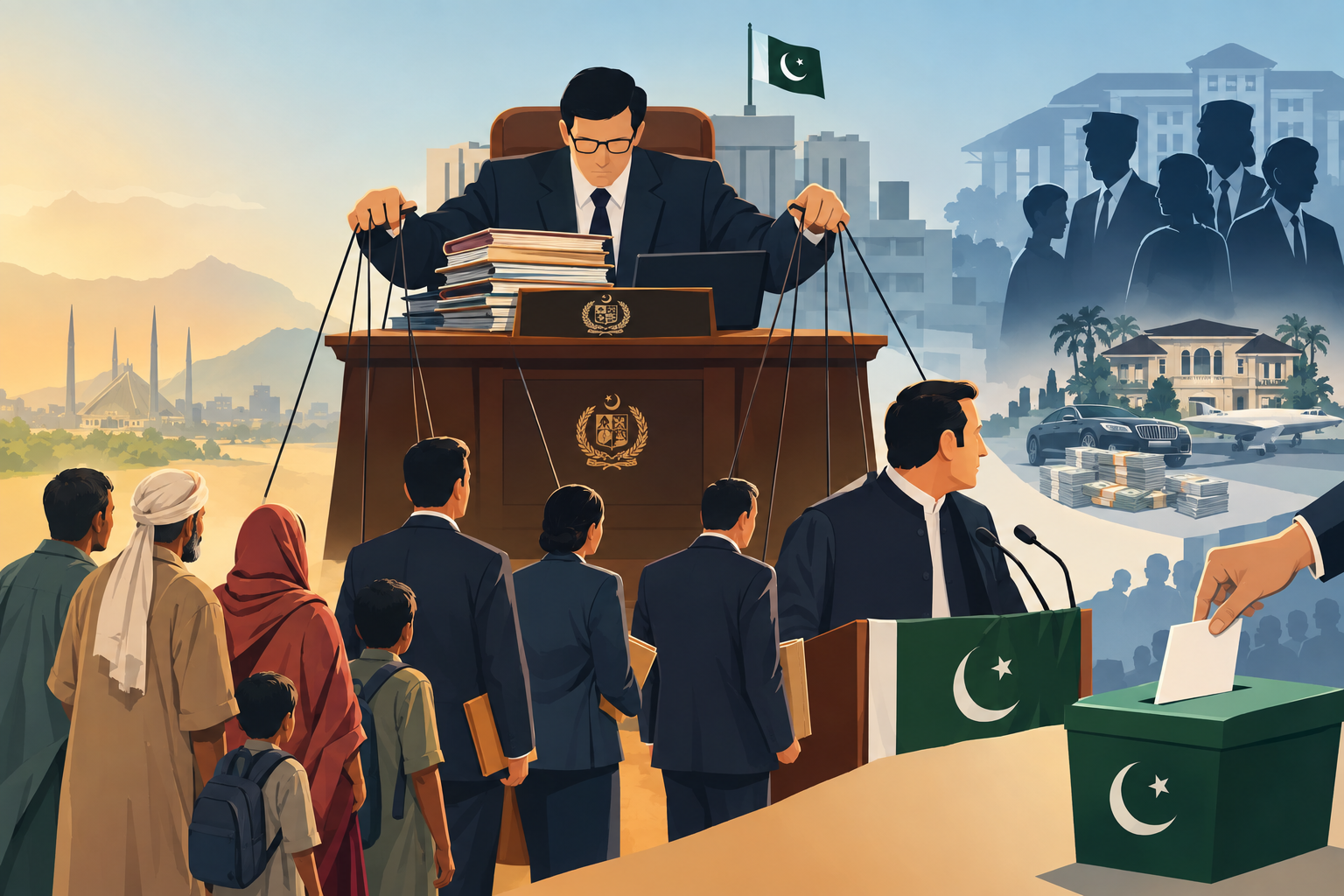
Pakistan has, for the first time in its 78-year history, produced a comprehensive national assessment of its own freedoms, and the findings are striking in their internal contradictions. Published by MISHAL Pakistan and presented at the Institute of Strategic Studies, Islamabad, on 15 June 2026, the State of Freedom Report: Pakistan 2026 paints the portrait of a country where personal agency is flourishing even as collective civic voice remains suppressed.
Based on a nationwide survey of 2,000 respondents, constitutional analysis, institutional benchmarking, and expert consultations, the 174-page report, the first edition of what is intended to become an annual series, evaluates political, civil, digital, economic, and gender freedoms across a country of more than 245 million people. Its core finding is deceptively simple: the further freedom moves from the individual toward the systemic, the more it erodes.
“Freedom is not an abstract philosophical ideal; it is a measurable condition of governance, institutional behavior, and citizen experience. A mature nation does not fear measurement, it welcomes it.”
— State of Freedom Report: Pakistan 2026, Preface
The Freedom Gradient: What Pakistanis Believe about their Rights
The survey asked respondents to rate their perceptions of freedom across nearly 20 indicators. The results reveal a dramatic descent in public confidence as freedom moves from private life into public institutions.
At the top of the confidence scale, 77% of respondents said citizens are free to choose their profession and occupation, the highest-rated freedom indicator in the entire survey. Seventy-five percent believe women now enjoy increasing opportunities, and an equal 75% feel businesses can operate without undue government interference. Sixty-five percent view freedom of religion positively.
But confidence collapses sharply below that threshold. Only 45% believe equality across gender, ethnicity, and religion is genuinely improving. Forty-four percent view the civil society environment as favorable. Just 37% believe political parties can operate effectively. Only 31% think upward economic mobility is achievable. A mere 20% positively rated respect for the right to protest and assemble. And at the very bottom of the scale, only 11% expressed strong confidence in freedom of speech protections.
The 66-point gap between career freedom and speech freedom is perhaps the report’s single most striking data point. Citizens feel confident exercising freedom in domains where the state is largely absent, choosing jobs, running businesses, practising religion. They feel almost entirely unprotected in the space where freedom must confront institutions directly: expression, assembly, and political voice.
Only 25% of respondents reported feeling financially empowered and economically secure, making economic anxiety the survey’s strongest expressed concern. Just 31% believed access to unbiased information was meaningfully available to them. Approximately 62% of citizens say they possess limited influence over governance and policymaking, that they feel, in the report’s phrase, structurally locked out of the system.
Digital Pakistan: A Connectivity Giant with Governance Gaps
One of the report’s most consequential chapters concerns Pakistan’s digital transformation, a story that is simultaneously one of the country’s greatest achievements and its most pressing governance challenge.
Pakistan has built a digital infrastructure of remarkable scale: 190 million-plus cellular subscriptions, 140 to 150 million broadband users, more than 110 million active internet users, a national fiber-optic backbone exceeding 230,000 kilometres, and international submarine cable capacity of 17.21 Tbps. The country ranks among the world’s leading freelance economies, generating more than $3 billion annually in IT and freelance exports. With 70 million active social media users, digital access is, as the report notes, “increasingly viewed by citizens as an essential component of modern freedom, economic participation, and opportunity.”
Yet this connectivity exists alongside a troubling control architecture. Between May 2025 and May 2026, Pakistan reported 15,391 digital account cases to global platforms, of which 7,036 accounts, a 45.84% action rate, were taken down or actioned. Platform compliance rates varied sharply: Telegram complied in 72.52% of requests, while both X/Twitter and YouTube complied at only around 15%. The report frames this disparity as “significant friction in regulatory enforcement.”
Pakistan’s information ecosystem has also migrated decisively online. The survey found that 24.8% of respondents rely on Facebook as their primary information source, followed by WhatsApp at 19.9%, general internet platforms at 18%, X/Twitter and television each at 15%. Traditional media, newspapers, radio, barely register. Approximately 55% of respondents expressed reservations about access to unbiased information, reflecting concern over media polarisation and algorithm-driven information environments. This shift has moved the battleground for civil liberties from the printing press to the platform.
Justice Deferred: The Pendency Crisis
No section of the report is more damning than its examination of rule of law, specifically, Pakistan’s catastrophic judicial backlog. As of 2025 to 2026, Pakistan’s courts hold approximately 2.25 million pending cases: 1,744,310 in district courts, 450,196 in high courts, and 59,191 before the Supreme Court. The report frames the structural failure as resting squarely at the district level, where the overwhelming majority of ordinary citizens encounter justice, or fail to.
Prison occupancy has exceeded system capacity in every major province. Punjab stands at 166.1% occupancy, Sindh at 161.4%, and Balochistan at 115.6%, with 102,026 inmates held nationwide. When the pipeline of justice is clogged at this scale, every downstream freedom diminishes.
The report acknowledges ongoing judicial modernisation initiatives, e-filing systems, alternative dispute resolution mechanisms, administrative reforms, but is clear-eyed about the scale of the challenge. Judicial pendency, it states, “remains the primary governance challenge” in the rule-of-law domain.
The report also records 91,000 crimes against women nationwide, including 35,000 domestic violence cases and 28,000 cyber harassment complaints. Against the backdrop of a justice system under this degree of strain, these numbers carry particular weight.
Women’s Freedom: Progress in Perception, Gaps in Power
The gender chapter reveals a pattern familiar across the developing world, visible social progress coexisting with structural exclusion from economic and political power.
Seventy-five percent of survey respondents believe women are enjoying increasing opportunities, and by many indicators this optimism has empirical grounding. Women are more visible across media, academia, healthcare, and entrepreneurship. Institutional support systems, dedicated women police stations, the Zainab Alert Response and Recovery Authority, and protection centres continue to expand. National primary school enrollment stands at approximately 69%.
But the gaps are substantial. Female labour force participation sits between 20 and 25%, against 65 to 68% for men. Women hold only 9 to 10% of federal cabinet positions and between 4 and 11% of provincial cabinet positions. They are 20% less likely than men to own a mobile phone, a hardware gap that compounds into a 40-percentage-point deficit in social media participation. The education pipeline fractures before women can reach higher opportunity: with a secondary school dropout rate near 31%, tertiary enrollment falls to just 13% nationally.
The report identifies a compounding dynamic in digital exclusion that it calls non-linear: initial deficits in hardware access “double in severity when translated into broader digital and social network participation.” A woman without a phone is not merely offline, she is excluded from the economic, civic, and social ecosystems that increasingly define modern freedom.
POLITICAL FREEDOM: DEMOCRATIC STRUCTURE, PUBLIC SKEPTICISM
Pakistan’s 2024 General Elections drew 128.5 million registered voters to 92,353 polling stations, with over 1.4 million election personnel deployed nationally. The National Assembly’s 336 seats include 60 reserved for women and 10 for minorities, giving women approximately 20% of parliamentary representation overall. The constitutional and procedural architecture of democracy, the report notes, is operational.
Public confidence in its functioning is a different matter. Only 37% of respondents believe political parties can operate effectively within the existing framework. Sixty-two percent say they feel structurally locked out of governance and policymaking. Just 35% express optimism about the country’s direction, while 48% remain skeptical.
One finding stands out on institutional trust: 59% of respondents hold positive views about national defense institutions, making them by far the most trusted entity in the survey. By contrast, only 44% view civil society organisations favourably, and 34% consider market competition regulators to be fair. The gap between security institutions and civic institutions in public trust is itself a governance story that the report does not shy away from documenting.
“Public trust in Pakistan is no longer granted by default. It is built by the ability of state institutions to translate reforms into measurable, transparent citizen outcomes.”
— State of Freedom Report: Pakistan 2026, Chapter 10
ECONOMIC FREEDOM: ENTREPRENEURIAL CONFIDENCE, DEEP ANXIETY
Pakistan’s economy is structurally bottom-heavy in a way that shapes freedom from the ground up. Small and medium enterprises account for 90% of all businesses and employ 80% of the non-agricultural labour force. Pakistan’s expanding technology sector generates more than $3 billion annually in IT and freelance exports. The country hosts 110 to 120 million branchless banking wallets, though only roughly half are actively used, pointing to a utilisation gap that the report argues demands a policy shift from account creation to behavioural integration.
The informal economy absorbs 70 to 75% of total employment, a figure that simultaneously reflects entrepreneurial energy and the barriers preventing that energy from formalising into stable, rights-bearing work.
Public sentiment on economic freedom is notably bifurcated. Citizens feel confident about occupational choice and business operations, the high readings on those indicators reflect genuine confidence in Pakistan’s entrepreneurial culture. But 58% express concerns about financial security, 48% doubt that upward mobility is achievable, and only 25% report feeling financially empowered. The report identifies inflation, energy sector pressures, and exchange rate volatility as the primary drivers of this economic anxiety.
RISK HORIZON: FOUR SYSTEMIC THREATS
The report’s penultimate analytical section identifies four systemic threats to Pakistan’s freedom trajectory that transcend any single administration’s capacity to resolve:
- Climate Vulnerability is identified as the ultimate systemic risk. The 2022 floods affected 33 million people, establishing an irrefutable link between climate shock, economic security, and human freedom. Pakistan ranks among the world’s most climate-exposed countries, and the report is emphatic that when floods destroy homes, farms, and livelihoods, they destroy the material conditions necessary for freedom itself to be exercised.
- Digital and Cyber Threats represent a fast-moving governance frontier. Cybersecurity, artificial intelligence governance, platform regulation, and online misinformation are escalating in complexity faster than existing regulatory frameworks can adapt, particularly given a user base of over 110 million internet users.
- Demographic Pressure — youth unemployment and rapid urbanisation is straining infrastructure, education systems, labour markets, public services, and urban governance capacity simultaneously. With 64% of the population below age 30, the governance response to these pressures will define the country’s medium-term trajectory.
- Geopolitical and Economic Instability, including regional instability, inflationary cycles, energy market volatility, and global supply chain disruptions, continue affecting investment confidence and economic stability in ways that directly constrain citizens’ practical freedoms.
Recommendations: An Annual Freedom Tracker
Among the report’s most significant institutional proposals is the creation of a standardised Annual Freedom Tracker, a 0-to-100 scoring framework covering political, economic, digital, social, and legal freedoms alongside institutional performance. The report argues that this would replace subjective evaluation with precise, annual, comparable measurement and provide policymakers, investors, and citizens with a consistent benchmark for tracking progress and holding institutions accountable.
The proposal reflects the report’s foundational premise: that freedom is not a fixed condition to be celebrated or condemned, but a dynamic governance variable that can be measured, monitored, and improved.
“Pakistan’s long-term progress,” the report concludes, “will depend upon its continued ability to translate constitutional guarantees, reform initiatives, digital transformation, and governance commitments into measurable improvements in citizen experience, public trust, institutional performance, and inclusive national development.”
ABOUT THE REPORT
The State of Freedom Report: Pakistan 2026 was produced by MISHAL Pakistan, Pakistan’s Country Partner Institute of the World Economic Forum, in collaboration with the Institute of Strategic Studies, Islamabad. The report was authored by Amir Jahangir, Puruesh Chaudhary, and Barrister Rufruf Chaudhary. It draws on constitutional review, institutional analysis, international benchmarking, the National TRUST Survey (N=2,000, conducted December 2025 to March 2026, ±2.2% margin of error), and expert consultations across legal, academic, and policy domains. The report spans 14 chapters and 174 pages and represents the first edition of an intended annual national assessment.