There are a few territorial disputes in the world that have generated as much legal and political debate as Jammu and Kashmir. More than seventy years after the partition of British India in 1947, the issue continues to involve competing legal claims, political narratives, and international commitments. While both India and Pakistan justify their positions based on history, constitutional law, and national security, international law approaches the dispute differently. It focuses on the principles of self-determination, the obligations arising from international agreements, and the peaceful settlement of disputes.
The dispute originated during the partition of British India in August 1947. Jammu and Kashmir, a princely state with a Muslim-majority population, was ruled by a Hindu Maharaja and had not yet decided whether to accede to India or Pakistan.
Following the outbreak of armed conflict in October 1947, Maharaja Hari Singh signed the Instrument of Accession to India. India accepted the accession while simultaneously assuring that the state’s future would ultimately be determined in accordance with the wishes of its people once peace and normalcy had been restored. This assurance later became a recurring element in international diplomatic discussions on Kashmir.
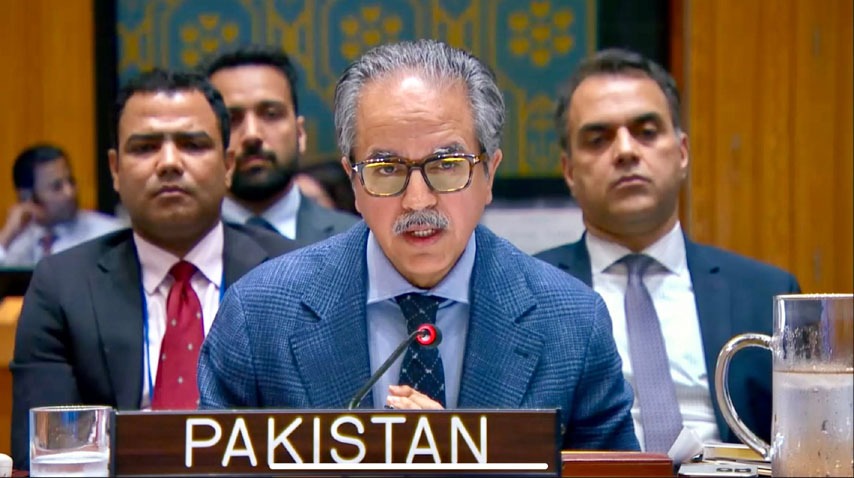
The dispute was subsequently referred to the United Nations Security Council (UNSC) in January 1948. The UNSC adopted a series of resolutions, most notably Resolution 47 (1948), recognising Kashmir as an international dispute requiring a peaceful and just settlement. The resolution called for a ceasefire, the phased withdrawal of Indian and Pakistani forces under specific conditions, and the holding of a free and impartial plebiscite under UN supervision to determine the wishes of the Kashmiri people.
Efforts to implement these resolutions, however, proved unsuccessful due to disagreements over the sequence of demilitarisation and troop withdrawals. Nevertheless, the resolutions remain significant because they demonstrate that the international community did not regard the question of Kashmir’s accession as fully settled.
At the centre of the legal debate lies the principle of self-determination. Recognised in the United Nations Charter and reaffirmed in the International Covenants on Civil and Political Rights and on Economic, Social and Cultural Rights, the principle grants peoples the right to determine their political status and pursue their economic, social, and cultural development.
Pakistan argues that the people of Jammu and Kashmir have consistently been denied this right in accordance with the spirit of the UN Charter. India, however, maintains that the Instrument of Accession legally integrated the territory into the Indian Union and that subsequent democratic elections have reflected the will of the people, rendering a plebiscite unnecessary.
India further argues that the dispute has effectively become a bilateral matter following the Simla Agreement of 1972, under which both countries agreed to resolve outstanding issues through peaceful bilateral negotiations. According to New Delhi, this agreement limits the role of international forums and establishes bilateral dialogue as the appropriate mechanism for resolving the dispute.
Pakistan, however, contends that bilateral agreements cannot supersede existing UNSC resolutions or override the internationally recognised principle of self-determination. From Islamabad’s perspective, the Simla Agreement complements rather than replaces the obligations established under the UN framework.
The legal debate gained renewed significance after India revoked Article 370 and Article 35A of its Constitution on 5 August 2019, ending the special autonomous status of Jammu and Kashmir and reorganising the region into two Union Territories. India has described the move as a constitutional and administrative decision falling within its sovereign authority.
Pakistan argues that unilaterally altering the legal status of disputed territory violates international law and existing Security Council resolutions. Likewise, some international legal scholars contend that domestic constitutional changes cannot, by themselves, alter the international legal status of a territory whose sovereignty remains disputed.
International humanitarian law and international human rights law have also become central to the debate surrounding Kashmir. Issues including prolonged military deployment, restrictions on civil liberties, arbitrary detention, communication blackouts, and the use of force have repeatedly been raised by international human rights organisations and UN human rights mechanisms.
India rejects many of these allegations as politically motivated and emphasises its responsibility to combat terrorism and maintain public order. Critics, however, argue that counterterrorism measures must remain consistent with international human rights obligations.
There are no simple legal answers to the Kashmir dispute. The continued non-implementation of Security Council resolutions, the failure of successive political negotiations, and changing geopolitical realities have all complicated prospects for an internationally mediated settlement.
From the perspective of international law, Kashmir continues to be regarded as an unresolved dispute requiring a peaceful settlement in accordance with the principles of the UN Charter. Neither prolonged conflict nor unilateral legal measures have produced a lasting resolution.
Ultimately, the legal status of Jammu and Kashmir remains one of the most complex questions in contemporary international law. Competing interpretations of sovereignty, self-determination, treaty obligations, and constitutional authority continue to shape the positions of India and Pakistan. A durable solution is therefore unlikely to emerge through legal arguments alone. Rather, it will require sustained political dialogue between New Delhi and Islamabad, alongside the meaningful inclusion of the people of Jammu and Kashmir in any future peace process.

Your go-to editorial hub for policy perspectives and informed analysis on pressing regional and global issues.