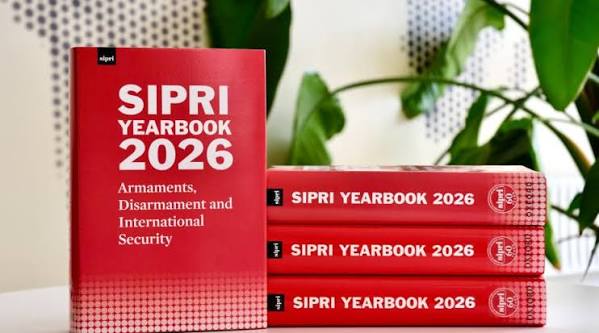
The Stockholm International Peace Research Institute (SIPRI) released its annual report on international security, disarmament, and weaponry. The main findings of the SIPRI Yearbook 2026 are that, despite growing risks of miscalculation and escalation, nuclear-armed states are increasingly relying on nuclear weapons as a tool of national security and strategic competition, reversing decades of reductions in nuclear weapons. Increasing the reliance of national security and defence plans on nuclear weapons will greatly raise the risk of nuclear war. One of the most significant findings for South Asia, which is alarming, is that India’s nuclear stockpile has increased to an estimated 190 warheads, as compared with approximately 180 in the previous SIPRI yearbook, while it continues to modernise its strategic forces. For South Asia, SIPRI’s latest assessment is particularly significant because it supports the concerns that have long been expressed by Pakistan regarding the evolving strategic balance in South Asia and the implications of India’s expanding nuclear capabilities for deterrence stability.
SIPRI highlighted that India has started deploying a small number of nuclear weapons with operational forces for the first time. It has deployed about 12 nuclear warheads, along with developing sea-based deterrent capabilities and a growing fleet of nuclear-powered ballistic missile submarines (SSBNs). Open-source evaluations may not accurately reflect the true size of India’s nuclear arsenal, which is larger than current estimates. The deterrence picture in South Asia has gone through a major shift with the development of operationally deployed sea-based nuclear capabilities. These findings also support Pakistan’s constant concerns expressed regarding India’s ongoing vertical proliferation, which will disrupt the already fragile environment of South Asia. Pakistan’s defence planning, which aims to maintain the credibility of its deterrent in a changed strategic context, will be impacted by India’s continuous modernisation. The strategic environment is also affected by India’s spending to build its advanced conventional capabilities. The acquisition of cutting-edge combat aircraft, long-range precision attack systems, integrated air and land missile defence systems, and hypersonic weaponry has been made possible by the increase in the defence budget in 2026. These developments may contribute to an action-reaction dynamic that could intensify strategic competition in South Asia.
When nuclear modernization combines with cutting-edge technology like artificial intelligence, cyber operations, missile defence systems, and space-based capabilities, the strategic ramifications become even more dangerous. These technologies raise the possibility of unintentional escalation during times of crisis by raising questions about intentions and capability. Pakistan has constantly maintained that it has no interest in engaging in an arms race. Nonetheless, it continues to take necessary steps to preserve the credibility of its deterrence posture and thwart potential Indian aggression while monitoring the evolving security environment.
Pakistan has continuously argued that military might or unrestrained armaments buildup cannot ensure strategic stability in South Asia. Instead, credible deterrence, meaningful communication, efficient crisis-management techniques, and progress in resolving long-standing conflicts that continue to create instability in the region are necessary for lasting peace. Limited strategic communication, frequent crises, and the development of military technologies create additional risks of misunderstanding and escalation. Maintaining strategic stability in South Asia will continue to be crucial for both regional and global security as the global arms-control framework deteriorates and nuclear competition escalates.

Ms. Nazia Sheikh is a Research Officer at the Centre for International Strategic Studies, AJK. She holds an MPhil degree in International Relations from the International Islamic University, Islamabad, Pakistan. Her research interests focus on arms control and disarmament.