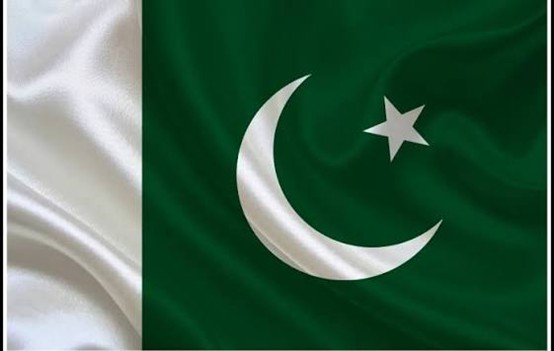
There is a detail in Pakistan’s flag that millions see, few question, and fewer still know the story behind.
Every August, as the green and white flag is raised across government buildings, schools, homes and streets, attention naturally falls on the crescent, the star and the deep green field. But along one edge of that familiar flag is a strip of white. It occupies one-fourth of the flag’s length. It is easy to overlook. Yet it carries a message that was deliberately placed there at the birth of Pakistan.
And behind that white is a name that has largely disappeared from popular memory: Syed Amir-uddin Kedwaii.
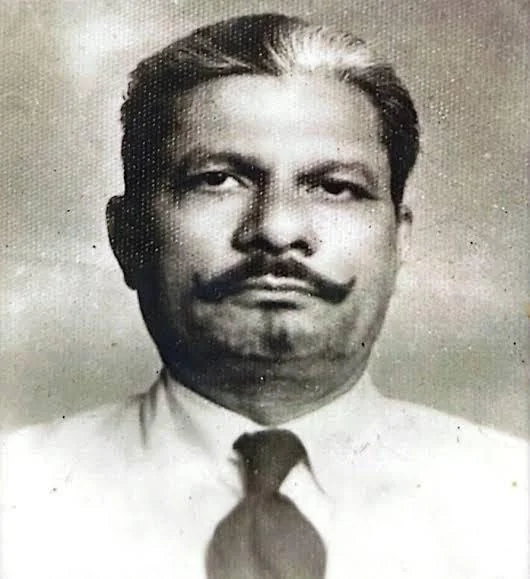
Syed Amir-uddin Kedwaii, a barrister, politician and independence activist, is credited with designing Pakistan’s national flag. The story becomes more interesting when the flag is traced back to its political predecessor. The All-India Muslim League’s earlier flag did not contain the distinctive vertical white bar that appears on Pakistan’s national flag today. That white portion was introduced when the symbol was transformed from the flag of a political movement into the flag of a new state.
The Constituent Assembly formally adopted Pakistan’s flag on 11 August 1947, just three days before independence. The final design consisted of a dark green field, a white vertical bar, a white crescent and a five-pointed star. The green represented the Muslim majority, while the white vertical bar represented the country’s religious minorities.
The difference is small in appearance but significant in meaning: the flag that had represented a political movement was now being designed to represent a state and that state was consciously making room for communities beyond its Muslim majority.
But the most intriguing part of the story is not merely who designed the flag. It is why the white was placed there.
The answer lies in the Constituent Assembly itself.
During the debate on the national flag, Liaquat Ali Khan explained the significance of the white portion, noting that it made room not only for the minorities existing at the time, but for “any other minorities that might spring up hereafter.”
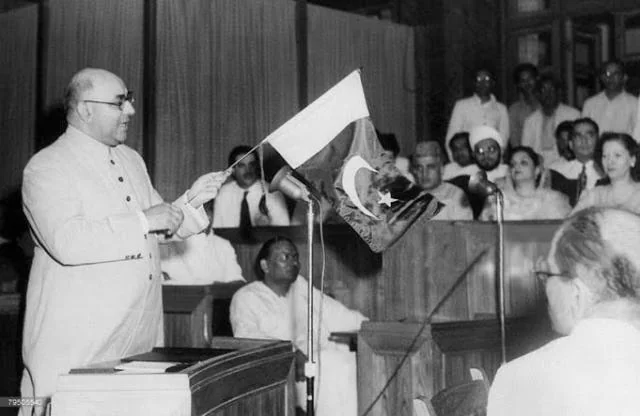
The white, therefore, was not an accidental colour choice. It was a deliberate statement about the composition of the new state and about who was expected to find a place within it.
The historical coincidence is notable.
On 11 August 1947, the Constituent Assembly formally approved Pakistan’s national flag. On the same day, Muhammad Ali Jinnah was unanimously elected President of the Constituent Assembly and delivered the address that would become one of the most cited statements on citizenship and religious freedom in Pakistan’s founding history.
Jinnah declared:
“You are free! You are free to go to your temples. You are free to go to your mosques or to any other places of worship…”
He went on to say that citizens could belong to any religion, caste or creed and that this would have nothing to do with the business of the state.
The two events should not be presented as if one directly caused the other. Yet their coincidence on the same historic day is difficult to ignore. One established a national symbol; the other articulated a conception of citizenship. Together, they offer a glimpse into how the new state was defining who could belong to Pakistan.
That principle did not remain confined to symbolism. It subsequently found expression in Pakistan’s constitutional framework.
The 1973 Constitution, like its predecessors, contains provisions protecting the rights and interests of non-Muslim citizens. Article 20 guarantees every citizen, subject to law, public order and morality, the right to profess, practise and propagate religion, while protecting the right of religious denominations and sects to establish and manage their institutions. Article 22 safeguards citizens from being compelled to receive religious instruction or participate in religious worship relating to a religion other than their own.
Article 25 establishes equality before law and equal protection of law. Articles 26 and 27 provide safeguards against discrimination in access to public places and public employment, while Article 28 protects the right to preserve and promote language, script and culture.
Taken together, these provisions provide a constitutional architecture for the principle represented symbolically by the white stripe that the religious identity does not erase citizenship.
But who, in demographic terms, occupies that white stripe?
Pakistan’s 2023 Population and Housing Census recorded approximately 8.77 million people belonging to officially enumerated non-Muslim categories, including Christians, Hindus, Scheduled Castes, Sikhs, Parsis, Ahmadis and others, around 3.65 percent of the population.
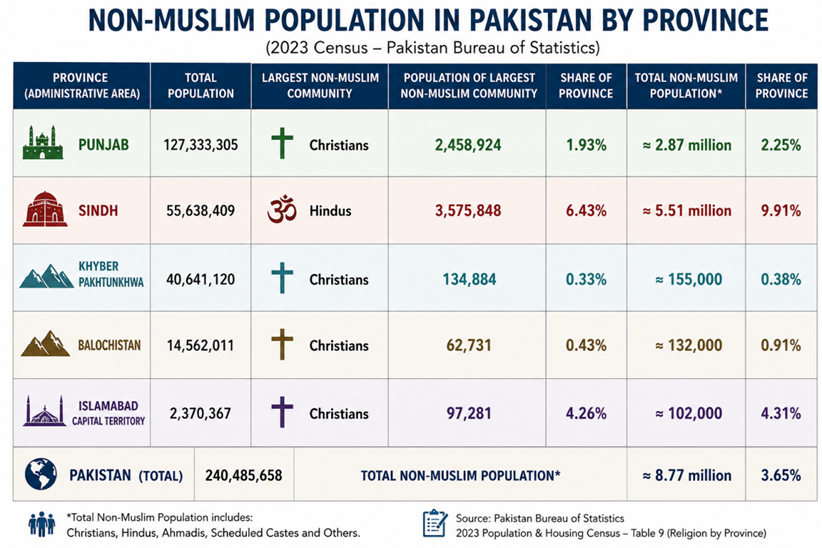
The numbers, however, become more meaningful when placed on the map. Religious diversity is not distributed evenly across Pakistan. Sindh contains particularly significant Hindu and Scheduled Caste populations, while Christian communities have substantial concentrations in Punjab and the federal capital Islamabad. Sikh communities retain important historical and cultural links with parts of Khyber Pakhtunkhwa and elsewhere.
The white stripe, therefore, does not represent some distant or abstract minority. It represents communities embedded in Pakistan’s cities, villages, institutions, markets, schools and national history, each with distinct geographical and cultural experiences.
That presence is also reflected in political institutions. Pakistan’s Parliament has 10 reserved seats for non-Muslims in the National Assembly and four in the Senate, providing 14 reserved seats across the bicameral legislature. Yet minority participation is not confined to reserved representation. Minority citizens have also contested and won general constituencies, demonstrating participation in the broader political process as Pakistani voters and representatives.
The current National Assembly also includes Dr. Mahesh Kumar Malani, who was elected on a general seat from NA-215 Tharparkar-II, alongside the members occupying the reserved non-Muslim seats.
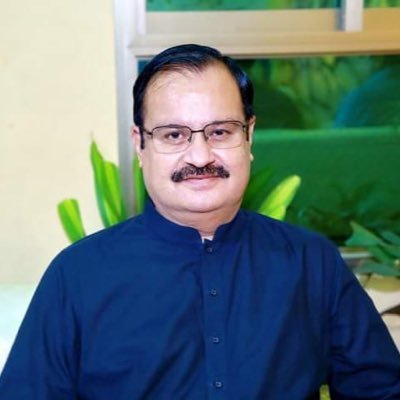
Moreover Ramesh Kumar Vankwani a former member of Pakistan National Assembly, he had been a member of the National Assembly of Pakistan, from August 2018 till August 2023.
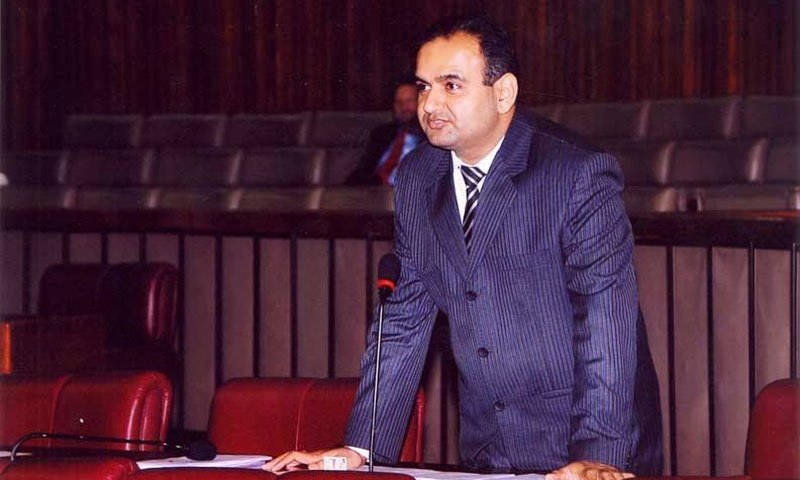
Perhaps the strongest answer lies not in statistics, but in stories.
Group Captain Cecil Chaudhry, a Christian fighter pilot and decorated Pakistan Air Force officer, served Pakistan during the 1965 and 1971 wars.Justice Rana Bhagwandas, a Hindu jurist, served as Acting Chief Justice of Pakistan. Dr. Abdus Salam, an Ahmadi physicist and Pakistan’s first Nobel laureate, contributed to the country’s scientific development and served as its Chief Scientific Adviser.
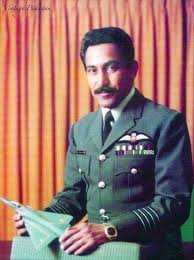
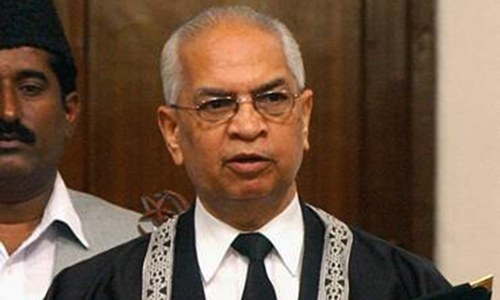
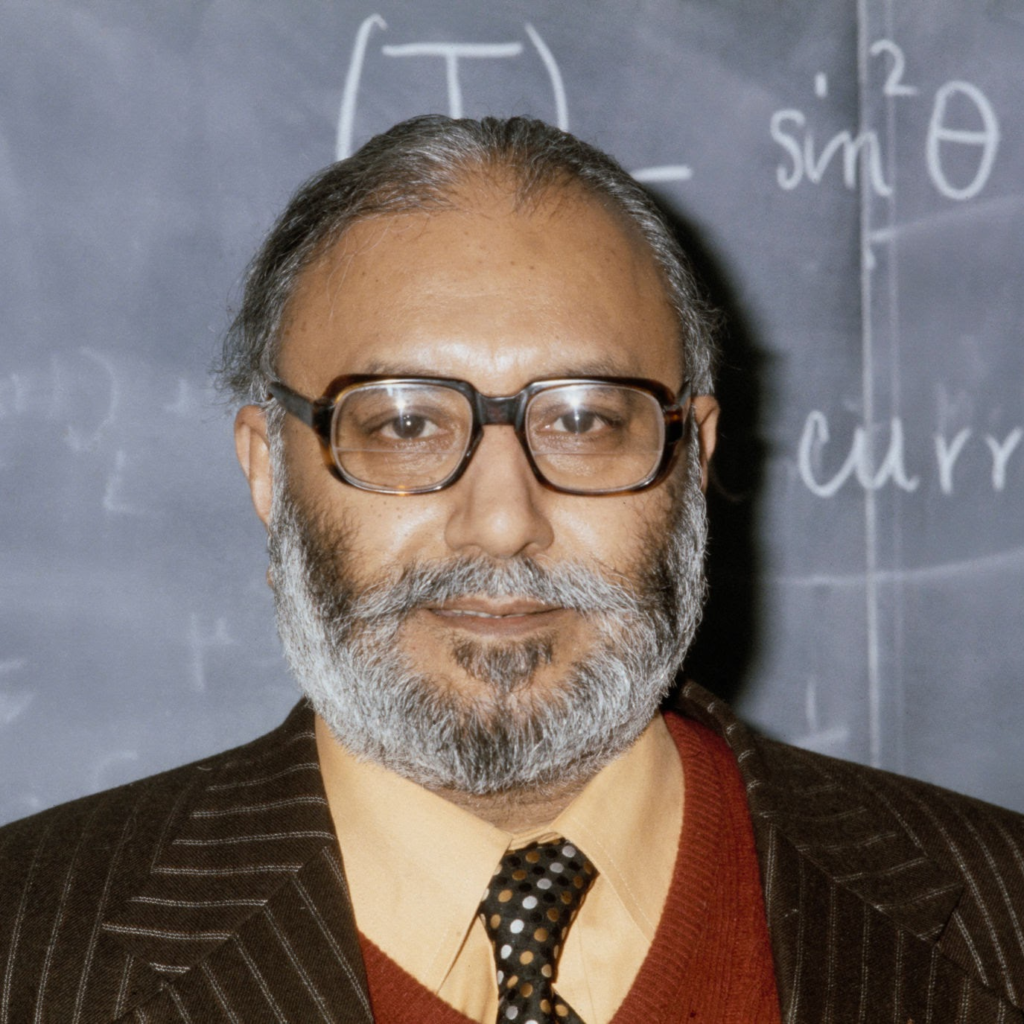
Their stories belong not to a separate “minority chapter” of Pakistani history, but to the national story itself. Their faiths were part of who they were; their service was part of what they gave to Pakistan.
That distinction matters.
And perhaps that is something worth revisiting every 11 August. Pakistan’s national identity was never represented by green alone. The white was deliberately incorporated into the same flag, alongside the same crescent and star, as part of the same national symbol.
The state has continued to build institutions around this principle through constitutional safeguards, political representation and measures concerning minority rights and inclusion. The National Commission for Minorities Rights Act, 2025, for instance, represents a recent development in this continuing institutional evolution.
Yet the enduring power of the flag lies in its simplicity.
The green represents the Muslim majority. The white represents religious minorities. But both belong to one flag.
Every time Pakistan’s flag rises, the white rises with it.
It is not a footnote to the country’s identity, nor a symbol standing outside the green. It is part of the national identity Pakistan chose for itself at birth.
Perhaps, then, the question on 11 August is not simply what the white stripe represents.
It is whether we still recognise the Pakistan it represents, that is, a country where religious difference can coexist with national belonging, and where citizenship and service can form one shared national story.

Your go-to editorial hub for policy perspectives and informed analysis on pressing regional and global issues.