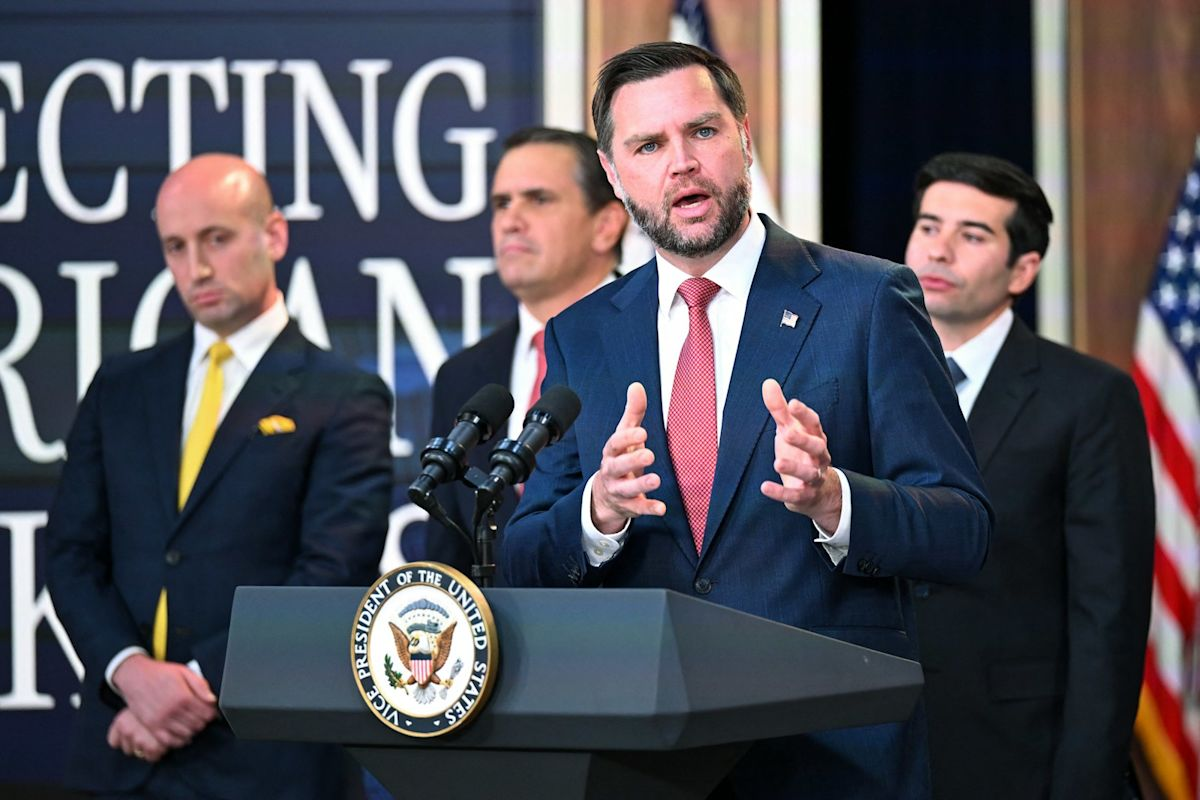
“Foreign indentured servants.” Vice President JD Vance chose those words carefully on October 8, and they will outlast the policy they were meant to defend.
He was explaining why the United States (US) had suspended Microsoft from the Program Electronic Review Management (PERM) program, the Labor Department process through which an employer takes the first formal step toward sponsoring a foreign worker for a green card. Within hours it emerged that Microsoft was not alone. Tata Consultancy Services (TCS), Infosys, Wipro and HCL Technologies had been suspended too, along with Cognizant, Capgemini and Adobe. No new applications will be accepted from the eight firms, and those already filed will sit untouched.
Nothing has been proven yet, and that should be said plainly. Microsoft says about 80 percent of its temporary work visa filings last year were for people already on its payroll. The National Association of Software and Service Companies (Nasscom), the Indian industry body, says its members have been hiring more Americans and relying less on visas. Those claims deserve a hearing. But Washington has stopped waiting for hearings, and Indian companies need to understand why.
The story begins long before Vance. In 1981, seven engineers in Pune pooled 10,000 rupees and started Infosys. By the late 1990s, as American banks and insurers panicked over the millennium bug, Indian programmers were boarding flights to Newark and Chicago in their thousands. The arrangement suited everyone. American companies got cheap, competent labor. Indian firms got revenue and prestige. Young engineers from Guntur and Coimbatore got a career, a mortgage in New Jersey, and eventually, if they waited long enough, a green card.
They have waited a very long time. The National Foundation for American Policy estimates that close to a million Indians were in the employment-based green card queue at the end of 2025, roughly four of every five people in the categories it examined. With only about 140,000 such green cards issued each year, a newly applying Indian in the third preference category can expect to wait around 38 years. PERM was never a fast lane. It was a ticket for a queue that could outlast a career. Now the ticket office has been shut for the largest Indian employers in America.
The numbers explain why New Delhi should be paying closer attention than it appears to be. Of the 399,395 H-1B petitions approved in fiscal year 2024, 283,397 went to workers born in India, about 71 percent, and nearly two-thirds of all approvals were for computer-related jobs. Cognizant alone had 3,510 approvals in fiscal year 2026, ranking sixth among American employers, behind Amazon, TCS, Infosys, Apple and Microsoft. Few countries have built so much of a modern industry on another country’s immigration rules.
Those rules have been tightening for a year. In September 2025, Washington imposed a one-time $100,000 fee on new H-1B applications. In May 2026, the Labor Department put a 180-day PERM suspension on Cloudera over alleged discrimination against American workers. In September, its inspector general, Anthony D’Esposito, suspended Cognizant’s filings under a fraud investigation that had begun in July after complaints from whistleblowers. The market got the message before the companies did. H-1B registrations fell by 38.5 percent, from 343,981 for fiscal year 2026 to 211,600 for fiscal year 2027.
For India’s technology sector, the arithmetic is uncomfortable. Nasscom puts the industry’s fiscal year 2026 revenue at $315 billion, with exports of about $246 billion and a workforce approaching six million. Exports made up about 79 percent of revenue the year before, and the US is the industry’s largest single market.American clients want engineers in the building, not just on the other end of a video call. The industry’s hybrid model, with most work done offshore in India and a smaller team placed onsite in America, depends on keeping experienced people close to those clients. The green card was how Indian firms kept their best onsite people loyal through years of uncertainty. Take it away and the engineer in Charlotte or Plano starts listening to recruiters from companies that can still sponsor her. The alternative is to hire Americans at American salaries, which erodes the cost advantage the whole model was built on. Neither option is fatal. Both are expensive.
The cost is not only corporate. A suspension stalls careers that may already have been on hold for a decade. It falls on families whose children risk ageing out of dependent status at 21, and on workers whose time on a temporary visa keeps running while the road to permanence is closed. These are the same people who send money home every month and give India its voice in Washington’s corridors. The diaspora New Delhi likes to celebrate is the one now bearing the burden.
There is also a quieter diplomatic cost. Indian officials have spent twenty years describing the relationship with Washington as something deeper than a transaction, rooted in shared democratic values and a diaspora several million strong. It is hard to square that language with a partnership in which the main channel for skilled Indian migration can be closed by an administrative notice, with no visible consultation. Nasscom’s own president has acknowledged that growth is now coming faster from Asia-Pacific and the Middle East than from North America. That shift used to read as a strategy. It increasingly looks like a fallback.
The same week brought an awkward reminder from the other direction. On October 7 and 8, Elon Musk publicly attacked the delays in Starlink’s commercial launch in India, suggesting that entrenched business interests were guarding their hold on telecommunications, and asking whether Mukesh Ambani was the country’s real decision maker.
Rahul Gandhi joined in, telling Musk he had not yet met “the other person,” without saying who that was. Musk thanked him and called the situation worrying. The government dismissed the insinuation, but foreign investors will have noticed the question even if New Delhi refuses to answer it.
Taken together, the two episodes expose India on both flanks. Abroad, its most successful export industry depends heavily on access to a single foreign labor market. At home, its own markets face growing questions about concentration and gatekeeping. The first makes India vulnerable to decisions it cannot control. The second weakens its standing to complain when others close their doors.
The suspensions may be narrowed, or even lifted, once the investigations conclude. Some firms will be cleared. But the larger assumption that sustained Indian IT for three decades, that America’s door would stay open to anyone with a degree and a sponsor willing to wait, has been badly shaken. Vance’s phrase was meant for Microsoft. It will be remembered in Bengaluru.

Your go-to editorial hub for policy perspectives and informed analysis on pressing regional and global issues.