The Administrative Case for New Provinces
Authority, resources and decisions in Pakistan are concentrated in provincial capitals, run through a colonial-era administration that answers upward, not to citizens. Smaller, duly empowered administrative units can close the gap between people and state, if the map is redrawn through the Constitution, with consent, and without dividing communities.
Executive Summary
- Governance is concentrated in provincial capitals. Punjab’s 127.7 million people are served from one secretariat in Lahore. The commissioners and deputy commissioners who shape citizens’ daily dealings with the state are appointed officials, answerable upward rather than to the people.
- The debate is now at the top of national politics. The Defence Minister has backed up to 12 provinces on administrative lines, and the government is reported to be preparing for a referendum. The Sindh Assembly has rejected any division of Sindh, and the Prime Minister’s adviser says Parliament will have the final say.
- The brief proposes empowering administrative units now. Any new province should follow five rules: whole divisions; no language-based units; shared water under common rules; a published minority audit; and a reachable capital. It adds a fiscal screen, a cap on the number of units and a dated transition law, all under Article 239 with provincial consent.
Introduction
Across Pakistan, citizens beyond the provincial capitals feel neglected and remote from government. Policies are made far away with little local input, and services struggle to reach large, diverse provinces. In this brief, Fakeha Laique does not argue for or against any particular province. She asks how smaller, duly empowered units can bring government closer to citizens, and how the map should evolve without weakening the federation. Applying four tests (reach, span, accountability and cost) to Pakistan’s own census and budget data, she finds that Balochistan strains reach, Punjab strains span, and every province strains accountability.
Where does the Debate Stand?
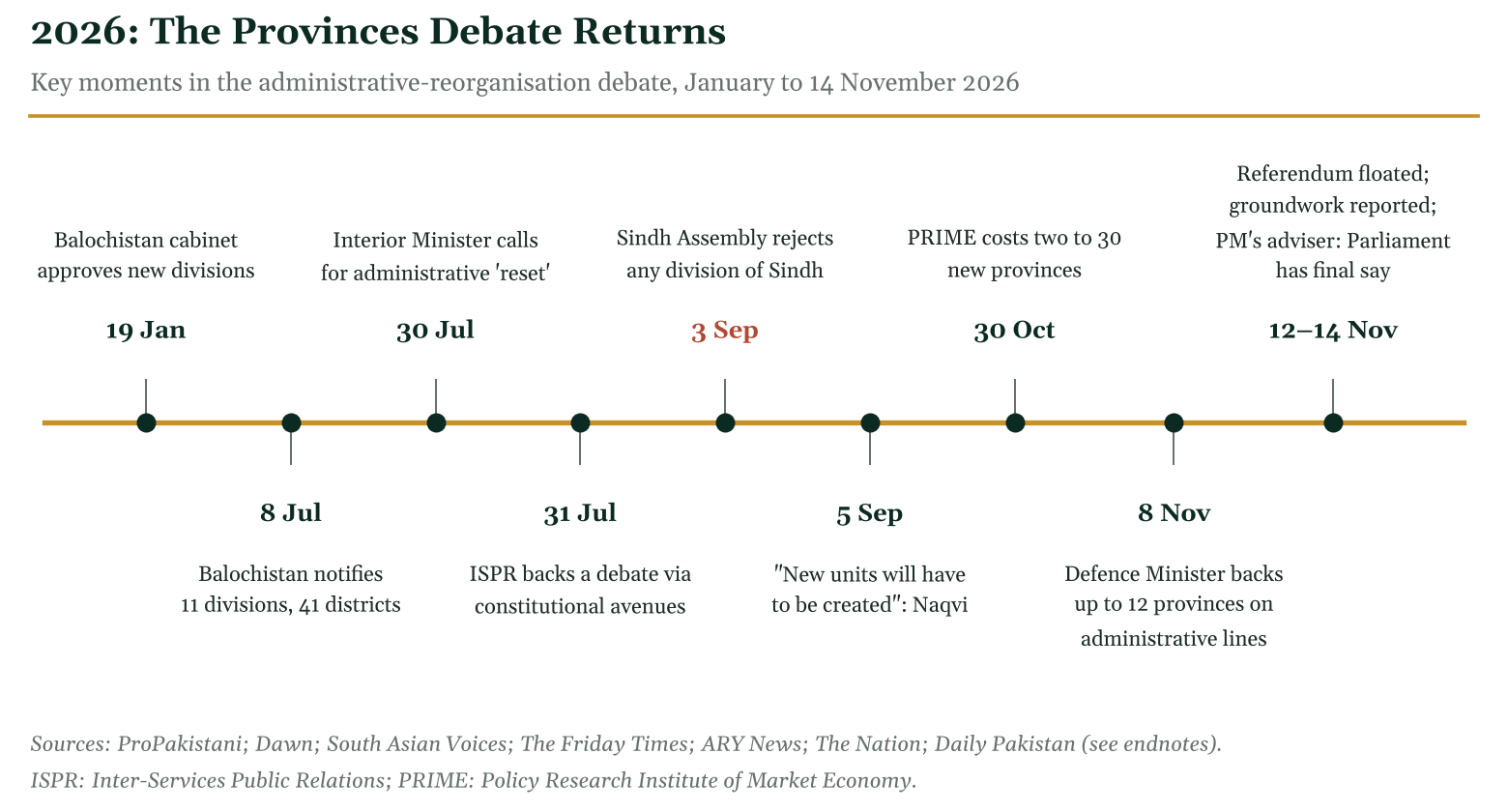
On 30 July, Interior Minister Mohsin Naqvi told the Pakistan Economic Summit that the governance system had collapsed and urged parties to consider new units. A day later, the Director General of Inter-Services Public Relations (ISPR) linked good governance to national security and stressed that any change must follow political and constitutional avenues. The Sindh Assembly unanimously rejected any division of Sindh on 3 September. On 8 November, Defence Minister Khawaja Asif backed up to 12 provinces on administrative rather than ethnic lines. By 14 November the government was reported to be preparing for a referendum, while the Prime Minister’s adviser, Rana Sanaullah, said Parliament would have the final say. A November survey reported 77 percent public support for more provinces. Under Article 239(4), changing a province’s limits needs a two-thirds majority in its provincial assembly.
Why Restructure?
Authority, resources, planning and execution are concentrated at provincial headquarters, and the district administration remains a colonial-era, bureaucracy-led structure. Smaller, duly empowered units can improve access to timely services, give local priorities a voice and make officials more accessible, while major policy and strategic matters remain with the federal and provincial governments. The South Punjab Secretariat, whose departments were later cut from 17 to 10, shows that a title without real powers changes little.
Applying four tests (reach, span, accountability and cost), the brief finds that Balochistan strains reach, Punjab strains span, Khyber Pakhtunkhwa strains span and integration, and Sindh strains scale at the metropolitan level, while every province strains accountability.
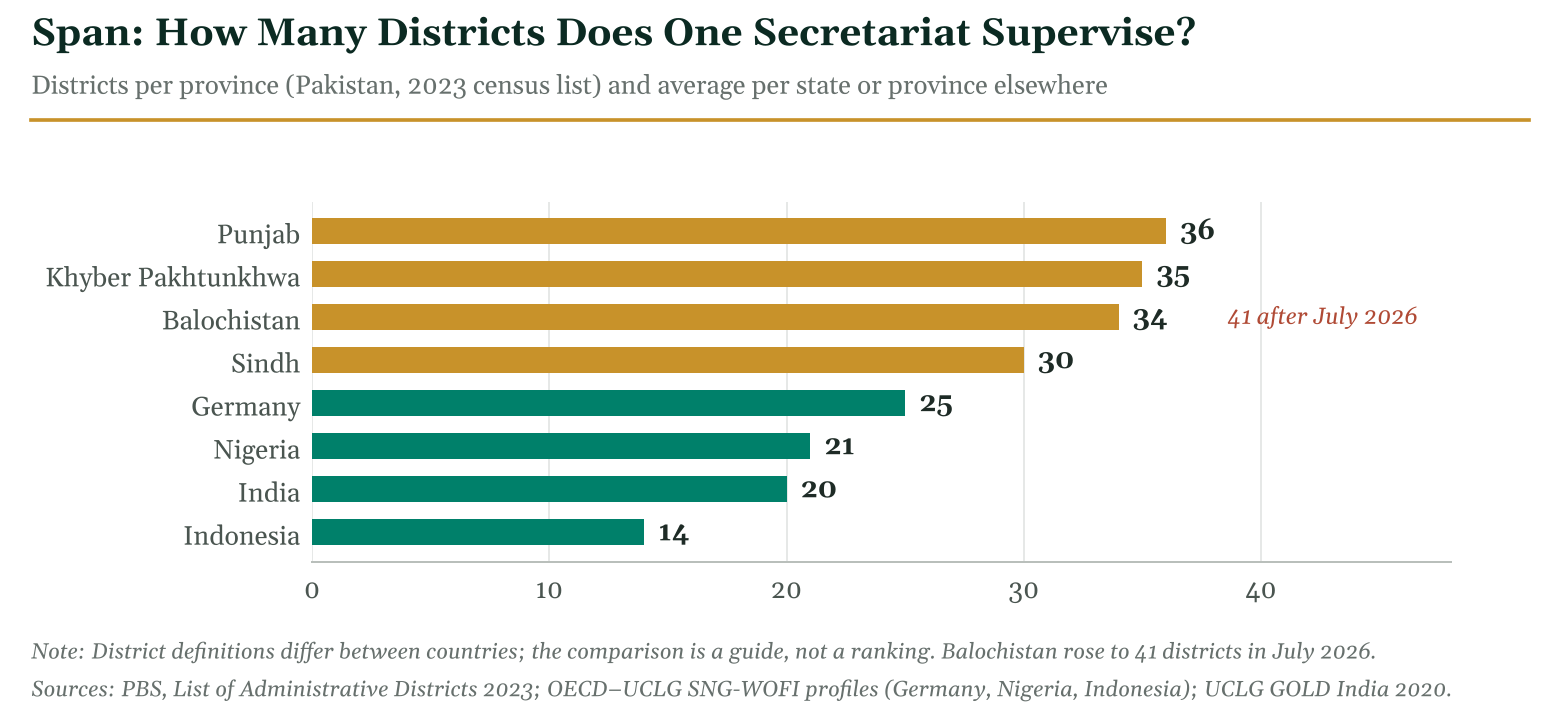
Punjab’s 127.7 million people live under one provincial government. Balochistan’s 14.9 million are spread over 347,190 square kilometres. Pakistan’s provinces each supervise 30 to 36 districts. In Germany, Nigeria, India and Indonesia, a state or province supervises 14 to 25. A citizen in Gwadar may travel about 910 km to Quetta for a final land-record appeal.
What Tier Already Exists?
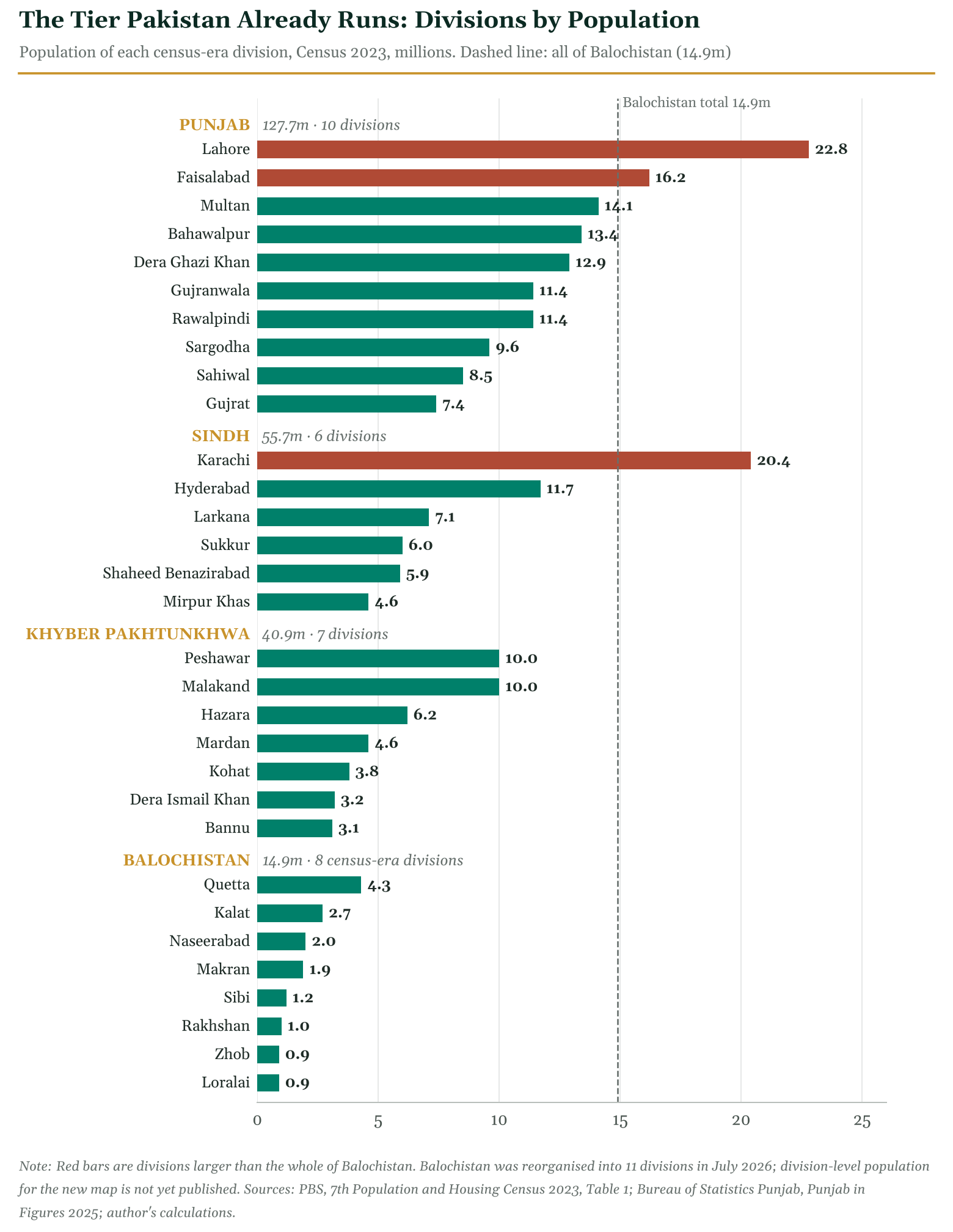
The division sits between the province and the district. It has a commissioner, staff and offices, but no elected body. Pakistan’s 31 census-era divisions range from 0.9 million people in Loralai to 22.8 million in Lahore. The Lahore, Faisalabad and Karachi divisions each have more people than all of Balochistan. A province built from whole divisions needs no new line on the map.
What Would it Cost?
In Balochistan’s 2026-27 budget, the provincial assembly costs 0.29 percent of current expenditure. One province is affordable, but many small provinces are not. An independent costing by the PRIME Institute finds that 14 of 30 division-sized provinces would fail a 10 percent fiscal sustainability test. The answer is to build provinces from several whole divisions and to cap their number.
What Should Pakistan do?
The brief recommends that Pakistan should:
- Establish a parliamentary commission on administrative units, with all provinces represented.
- Empower administrative units now, with devolved functions, budgets and elected oversight, and make commissioners and deputy commissioners answerable to elected bodies.
- Freeze and publish a reference map of divisions, with population and fiscal data.
- Adopt a five-question test as a statutory screen for every proposal.
- Screen every unit fiscally and write a ceiling on the number of provinces into the amendment.
- Bind every province to devolve powers and funds to elected local councils under Article 140A.
- Legislate the transition with owners and end dates, following the FATA merger precedent.
- Keep to the constitutional route under Article 239, with the consent of the province concerned.
Read the Full SAT Brief
Policy Research · 34 Pages · PDF Format

Full 34-page policy brief including four tests of scale, census division audits, PRIME Institute fiscal costings, five statutory rules, and constitutional transition roadmap.
↗ Open PDF in FullscreenWrite for SAT Briefs
South Asia Times invites researchers, scholars and practitioners to write forthcoming SAT Briefs: rigorous, well-sourced policy research on consequential questions in regional and international affairs. Contributors are paid. Send a working title, a 300-word outline, and a note on your expertise to submission@southasiatimes.org. Terms are discussed after review.

Fakeha Laique
Fakeha Laique is a bachelor’s graduate in International Relations from BUITEMS, Quetta, and a young researcher with a growing focus on international relations, regional dynamics, and security issues in South Asia.