During the Cold War, Pakistan and the Soviet Union viewed each other through the strategic choices each had made elsewhere. Pakistan looked towards Washington for security support, while Moscow developed a close relationship with New Delhi. Their diplomatic relations survived, but their geopolitical priorities rarely aligned. Today, the two countries are engaging more actively in defence, energy, trade and regional diplomacy. The shift is significant, but it should not be mistaken for an alliance. Pakistan and Russia are not overcoming their differences out of historical reconciliation. They are responding to a regional environment in which selective cooperation has become increasingly useful to both.
Pakistan and the Soviet Union established diplomatic relations on 1 May 1948, only months after Pakistan’s independence. Yet formal recognition did little to prevent the strategic divergence that followed. Pakistan’s Ministry of Foreign Affairs records the establishment of diplomatic relations. Pakistan’s participation in the Southeast Asia Treaty Organization (SEATO) in 1954 and the Baghdad Pact in 1955, later renamed the Central Treaty Organization (CENTO), placed it within Western-led security arrangements. For Islamabad, these arrangements were closely connected to its security concerns and search for external support. For Moscow, however, Pakistan’s alignment reinforced the perception that its regional position was tied to American strategic interests.
The Soviet Union’s relationship with India deepened this divide. The 1971 Indo-Soviet Treaty of Peace, Friendship and Cooperation formalised a strategic relationship that carried particular significance during periods of regional tension. The Soviet intervention in Afghanistan in December 1979 further damaged relations. Pakistan became a central supporter of the Afghan resistance, while Moscow regarded Islamabad’s involvement as a major obstacle to its objectives in Afghanistan. The conflict transformed Afghanistan into a source of prolonged mistrust between the two countries.
Yet the relationship was never entirely defined by hostility. The Soviet Union facilitated the Tashkent Declaration in January 1966, following the 1965 India–Pakistan war. Soviet mediation demonstrated that Moscow could engage Pakistan diplomatically even while maintaining close relations with India. Economic cooperation offered another important exception. The Soviet Union provided technical and financial assistance for the establishment of Pakistan Steel Mills, with the construction agreement signed in January 1971. These episodes matter because they show that strategic disagreement did not make cooperation impossible. Even during periods of political distance, both sides recognised areas where engagement served practical interests.
The dissolution of the Soviet Union in 1991 created a different diplomatic setting. Pakistan was no longer dealing with the same ideological and geopolitical structure that had shaped its earlier relationship with Moscow. The Russian Federation inherited the Soviet Union’s position as a major Eurasian power, while both countries gradually reassessed their bilateral priorities. This did not produce an immediate strategic realignment. Rather, it opened space for a more pragmatic relationship, less constrained by the rigid alignments of the Cold War.
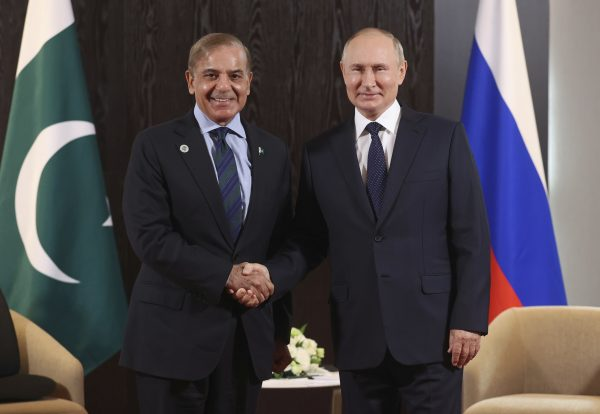
A visible turning point came in November 2014, when the two countries signed a defence cooperation agreement during Russian Defence Minister Sergei Shoigu’s visit to Pakistan. The agreement marked an important departure from Moscow’s earlier reluctance to develop military cooperation with Islamabad. Joint military exercises under the Druzhba series, which began in 2016, added a practical dimension to this engagement. Pakistan’s full membership of the Shanghai Cooperation Organisation in 2017 also placed both countries within a shared multilateral framework. These developments did not erase earlier differences, but they established regular channels through which the two states could engage on security and regional issues.
The motivations behind this rapprochement are not identical. Pakistan has an interest in diversifying its external partnerships, particularly as economic pressures, energy requirements and changing regional alignments complicate its foreign policy choices. Engagement with Russia offers Islamabad additional diplomatic and economic options beyond its traditional partnerships. However, diversification should not be confused with replacing one strategic dependence with another. Its value lies in widening Pakistan’s room for manoeuvre.
For Russia, engagement with Pakistan offers another route into South Asian diplomacy and the wider Eurasian regional framework. Pakistan’s geographical position, connecting Central Asia to the Arabian Sea, gives it potential relevance to Russian interests in regional connectivity. Cooperation through the SCO also provides a platform for engagement on Afghanistan, counterterrorism and regional stability. In 2025, both governments continued to emphasise trade, energy and connectivity during high-level meetings, while the tenth Pakistan–Russia Intergovernmental Commission reviewed cooperation across economic and technical sectors.
Nevertheless, the rapprochement has clear limits. Russia’s relationship with India remains an important part of its South Asian policy, while Pakistan’s own regional relationships and international commitments shape the boundaries of its engagement with Moscow. Afghanistan also remains a difficult arena where shared security concerns do not necessarily produce identical priorities. More importantly, diplomatic exchanges and defence exercises should not be presented as evidence of a mutual security commitment. Neither country has established a formal alliance with the other.
Therefore, Pakistan–Russia relations are best understood as a gradual convergence of interests rather than a strategic realignment. Both countries have reasons to maintain closer contact, but neither has abandoned its wider foreign policy priorities to accommodate the other. The challenge is to make this relationship consistent enough to produce tangible economic, diplomatic and security outcomes. For Pakistan, the objective should be to engage Russia without compromising its broader partnerships. For Moscow, it should be to develop a relationship with Islamabad that extends beyond occasional diplomatic initiatives. The history of their relations suggests that cooperation is possible despite disagreement. Whether the current rapprochement becomes durable will depend less on the language of strategic partnership and more on what both countries are prepared to build together.

Sherzimah Akbar
Sherzimah Akbar is a Research Officer at the South Asia Times and graduated from International Islamic University, Islamabad. Her research interests include Indian defense and military modernization, maritime strategy, South Asian security, India–Pakistan relations, and the Indo-Pacific.