AI in Warfare and Pakistan’s Preparedness
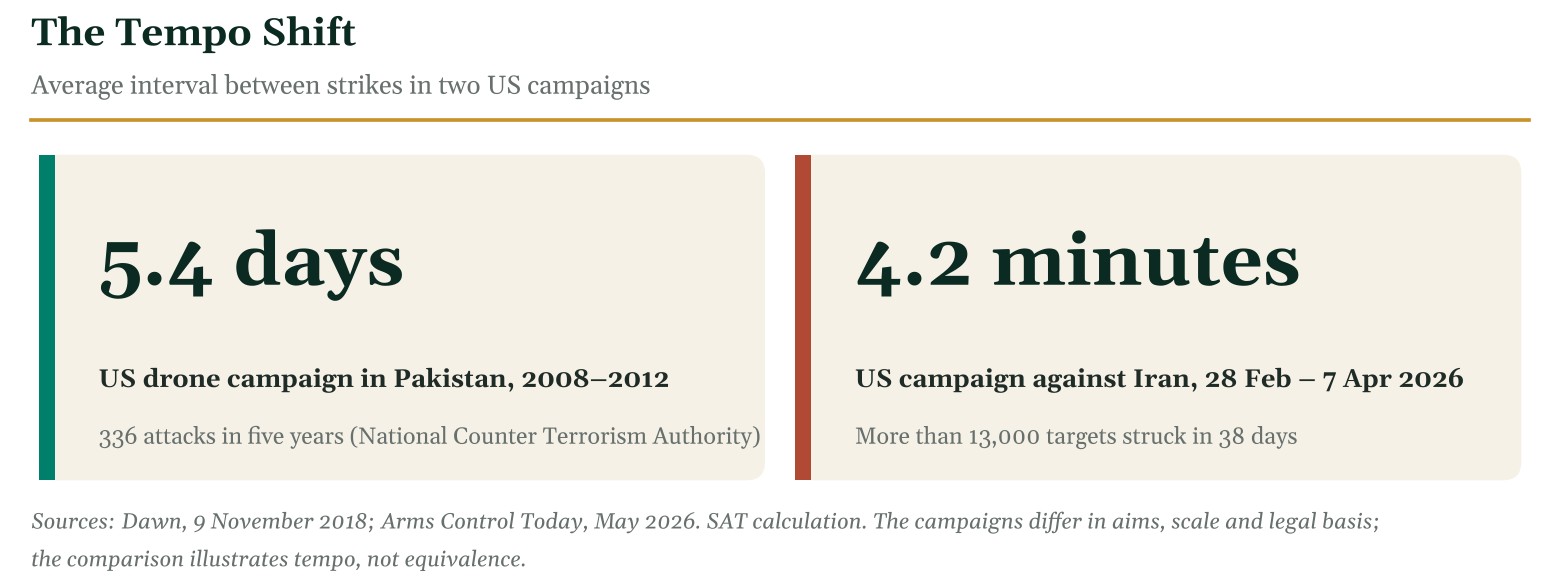
The interval between United States (US) strikes has fallen from about five days over Waziristan to about four minutes over Iran. Artificial intelligence (AI) has made speed the decisive advantage in war, and its greatest hazard.
Executive Summary
- In the first 38 days of the 2026 war on Iran, the US struck more than 13,000 targets, about one every four minutes, with Palantir’s Maven Smart System helping to nominate targets and pair weapons. During the peak years of the US drone campaign in Pakistan (2008–2012), the average interval was about five days.
- From the US National Security Agency’s (NSA) SKYNET programme in Pakistan, through Israel’s Lavender system in Gaza, to the strike on a girls’ school in Minab, the failures share a pattern: flawed data meeting human checks compressed to seconds.
- Pakistan has credible foundations but is not yet ready. The brief argues that its gap lies in doctrine, joint integration and an innovation ecosystem, not in algorithms, and proposes five steps to close it.
Introduction
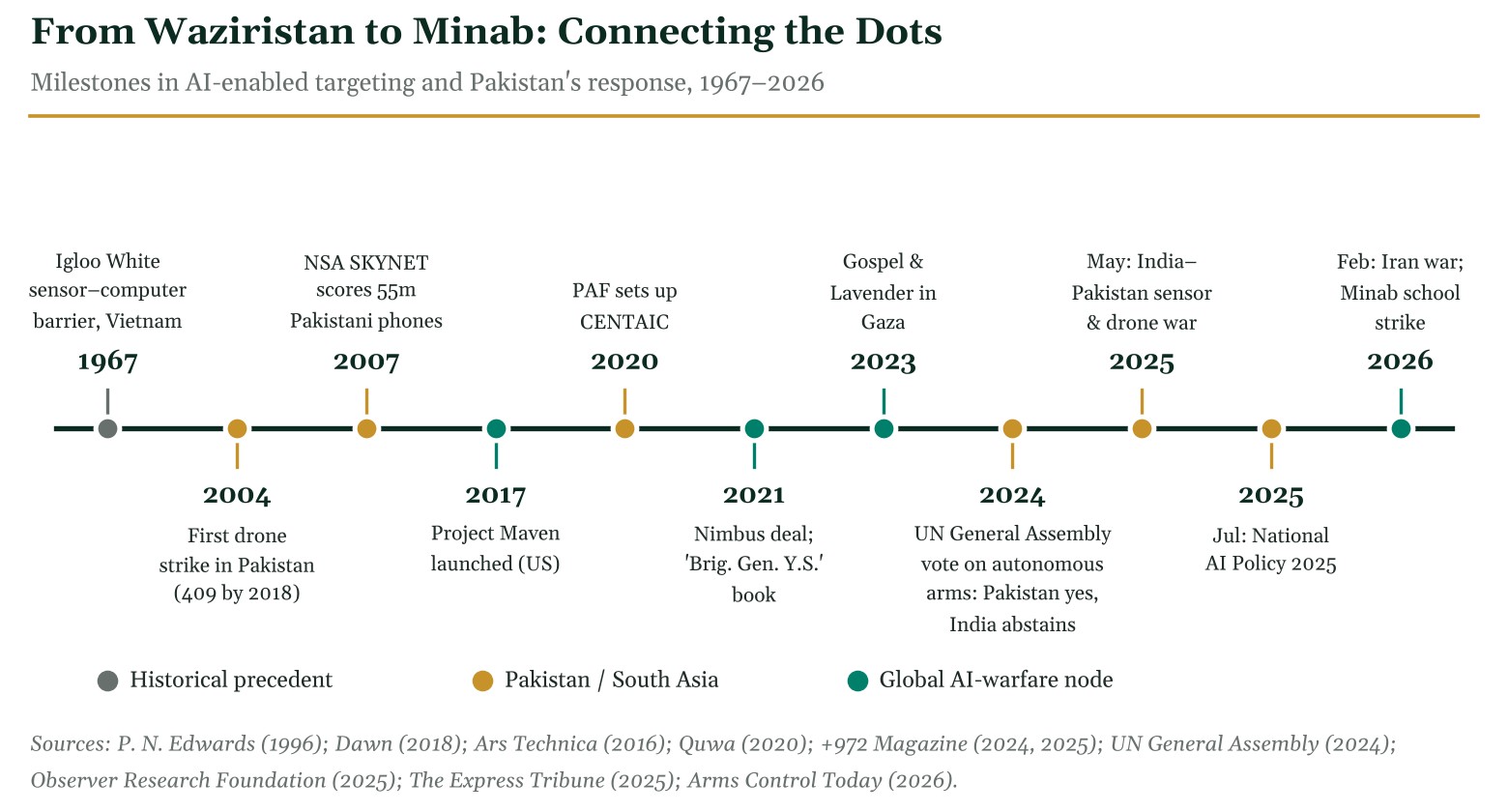
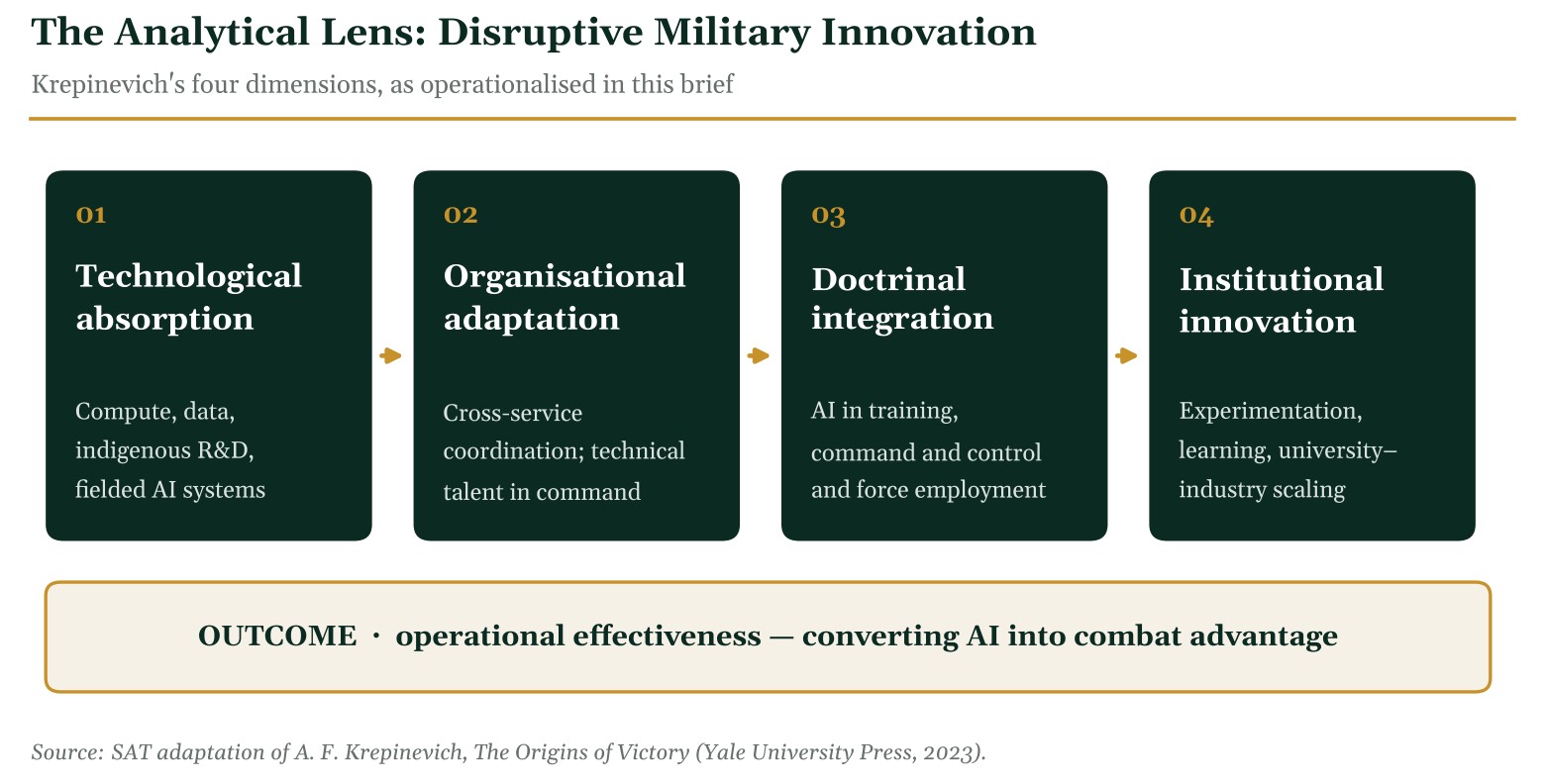
Long before AI dominated headlines, it was at work over Pakistan. Between 2004 and 2018, Pakistan’s National Counter Terrorism Authority (NACTA) recorded 409 drone attacks on Pakistani territory, and intelligence agencies were already using machine learning to nominate targets. In this brief, Azhar Zeeshan follows that line from Waziristan to Gaza, Iran and the India–Pakistan crisis of May 2025. Drawing on Andrew Krepinevich’s theory of disruptive military innovation, he argues that the advantage goes not to the state that owns AI, but to the one that can turn it into operational effectiveness.
How has AI changed the speed of war?
AI compresses the kill chain: the sequence by which a military finds, tracks and strikes a target. According to White House figures reported by Arms Control Today, the US struck more than 13,000 targets in Iran in 38 days. Pentagon officials said the Maven Smart System helped identify top-priority targets and choose weapons.
What went wrong in Minab?
On 28 February 2026, a US cruise missile struck the Shajareh Tayyebeh girls’ school in Minab, killing between 156 and 175 people, most of them children. The building had been separated from an adjacent Islamic Revolutionary Guard Corps (IRGC) base between 2013 and 2016, but US target coding still listed it as military. Whether AI target nomination was decisive remains disputed: a preliminary US Central Command finding pointed to an AI-generated target list, while officials quoted by The New York Times blamed human error. What is clear is that a stale record survived a process built for speed.
Where did this start?
Documents leaked in 2015 showed that the NSA’s SKYNET programme applied machine learning to the phone metadata of about 55 million people in Pakistan to flag suspected couriers. In Gaza, investigative reporting by +972 Magazine found that Israel’s Lavender system flagged as many as 37,000 Palestinians as suspected militants, with human review reportedly lasting about 20 seconds per target; the Israeli military disputes that account. Speed does not cause the error, but it multiplies it.
Has South Asia already fought an AI-enabled war?
In May 2025, both sides described their operations in the language of data. Pakistani officials told Reuters that air, land and space sensors were linked into a single kill chain through an indigenous Data Link 17. The Indian Army says AI helped it locate Pakistani guns and missiles with more than 94 percent accuracy. Between two nuclear-armed states, machine-speed decisions raise the risk of inadvertent escalation.
How ready is Pakistan?
Pakistan has built credible foundations: the National Centre of Artificial Intelligence (NCAI), the Pakistan Air Force’s (PAF) Centre of Artificial Intelligence and Computing (CENTAIC), the National Aerospace Science and Technology Park (NASTP) and the National AI Policy 2025, which aims to train one million AI professionals by 2030. Measured against Krepinevich’s four dimensions, technological absorption is emerging, organisational adaptation uneven, doctrinal integration partial and institutional innovation early.
What should Pakistan do?
The brief recommends that Pakistan should:
- Harness commercial capital and expertise rather than trying to match great-power budgets.
- Give local firms a clear route from prototype to trials, procurement and deployment.
- Build and retain specialist talent through programmes linking NCAI, universities, CENTAIC and private firms.
- Concentrate on affordable niches: intelligence processing, autonomous surveillance, electronic-warfare support and counter-AI deception.
- Govern targeting data, and pursue commitments with India on human control over nuclear-adjacent decisions.
Read the Full SAT Brief
Policy Research · 26 Pages · PDF Format

Full 26-page policy brief including kill-chain analysis, historical parallels (Igloo White), Pakistan’s readiness assessment, and crisis stability measures.
↗ Open PDF in FullscreenWrite for SAT Briefs
South Asia Times invites researchers, scholars and practitioners to author forthcoming SAT Briefs: rigorous, well-sourced policy research on consequential questions in regional and international affairs. Contributors are paid. Send a working title, a 300-word outline, and a note on your expertise to submission@southasiatimes.org. Terms are discussed after review.

Azhar Zeeshan
Azhar Zeeshan is a Reseacher at the Centre for Aerospace and Security Studies (CASS), Lahore.