The end of the Cold War led scholars to develop new theories of international politics. One influential work was Samuel P. Huntington’s The Clash of Civilizations and the Remaking of World Order. Huntington claimed that the end of ideological conflict between capitalism and communism would change global politics.
He asserted that future conflicts would emerge mainly from cultural and civilizational dissimilarities. Civilizations such as Islamic, Western, Confucian, Hindu, and Orthodox worlds would become the primary source of tension and conflict. Events like the September 11 attacks and the War on Terror seemed to support his argument. Tensions between the West and the Muslim world would also strengthen his thesis.
The twenty-first century has brought a new kind of rivalry. Artificial Intelligence, Cyber warfare, digital surveillance, semiconductors, and data control have become critical. Innovation in technology is now central to international politics. States compete for technological superiority.
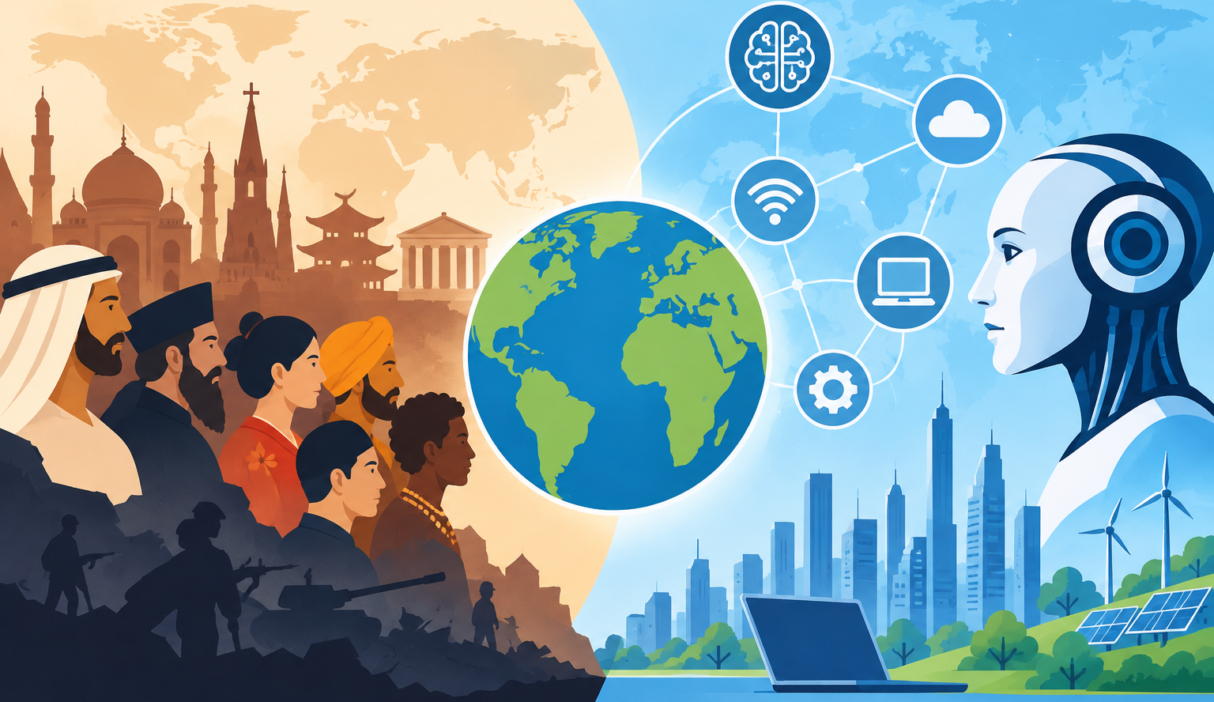
They seek control over digital infrastructure. Military strength and ideology are no longer the only source of power. Modern politics now reflects a “Clash of technologies”.
In “The Clash of Civilizations and the Remaking of World Order”, Huntington argues that the end of ideological conflict between capitalism and communism would change global politics. He asserted that future conflicts would emerge mainly from cultural and civilizational dissimilarities. However, the current clashes are different from the old clash of civilizations.
Artificial Intelligence was once a scientific tool, but now it is a strategic asset in global politics. Governments see AI as essential for economic growth, military modernization, and intelligence gathering. AI also reinforces cybersecurity and diplomatic influence.
Through AI, countries are gaining strategic advantages, including defense, finance, healthcare, communication, and global markets. In the past, power was dependent on geography, population, and natural resources. But nowadays, global influence comes from technology and digital innovation.
The competition between the United States and China is the strongest example of this change. Both countries still have political and ideological differences. Their main struggle now is for technological dominance. The United States desires to keep its lead in AI and semiconductor technology. China aims to become the world leader in advanced technology by 2030.
The US restricts semiconductor exports to China. It limits Chinese access to high-level AI chips. The US also encourages allies to rely less on Chinese digital infrastructure. These actions show that technology is now a significant tool in global competition. China has countered by investing in AI research and domestic chip production. It is building digital surveillance systems and modernizing its military. Companies like Huawei symbolize this growing competition.
Technology, Warfare, and the Future Global Order
Artificial intelligence is now transforming warfare and national security. Previous conflicts depended on soldiers, tanks, and aircraft. Conventional military powers were the main factor. Presently, war involves cyber operations and autonomous weapons. Drone systems, satellite intelligence, and AI-powered information warfare are now common. The Russia-Ukraine war demonstrates the impact of digital technology. Drones, Cyber tools, and online propaganda shaped military outcomes. These tools also influenced public opinion at the same time.
In 2025, in India-Pakistan military tensions, technology played a much bigger role. AI-powered surveillance, drone monitoring, satellite tracking, and cyber tools became central to military strategy. These technologies shaped preparedness and communication for both countries.
Social media was loaded with AI-generated misinformation and manipulated videos. Nationalist propaganda spread widely to influence public opinion. Domestic and international audiences were targeted by these digital campaigns. The conflict demonstrated that battles now happen on physical fields and in cyberspace. The digital information environment is as important as traditional battlefields.
The technology aspect of India-Pakistan rivalry shows how technology can intensify existing tensions. South Asia has long faced territorial disputes and military competition. Political mistrust, especially over Kashmir, has shaped the region. Now, AI systems, cyber espionage, and digital surveillance make these conflicts more complex. States compete for information dominance and cyber readiness. Technological capabilities are now as important as military strength.
AI development has created a new global divide based on technology. Huntington saw civilization as the main dividing lines, but today the world is split between advanced and dependent societies. Countries with strong AI and innovation attain higher economic growth, military power, and international influence. Meanwhile, states are becoming dependent on major powers for digital systems, communication infrastructure, and cybersecurity.
Technology companies have become major global players. Firms like Google, Microsoft, OpenAI, and leading Chinese tech companies now shape digital communication and cybersecurity. They sway political discussions and economic systems across the world. In some areas, these corporations hold power similar to that of states. Huntington’s civilization theory did not anticipate the rise of such powerful companies. Today, tech corporations can shape global politics and international security.
Huntington’s theory still holds some relevance. Civilization and cultural identities influence global politics, now interconnected with technological competition. Western countries concentrate on ethical AI, democratic regulation, privacy, and free expression. On the contrary, China stresses state-driven digital control, surveillance, and centralized authority. Civilization remains important because political culture continues to shape how societies develop and use technology.
States leading in AI, digital infrastructure, semiconductors, cybersecurity, and innovation will shape the future international order. Military power alone cannot secure global influence.
Technological competition brings risks such as cyberwarfare, misinformation, autonomous weapons, and digital surveillance, destabilizing societies and increasing geopolitical tensions. Without international regulation and cooperation, the technology race could drive global insecurity in the decades ahead.
The rise of Artificial Intelligence basically challenges Huntington’s prediction that civilization would remain the main source of future disputes. While cultural identities and ideological differences still shape international politics, technological competition is progressively becoming the ruling force defining global relations.
Conflicts like US-China, India-Pakistan, and the rise of cyberwarfare show that the world faces a clash of technologies, not just civilizations. In this century, global powers lean on control of data, algorithms, innovation, and digital systems, not only military might or identity.

Azha Javed
Azha javed is a scholar of International Relations at the International Islamic University Islamabad, Pakistan. Her areas of interest include international security, emerging technologies, and South Asian affairs. As a writer, her works relate to the intersection of Artificial Intelligence and international politics.