Managed Fragmentation of the Global Technology Order and Pakistan’s Choices
The best American and Chinese AI models are now separated by less than 3 percent. The contest has moved to chips, compute and rival clubs, and middle powers such as Pakistan must keep access to both.
Executive Summary
- In March 2026, the best US artificial intelligence (AI) model led the best Chinese model by about 2.7 percent, down from 9.3 percent in January 2024. The US still leads in investment and computing power; China leads in open models, research volume and patents.
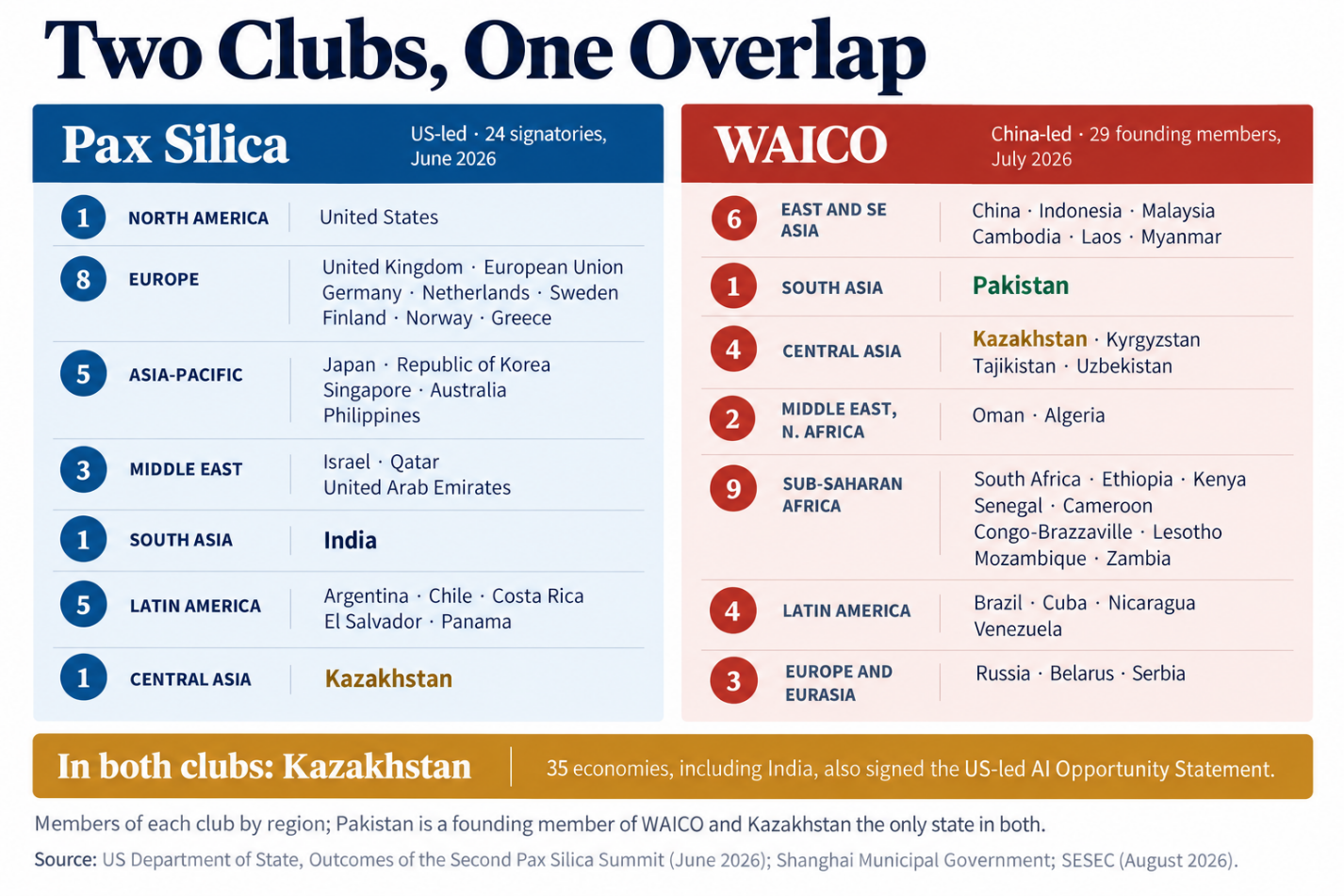
- Washington and Beijing are institutionalizing their advantages in rival clubs: the US-led Pax Silica supply-chain coalition (24 signatories) and the China-led World AI Cooperation Organization, or WAICO (29 founding members, including Pakistan).
- The brief argues for a Pakistani strategy of dual access, consistent with the National Security Policy’s rejection of camp politics, built on sovereign compute, skills and inclusive, UN-centered rules.
Introduction
The AI race between the United States (US) and China is often described as a sprint to a single finish line. In this brief, Sumaiyya Kainat argues that the picture is more complex. The leading models are now close in quality, while the inputs that produce them, from chips and computing power to capital and alliances, remain sharply unequal. The result is a managed fragmentation of the global technology order, with consequences for every middle power.
Who is ahead?
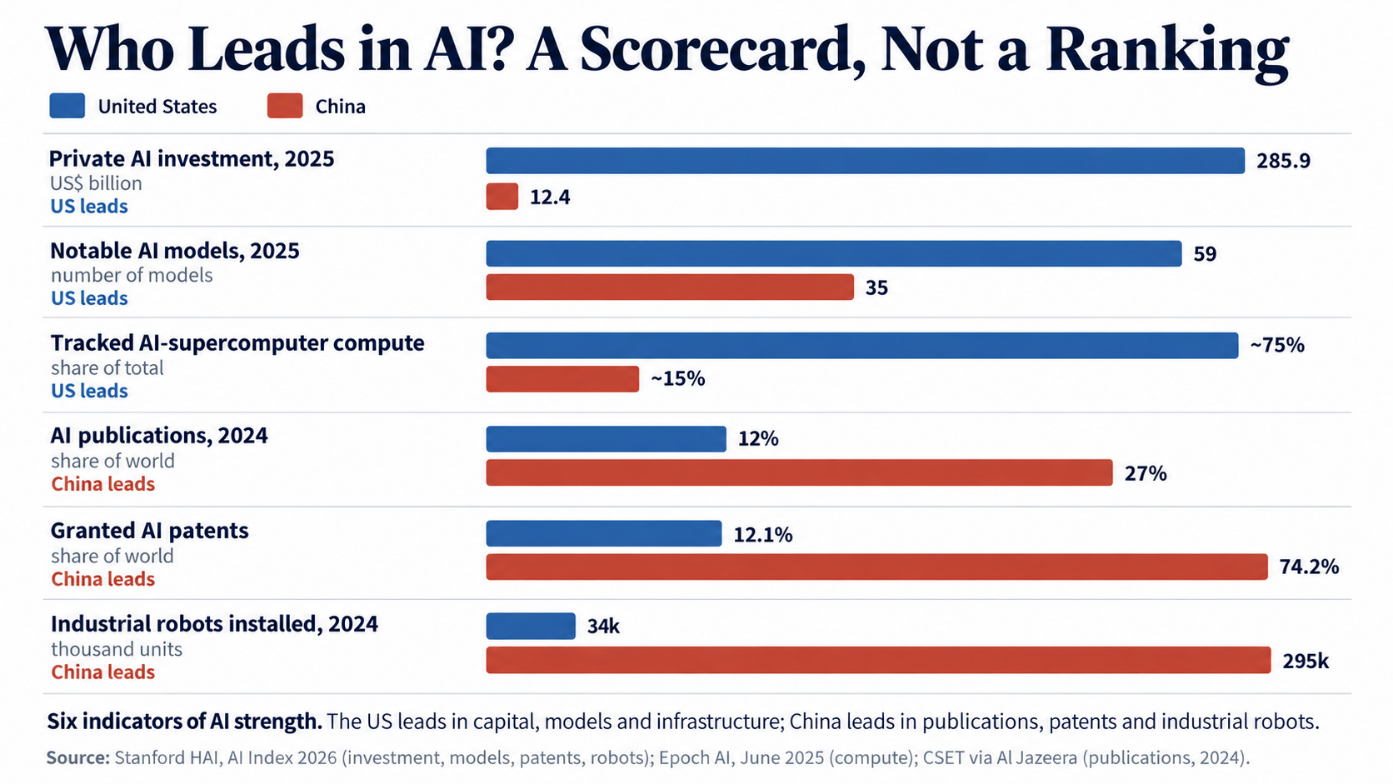
According to Stanford University’s AI Index, the top US model led the top Chinese model by about 2.7 percent in March 2026. US private AI investment reached $285.9 billion in 2025, 23 times that of China, and the US hosts about three-quarters of tracked AI-supercomputer capacity. China, however, produced more than 27 percent of global AI publications in 2024, against 12 percent for the US, and holds 74 percent of granted AI patents.
How have chip controls changed?
Washington has moved from denying advanced chips to China to licensing them under conditions. Since January 2026, Nvidia’s H200 chips may be sold to approved Chinese buyers on a case-by-case basis, with a 50 percent volume cap, independent testing and a 25 percent tariff. Few have shipped. Beijing holds its own lever: China produces about 91 percent of the world’s refined rare earths.
What are the two stacks?
US firms offer closed, premium models and full-stack export packages through the American AI Exports Program. Chinese labs spread open-weight models, which overtook US open models in cumulative downloads in mid-2025 and reached 1.15 billion by March 2026, against 723 million.
What are Pax Silica and WAICO?
Pax Silica, launched by the US State Department in December 2025, had 24 signatories by June 2026, including India. WAICO was founded in Shanghai on 16 July 2026 by 29 countries; Deputy Prime Minister Ishaq Dar signed for Pakistan. Kazakhstan is the only state in both, which shows that membership signals preference rather than exclusivity.
Where does Pakistan stand?
Pakistan combines close strategic ties with China and long-standing cooperation with the US, a balance its National Security Policy 2022–2026 frames as a rejection of camp politics. At home, the National AI Policy 2025 created a National AI Fund and seven Centers of Excellence, the Prime Minister has pledged $1 billion for AI by 2030, and IT exports reached a record $4.6 billion in fiscal year 2026. Yet only about 10 percent of working-age Pakistanis used AI tools in late 2025.
What should Pakistan do?
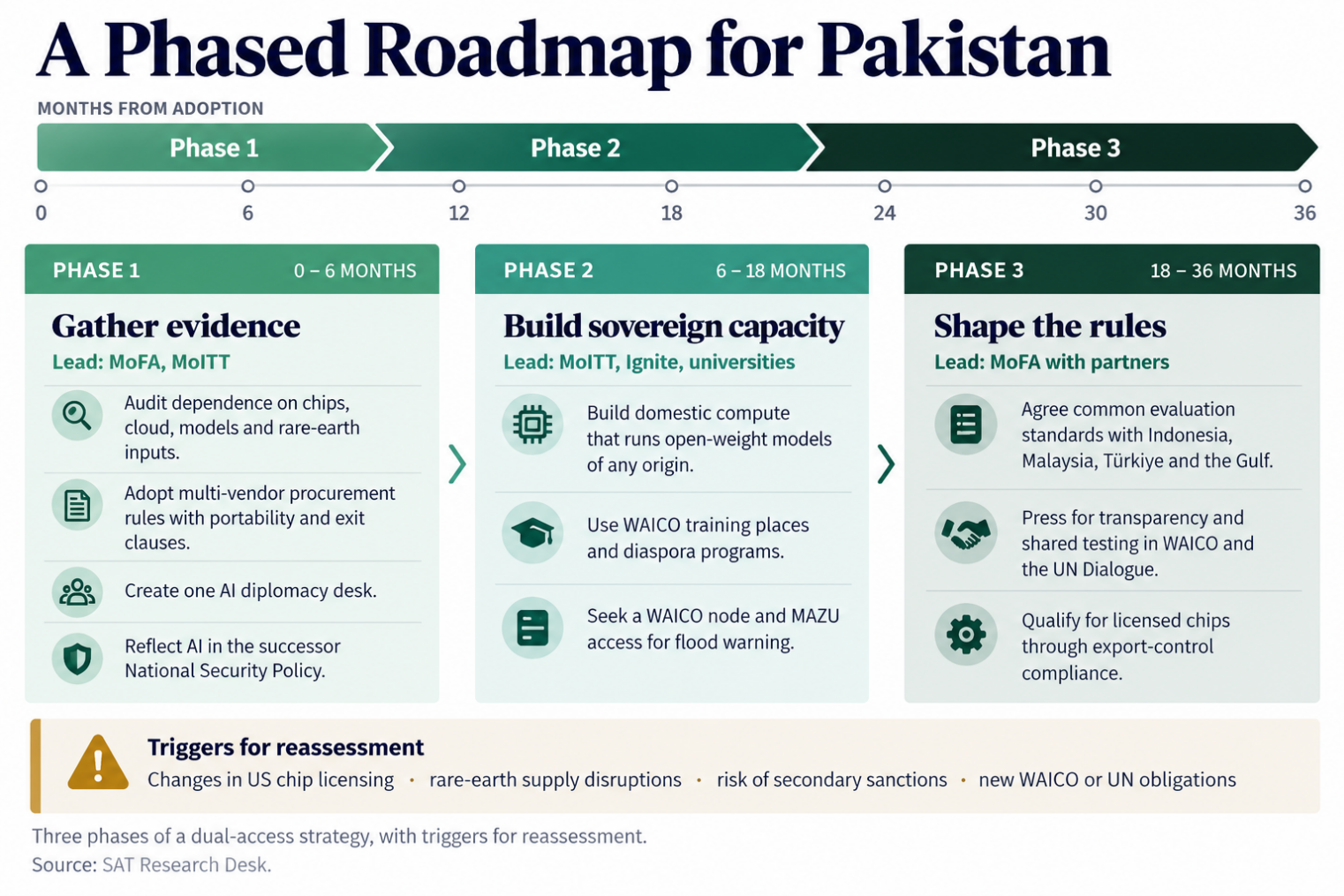
The brief recommends a three-phase, dual-access strategy. Pakistan should:
- Make WAICO membership deliver: Secure training places, a regional cooperation node and access to early-warning systems for floods.
- Keep the US channel open: Pursue American AI Exports Program partnerships and build a rigorous export-control compliance framework.
- Build sovereign compute: Develop multi-vendor computing capacity capable of running open models of any origin.
- Close the adoption gap: Prioritize Urdu and regional-language AI to expand access beyond the current 10 percent user base.
- Institutionalize strategic policy: Dedicate an exclusive chapter to AI in the next iteration of the National Security Policy.
- Shape multilateral rules: Coordinate alongside like-minded middle powers within WAICO and the UN Global Dialogue on AI Governance.
Read the Full SAT Brief
Policy Research · 27 Pages · PDF Format
Full 27-page policy brief including scorecard comparison, club membership mapping, and Pakistan’s dual-access roadmap.
↗ Open PDF in FullscreenWrite for SAT Briefs
South Asia Times invites researchers, scholars and practitioners to author forthcoming SAT Briefs: rigorous, well-sourced policy research on consequential questions in regional and international affairs. Contributors are paid. Send a working title, a 300-word outline, and a note on your expertise to [email protected]. Terms are discussed after review.

Sumaiyya Kainat
Sumaiyya Kainat is an MPhil Scholar at the National Institute of Intelligence and Security Studies (NISS), Quaid-i-Azam University (QAU), Islamabad. Her research interests include international relations, geopolitics, regional security, strategic affairs, and emerging security challenges.