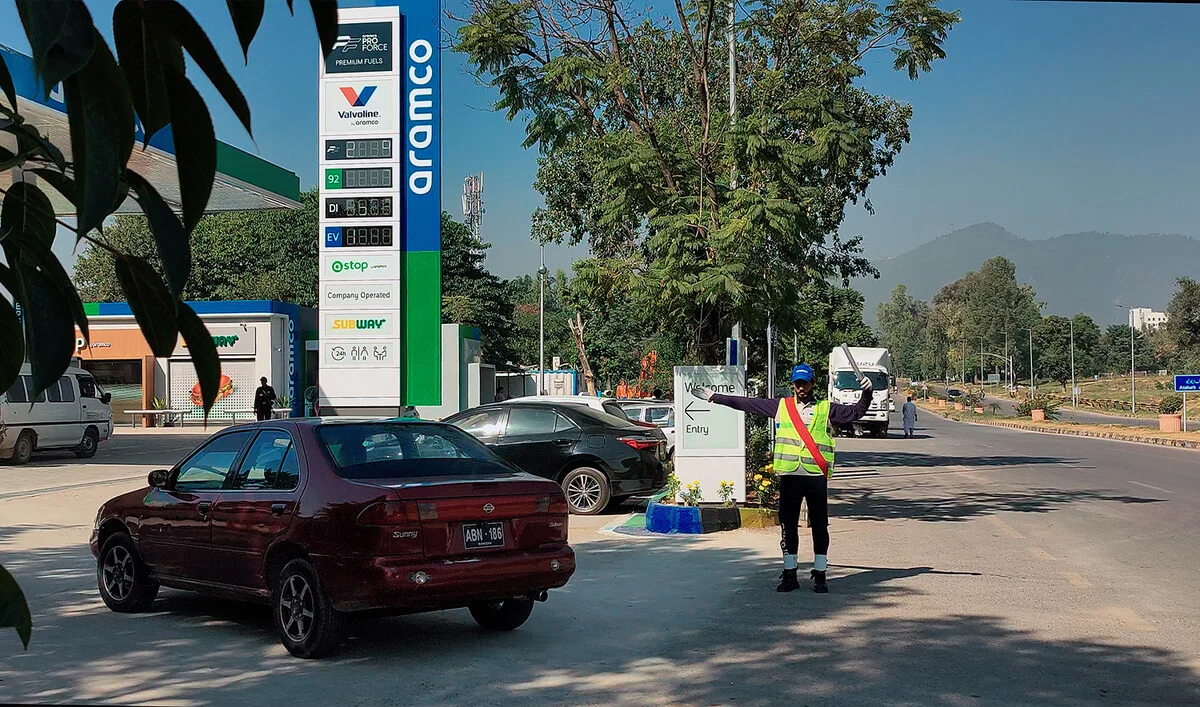
Pakistanis in Islamabad on Monday hailed the opening of Aramco’s branded retail petrol station as a valuable addition to the capital’s oil marketing landscape, expressing hopes for high-quality fuel and services from the Saudi oil giant.
This is Aramco’s second retail outlet in Pakistan, following the opening of its first station in Lahore on October 29 after the global oil giant acquired a 40 percent stake in Gas & Oil Pakistan Ltd, commonly known as GO Petroleum.
According to a statement shared last week by Corporate and Marketing Communications (CMC), which manages public relations for GO and Aramco in Pakistan, Aramco-branded stations in Pakistan will offer premium fuel, high-quality lubricants, professional automotive services, and modern convenience stores, aiming to deliver a seamless customer experience.
The Saudi oil giant’s Islamabad outlet is located on Ataturk Avenue in the Pakistani capital, which is being frequented by a large number of customers anticipating quality fuel supply and services.
“This is a great addition to Islamabad. I hope that this global oil giant will focus on providing quality oil products, along with ensuring top-notch service and accurate fuel measurements,” Muhammad Asim, a Pakistani government employee, told Arab News, while filling up at the newly opened station.
“Looking forward to seeing the positive impact it brings to the city.”
Also See: Pakistani PM pitches energy, infrastructure, technology investments to QBA
Aramco is a global integrated energy and chemicals company that produces approximately one in every eight barrels of the world’s oil supply. GO, one of Pakistan’s largest retail and storage companies, is involved in the procurement, storage, sale and marketing of petroleum products and lubricants.
Together with GO, which has a network of over 1,200 fuel retail stations in Pakistan, Aramco’s plans involve expanding its retail network and establishing a presence in the fast-growing Pakistani economy.
“Having Aramco in Pakistan is exciting,” said Sara Ahmed, a local business owner. “It raises the bar for fuel quality and customer service.”
She hoped that the Saudi company would set new standards in fuel quality and customer care, something that had been needed in Pakistan for quite some time.
Another customer, Ali Asghar, said Aramco is a renowned name globally and hoped the company would uphold its international standards in Pakistan.
“We need reputable global companies like this, not only to provide quality products but also to encourage competition among other companies, ultimately benefiting customers,” he told Arab News.
Pakistan and Saudi Arabia enjoy strong trade, defense, and cultural ties. The Kingdom is home to over 2.7 million Pakistani expatriates and serves as the top source of remittances to the cash-strapped South Asian nation.
In February 2019, Pakistan and Saudi Arabia inked investment deals totaling $21 billion during a visit by Saudi Crown Prince Mohammed bin Salman to Islamabad. The agreements included about $10 billion for an Aramco oil refinery and $1 billion for a petrochemical complex at the strategic Gwadar Port in Pakistan’s Balochistan province.
Islamabad and Riyadh have also been working in recent months to increase bilateral trade and investment, and the Kingdom this year reaffirmed its commitment to expedite an investment package worth $5 billion for Pakistan. Both countries last month signed $2.2 billion in agreements and memorandums of understanding during the visit of a high-level business delegation, led by Saudi Minister for Investment Khalid Al-Falih.
This news is sourced from Arab News and is intended for informational purposes only.

Your trusted source for insightful journalism. Stay informed with our compelling coverage of global affairs, business, technology, and more.