At the United Nations Security Council, Pakistan drew a line that matters most in South Asia: no machine should ever decide on the use of nuclear weapons, and no algorithm should ever target the systems that command them. The harder task is turning that principle into guardrails, and finding the partners to build them.
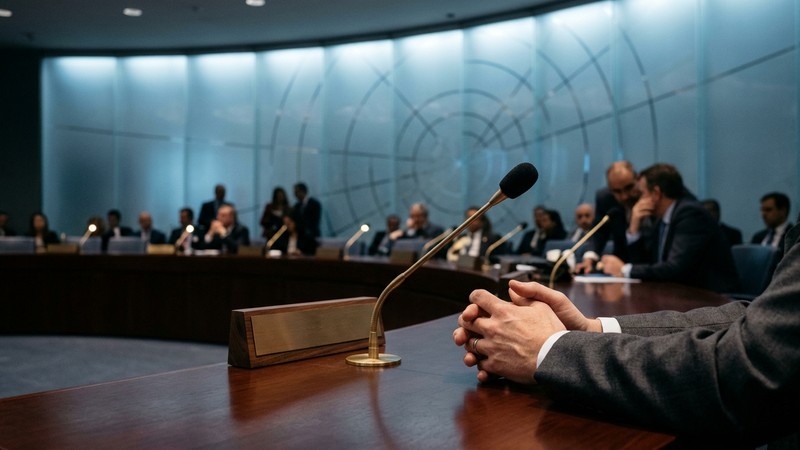
The Security Council met on November 24 for a high-level open debate titled “Conflict resolution in an era of rapid technological change,” convened by Latvia. Speakers urged human control and legal oversight as artificial intelligence reshapes war. Pakistan’s Permanent Representative, Ambassador Syed Haider Shah, went further than most. Human control, he said, “is most critical in the nuclear domain, where decisions on the use of nuclear weapons must remain under human control, and AI systems must never be used to target nuclear command, control and communications systems.”
Shah also pressed a point aimed at the world’s leading technology powers. “Delaying regulation to secure advantage and domination will not work,” he said, calling for “layered governance frameworks, accountability measures and, where appropriate, legally binding instruments,” developed in “inclusive and representative multilateral forums under UN auspices.” He backed crisis communication, deconfliction and mutual restraint as ways to prevent accidental escalation.
For most of the 15 Council members, AI and nuclear weapons are a distant risk. For Pakistan, they are a matter of minutes. The question now is which guardrails Islamabad should push for over the next year, and where it can find the allies to make them real.
Minutes Not Hours in South Asia
Nowhere is the margin for error thinner. India and Pakistan are neighbors with nuclear arsenals of roughly similar size: about 190 warheads for India and 170 for Pakistan, according to the Stockholm International Peace Research Institute. Their capitals sit within minutes of each other’s missiles. A nuclear-armed missile fired from one country would reach the other’s capital in about six or seven minutes, far too short for the deliberation that the Cold War superpowers could afford.
The May 2025 crisis showed how quickly those minutes can arrive. India’s strikes under Operation Sindoor were followed by Pakistan’s response, Operation Bunyanum Marsoos, and a ceasefire on May 10. During the fighting, a senior aide to Pakistan’s prime minister said Islamabad had only 30 to 45 seconds to judge whether an incoming BrahMos missile carried a nuclear warhead. Pakistan told the United Nations General Assembly’s First Committee that the conflict “marked the first-ever use of such capabilities by one nuclear-armed state against another.”
Artificial intelligence is now compressing those timelines further. India reportedly used AI-enabled tools that combined drone, radar and satellite feeds with years of archival intelligence to support targeting during Operation Sindoor. Pakistan’s Air Force, for its part, has set up a dedicated Center for Artificial Intelligence and Computing. Analysts warn that both states are building systems “designed to accelerate decision-making in a crisis environment already defined by compressed timelines, political pressure and deep mistrust.” As one assessment put it, AI-enabled systems “further shorten the fuse.”
Table 1. Why South Asia’s nuclear margin is so thin
| Indicator | Figure |
|---|---|
| Estimated nuclear warheads, India | About 190 |
| Estimated nuclear warheads, Pakistan | About 170 |
| Missile flight time between the two capitals | About six to seven minutes |
| Time Pakistan says it had to judge an incoming missile in May 2025 | 30 to 45 seconds |
| Direct link between the two countries’ nuclear command authorities | None |
Description. A two-column table of five indicators showing how little time India and Pakistan have to make nuclear decisions in a crisis, and the absence of a direct nuclear communication link between them. Sources. Stockholm International Peace Research Institute and Pakistani official remarks, as reported by The Pioneer; Stimson Center.
A Principle Most Powers Already Accept
Pakistan is not alone in the debate, and that is its opportunity. At the same Council meeting, India’s Permanent Representative, Ambassador Harish Parvathaneni, called for a human-centric approach. “Human judgement and oversight remain essential,” he said, and on autonomous weapons, “responsibility for the use of such systems must always rest with humans.” “Technology is a means to achieve human-directed objectives and goals; it is not an end in itself.” New Delhi did not single out nuclear decisions, as Islamabad did. But on the core principle, the two rivals stood on the same ground.
The major powers have moved in the same direction. The United States, the United Kingdom and France have committed to maintain human control over decisions on nuclear weapons employment. In November 2024, the presidents of the United States and China agreed on the need to maintain human control over the use of nuclear weapons. In February 2026, a senior American defense official said it “remains the Department’s policy that there is a human in the loop on all decisions on whether to employ nuclear weapons.” The United Nations Secretary-General has said repeatedly that “until nuclear weapons are eliminated, any decision on their use must rest with humans – not machines.”
Pakistan’s own record is consistent. Its 2025 submission to the First Committee warned that integrating AI with nuclear command, control and communications could lead to “miscalculations, accidents, and catastrophic consequences,” and called meaningful human control over nuclear employment decisions “a principle Pakistan supports and urges all nuclear-weapon states to endorse.” A year earlier, at the Council, Defense Minister Khawaja Asif said military AI applications “without meaningful human control should be prohibited.”
What is missing is not agreement on the principle. It is the machinery to make it binding and verifiable, especially between the two nuclear states that need it most.
The Guardrails Pakistan Should Push
South Asia already has a thin layer of nuclear risk reduction: an agreement not to attack each other’s nuclear installations, with lists exchanged every January, advance notification of ballistic missile tests, and military hotlines. But nearly three decades after both became nuclear powers, India and Pakistan still have no direct communications link between their nuclear command authorities. Pakistan says formal bilateral talks on nuclear and conventional confidence-building measures have not been held for years. AI makes each of those gaps more dangerous. Six guardrails would close the most urgent ones.
Table 2. AI and nuclear guardrails for Pakistan to pursue, and where to find allies
| Guardrail | What it would do | Likely partners |
|---|---|---|
| Human-in-the-loop declaration | Every nuclear-armed state commits publicly that only humans authorize nuclear use | United States, United Kingdom and France, which already have; China, which agreed with Washington in 2024; India, on the principle it set out at the Council |
| Non-targeting pledge for nuclear command systems | States commit never to use AI or cyber tools against each other’s nuclear command, control and communications | Nuclear-armed states with an interest in stable deterrence; the Secretary-General |
| A direct nuclear hotline | A dedicated link between the national command authorities in Islamabad and New Delhi, separate from military channels | India, if framed as risk reduction rather than concession; third parties that mediated in May 2025 |
| Wider pre-notification | Extend the 2005 ballistic missile notification to cruise and hypersonic missiles, whose short flight times leave the least room for error | India and Pakistan bilaterally |
| AI incident channel | A protocol to flag and explain malfunctions or anomalous behavior in AI-enabled military systems during a crisis | Regional states; the Council’s informal expert group on technology |
| A UN-led forum | Negotiate rules on military AI in inclusive forums under UN auspices, with access to peaceful technology protected | Developing countries wary of technology denial; China; the Secretary-General |
Description. A three-column table of six AI and nuclear guardrails Pakistan could pursue, what each would do, and the states or bodies most likely to support it. Source. SAT Dispatch Desk analysis, drawing on statements at the November 24, 2026 Security Council debate and published national positions.
The sequencing matters. The first two guardrails can be pursued globally, where Pakistan has natural partners and the principle is already broadly accepted. The hotline and wider pre-notification are bilateral, and depend on a dialogue with India that has been frozen. The incident channel and the UN forum sit in between, and could give both rivals a multilateral setting in which cooperation carries less political cost at home.
What Happens Next
The coming year offers several openings. The General Assembly’s First Committee will again take up resolutions on AI in the military domain, where Pakistan can propose language on human control of nuclear decisions and on protecting command systems. Talks on lethal autonomous weapons in Geneva, which met days before the Council debate, continue without a binding outcome. And as a non-permanent member of the Security Council, Pakistan can press the Council to keep technology on its agenda and to address the misuse of drones and AI by terrorist groups when peacekeeping mandates are renewed.
The obstacles are real. India has warned that technology controls could deepen inequalities, a concern Pakistan shares, but the two remain far apart on bilateral dialogue. The major powers prefer selective groupings, which Shah criticized as “discriminatory agendas and forums with selective representation.” And every state building military AI has an incentive to keep its systems secret.
Yet the principle Pakistan set out at the Council is one almost no one is willing to oppose in public. A decision to use nuclear weapons must be made by a human being, and the systems that carry that decision must be off limits to machines. In a region where a missile can cross a border in minutes and a commander may have less than a minute to judge it, that is not an abstract ideal. It is the last safeguard between a crisis and a catastrophe. Pakistan has staked out the right position. The task now is to turn a shared principle into shared rules, before the next crisis tests whether anyone is still in control.
Read More on SAT
- Nuclear Arms Control in South Asia: Politics, Postures and Practices
- Restraint Has Its Limits, Pakistan’s National Command Authority Advisor Tells IISS Workshop
- Cyber Warfare in South Asia: Can India and Pakistan Move Towards Confidence-Building Measures?
- Book Review: Sabre Rattling in Space, A South Asian Perspective
Sources
- Dawn: Pakistan calls for human control over decisions on nuclear weapons use
- United Nations Meetings Coverage: Security Council
- India Strategic: India stresses human oversight in AI use during conflicts
- The Pioneer: India must draw South Asia’s AI-nuclear red line
- South Asian Voices: AI targeting risks in South Asia
- Asia Times: AI shrinking the margin for nuclear error in South Asia
- Asia-Pacific Leadership Network: AI is quietly reshaping nuclear risk in South Asia
- South Asian Voices: A hotline between command authorities to manage tensions
- UNODA: Pakistan’s submission on AI in the military domain, 2025
- UNODA: Pakistan’s statement to the First Committee, 2025
- United Nations: Secretary-General’s remarks on AI to the Security Council
- Wikipedia: Nuclear command and control
- Express Tribune: Pakistan calls for UN-guided AI to ensure global stability