
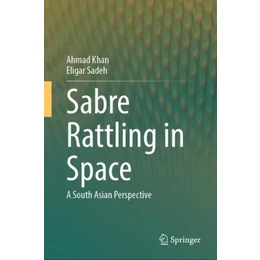

Khan, Ahmad, and Eligar Sadeh. Sabre Rattling in Space: A South Asian Perspective
Ahmad Khan and Eligar Sadeh present in their book Sabre Rattling in Space: A South Asian Perspective that major nations with the capability to conduct operations in space are moving beyond the militarization of the space domain to a new phase of weaponization, and that the result of this transition is a significant change to the way that international security is approached.
By combining both author’s analyses of the ‘space security trilemma’ faced by South Asian countries, the authors argue that the actions taken by one state to protect itself from another result in a lack of security for another (pp. 2–6, 229–234).
As most of the literature pertaining to space security in South Asia has been written from an Indian or American point of view, this book is a Pakistani strategist’s reading of the China–India–Pakistan triangle.
The authors have also produced their analysis from the perspective of Pakistan’s interests in this subject and the need for Pakistan to develop its own place as a response to the China-India-Pakistan triangle, with concrete policy recommendations for Pakistan (pp. 1, 229).
In addition, as the editor of Astropolitics, Sadeh infuses disciplinary context into Khan’s doctoral research (pp. 20–26, 31–48) and argues that the authors’ conclusions about US-China relations are realist in nature (p. 229). The structure of the book is fairly straightforward.
Chapters Two and Three present typologies that Muelller and Hays created for how scholars think and analyze space security (pp. 20–26, 31–48). , and Pakistan, and Chapter Seven discusses US-China relations, while Chapter Eight returns to the space security trilemma. Chapter 9 addresses space governance and the Moon.
The Argument for the Region of South Asia is that China’s anti-satellite test conducted in 2007 directly impacted the decision made by India to conduct its own anti-satellite test in 2019, and subsequently, India’s ballistic missile defence ambitions exacerbate the current strategic asymmetry between conventional forces and the space capabilities of the countries in the region.
Pakistan, on the other hand, does not have any military space satellite, and all of its space program is geared towards the peaceful socio-economic development of its citizens; therefore, Pakistan relies on credible minimum deterrence to ensure its security (pp. 77, 128, 211). Additionally, the authors recommend creating a legally binding instrument under the PAROS and that Pakistan develop early warning and surveillance satellites to provide the basis for its credible minimum deterrence. (pp. 231, 235).
Readers are mainly drawn to this book by its perspective on the use of outer space in Pakistani strategy. In this work, a detailed and thoughtful discussion of Pakistan’s strategic thinking about using space is provided, explaining the reasons that why Pakistan interprets missile defence, surveillance coverage, and nuclear threshold as a single strategic activity and the importance of space-based early warning in supporting Pakistan’s credible minimum deterrence (pp 6, 211).
The authors further discuss that the political leadership of Pakistan has consistently discouraged the weaponization of space (p 211) and credit Pakistan for its continued progress by announcing the establishment of Space Vision 2047, a National Space Policy in the year of 2023, and a regulatory board in 2024 (pp 76, 77), as well as the continued support of Pakistan for the PAROS and Long-term Sustainability Guidelines (p viii).
The applicability of the framework and typologies makes this an original and worthwhile contribution to the field. The authors bring together complementary backgrounds, one is a strategic studies scholar, the other an aerospace engineer (p xvii). Together, the combination of these backgrounds enables the authors to have an understanding of the technical aspects of orbital and technical issues as well as the theoretical framework for deterrence.
Compared to the breadth of coverage provided in Moltz’s Asia’s Space Race (which the authors acknowledge as being an influence), this book’s sustained emphasis on nuclear stability contributes to the body of knowledge in a different way.
In particular, the lunar chapter connects the book to the growing body of literature on cislunar security. In particular, chapter 5 discusses the ways in which the US plans to use cislunar monitoring satellites located at Lagrange points as well as a ten-year lunar architecture study by DARPA (p 105).
Chapter 9 compares the 44 signatories of the Artemis Accords and the China–Russia International Lunar Research Station to the manner in which the former represents a soft interpretation of the Outer Space Treaty and the latter demonstrates the interest of the US in potentially developing military bases on the moon (p 220).
The legal primer presented in chapter 9 helps those unfamiliar with issues related to lunar governance, tracing the trajectory of the US draft treaty and the Argentine draft toward the Moon Agreement (p 220). It also sets out the divide between states favoring non-binding norms and those pressing for a binding instrument on an arms race in outer space.
The research method used in the book is predominantly qualitative, documentary and deductive in nature. The research primarily uses documentary sources (official documents and statements, secondary literature, newspapers and blogs (pp. 7-8). Thus, for a study whose aim is to develop or evaluate policies within an area where states disclose little about their space programs, this is a very appropriate model of a qualitative, policy-based methodology.
The endnotes and references to each chapter are provided in addition to tables and figures, such as those used in the context of space situational awareness (pp. 104-105) and the schools of thought (p. 26) support the findings and provide a comprehensive overview of the author’s conclusions. The authors are commendably candid about the limits of their approach, they note that document analysis tells little about actual operations (p. 9) and that quantifying an arms race is “quite tricky” because launches conceal payloads (p. 229). That candour strengthens their conclusion that “there is an arms race” (p. 229), which rests on informed judgement, the firmest footing the secrecy around space programs allows.
The authors provide a comprehensive view of the dynamics in the South Asian region based on an understanding of the trilemma theory, which applies a variety of logics to assess India’s missile defense systems and their ambitions. The pace of India sets that pace, while the response from Pakistan to develop an array of alternative missile systems, e.g., Nasr (pp. 6, 207); Ababeel (pp. 212); Fateh-II (pp. 6, 207, 212), provides a basis for establishing credible minimum deterrence).
The analysis provided by the authors is consistent with the defensive logic attributed to Pakistan’s military planners throughout this book. The author’s analyses also illustrate that India is “moving faster” than any other Asian state (p. 209) and has specific merit due to the empirical evidence provided in the missile testing table, demonstrating that India conducted 176 missile tests while Pakistan conducted 80 tests (p. 210).
The author concludes that the combination of this table and the range and payload capabilities of missiles would thus provide an additional argument for supporting this contention.
I also would have liked the pairing of inevitable weaponisation with likely “assured space deterrence” (p. 234) in the conclusion to have been more thoroughly evaluated versus the assertion that space warfare would be as devastating as nuclear warfare (pp. 232, 234). This creates a tension and therefore represents the most pressing policy question that this book raises, which deserves a separate chapter to adequately explore this theme.
An interesting avenue that was opened in this book which deserves mention is that Pakistan joined the Lunar Station during the third quarter of 2021. India became a signatory to the Lunar Station Accords in early 2023 (p. 10), and a rover developed by the SUPARCO program will be launched on the Chinese Chang’e-8 mission (p. 206). Each of the three states in the triangle has made their decision to align with the Moon.
Pakistan’s alignment with the Moon is a culmination of a partnership with China dating back to 1958 (p. 206). This demonstrates a growing pattern of cooperation in Pakistan’s space program, and supports the authors’ argument in Chapter 7 that the lunar domain provides “opportunities for cooperation” (p. 234). A subsequent study could explore how the concept of lunar alignment supports the logic of the trilemma.
This book is well suited for students and analysts looking to understand the strategic stability of South Asia, arms control, and for arms-control diplomats working through the New York, Geneva and Vienna forums as identified in the foreword (pp. viii-ix), as well as practitioners who are trying to understand how Pakistan’s strategic decision makers view the connections between space, missile defence and nuclear deterrence. The writing is straightforward and all chapters are logically arranged, from ideation through to the development of capacities and the implications for regional stability, making it convenient for readers to navigate to any chapter of interest for their needs.
Additionally, the book’s recommendations for legally binding instruments based on the principles set forth in PAROS and the transparency measures offered in the Report of the Group of Governmental Experts (pp. 4, 235) should receive serious consideration from relevant planners. Readers who are interested in a technical analysis of counter-space capabilities will need to supplement this book with technical assessments and other relevant literature.

Muneeb Ur Rahman
The author is a Research Officer at the Balochistan Think Tank Network at Balochistan University of Information Technology, Engineering and Management Sciences (BUITEMS), Quetta. He can be reached atmuneebnasar@yahoo.com