
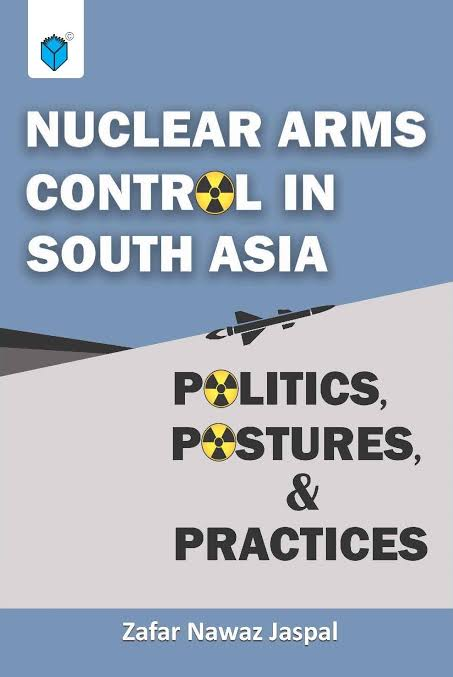

Author: Dr. Zafar Nawaz Jaspal
Publisher: Paramount Books (Pvt.) Ltd.
In Nuclear Arms Control in South Asia: Politics, Postures and Practices, Dr Zafar Nawaz Jaspal explicates the nuclear politics, postures and doctrines adopted by nuclear armed rivals in South Asia. It thoroughly explains the arch rivalry between India and Pakistan with particular emphasis on arms race and nuclear weapons proliferation.
This book is comprised of three sections containing eleven chapters. The first section consists of two chapters explaining the philosophical perspectives on nuclear politics and transitioning trends in the nuclear order. The second section, consisting of four chapters, delves into deterrence and nuclear postures of India and Pakistan. It is followed by the third and the last section that describes the practices in South Asia.
The book addresses the question that how nuclear politics is changing the global security dynamics focusing particularly on South Asian strategic stability. It provides a detailed perspective on the nuclear non-proliferation and arms control regimes.
The first chapter helps us to understand different perspectives regarding nuclear politics. It examines how different theoretical approaches explain nuclear politics in South Asia and argues that nuclear weapons proliferation triggers a chain reaction that destabilizes the region. Meanwhile, the second chapter highlights transitioning trends in nuclear order. It explains the abolition of arms control treaties and force modernization particularly focusing on nuclear terrorism and the safety and security of nuclear material, demonstrating how illicit trafficking of nuclear material jeopardizes the security of states.
Moving ahead, the section 2 carefully examines the nuclear postures and doctrines of India and Pakistan. It explains the phenomenon of deterrence and compellence in the strategic domain and clarify that these two doctrines are not the same rather they have a clear distinction. It also addresses how nuclear deterrence shaped the strategic environment in South Asia.
Dr. Jaspal differentiates between doctrines and postures in general and of India and Pakistan in particular. He analyzed India’s Nuclear development and its paradoxical behavior towards arms control and disarmament by asserting that it showed support for arms control on the global level while clandestinely developing atomic bomb to enhance its security.
The book traces the evolution of India’s nuclear doctrine from credible nuclear deterrence to credible deterrence and then into nuclear compellence strategy. It also highlights Pakistan’s nuclear doctrine and posture of Full Spectrum Deterrence and Quid Pro Quo Plus strategy adopted to withstand India’s strategic changes and aggressive posture.
The 3rd section explores the arms control and nuclear non-proliferation regimes in practice including the response of India and Pakistan. Dr Jaspal analyzed how arms control regimes developed during the cold war era and their demise after the disintegration of Soviet Union.
The author highlights the duality in the policy of India concerning arms control regimes. India’s prejudiced behavior towards South Asian region by supporting arms control and disarmament regimes internationally while expanding its own arsenal.
In addition, India also received assistance from the U.S – India nuclear deal in 2005 which strengthened the strategic apparatus of India. The inclusion of India in Missile Technology Control Regime and the waiver of Nuclear Suppliers Group in 2008 resulted in the transformation of nuclear technology and enabled nuclear commerce.
Pakistan’s response to arms control and Nuclear Non-Proliferation implies that it will act as per global disarmament norms despite not being a signatory to the NPT. The book addresses that Pakistan ensured the safety and security of its nuclear weapons to prevent radiological and nuclear terrorism.
Dr Jaspal also described the role of emerging technologies in military systems including hypersonic weapons, cyber and artificial intelligence tracing how their proliferation effects strategic stability in South Asia.
This book’s main strength is the simplification of broader terms because it provides a detailed analysis of changing nuclear dynamics in the world. It also addressed the questions regarding nuclear politics with an eloquent manner by going into complex concepts. However, there is also room for improvement such as the over explanation of concepts in some domains which can be avoided.
Apart from this, the book must be explored and read by the students of International Relations, Strategic Studies, Peace and Conflict Studies, and other related fields because it provides clear understanding of nuclear politics in South Asia. The critical analysis of nuclear politics, postures and practices by the author presented both the perspectives of India and Pakistan and it is a valuable addition to existing academic literature.

Umar Iftikhar
Umar Iftikhar graduate in International Relations serving as a Research Intern at CISS AJK.