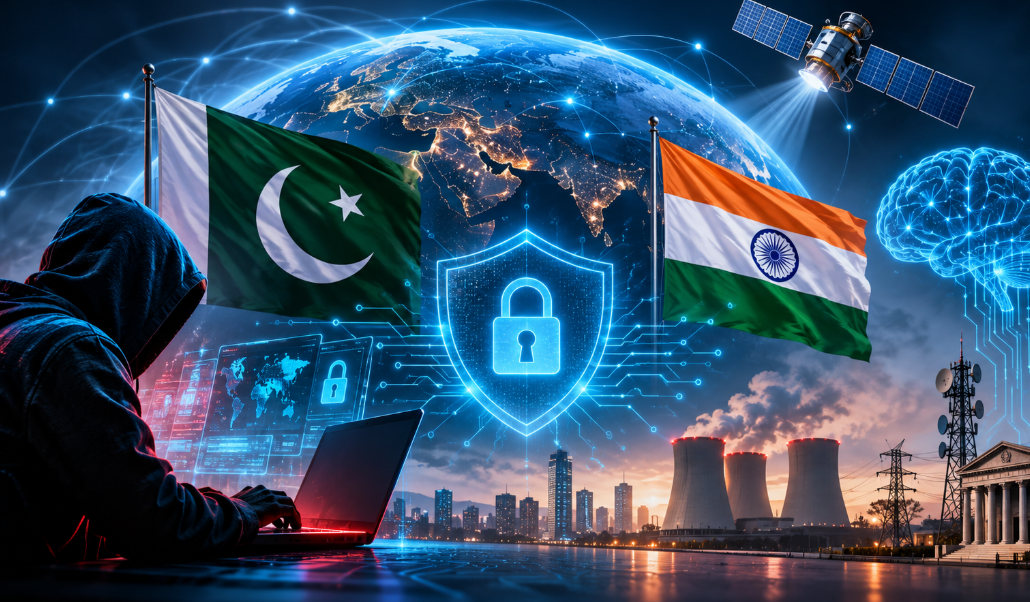
William Gibson popularized the word cyber in 1982-1984 to describe computer-generated virtual reality. It is also a domain of war, like land, sea, air, and space. However, Cyber Warfare is when one country attacks another country using modern technologies like AI, computers, and the Internet, instead of conventional tools like arsenals, guns, bombs, and biological and chemical weapons. According to the US Department of Defense, with the help of this technology, it can shut down a power plant, stop a bank system, and steal a country’s secret military data.
At the Global level, cyber warfare is one of the main issues, particularly in the context of major powers since 1997. These countries have used the cyber domain to achieve their political and geopolitical goals. According to the World Economic Forum 2026, 64% of organisations are planning geopolitical attacks to shut down power plants, spy, and steal data. The responsible countries for such attacks include the US, China, Russia, Iran, and North Korea. For instance, according to US cybersecurity agencies, China-linked hackers disrupted the critical infrastructure of the US in the case of Salt Typhoon and Volt Typhoon in 2024. Just to gain a lead in case of a future Taiwan conflict between the US and China. Other examples include Russian attacks on NATO and Ukraine, and North Korea stealing cryptocurrency.
Artificial Intelligence (AI) acts as a catalyst in case of cyberattacks and makes them more dangerous. According to WEF (2026), AI helps in making fake reports, deepfakes, and attacks faster. It is also an emerging threat to states, as there is no international binding treaty for cyber. The Tallinn Manual, which has no signatory states so far, is only an academic interpretation of international law, not a binding treaty. The misuse of technology can further create vulnerabilities for countries.
At the regional level, Pakistan is a target of cyber warfare. India has employed more sophisticated cyber warfare campaigns against Pakistan. This does not mean India is top-ranked. IISS reports show that India is a Tier-3 (developing power) Cyber power, as its offensive aims are only regional and Pakistan-centric. Nonetheless, the ITU 2024 report shows that Pakistan and India ranked Tier 1 (superpower), as Pakistan jumped from 79th to 46th. The argument is just to show that both states have the capability for offensive and defensive attacks.
According to CASS (2025), cyber operations can hit the nuclear command and control systems, create misunderstandings, and increase the risks of inadvertent use. They can cause attacks by mistake.
States use modern techniques to damage other countries through cyberattacks known as Advanced Persistent Threats (APTs). The first aim is to spy and enter the system. The second is to hide there. The final aim is to attack when war starts: steal data, delete it, or shut down the system. In the case of India, if it attacks Pakistan, it may target the main assets of Pakistan, which are discussed below:
The main actors conducting espionage against Pakistan are Sidewinder (active since 2012) and Sloppy Lemming (active since 2021). They mainly target: Military and defence, Power and Energy, Telecom and Internet, Banks and the economy, and, in Pakistan’s case, mainly Nuclear and sensitive institutions.
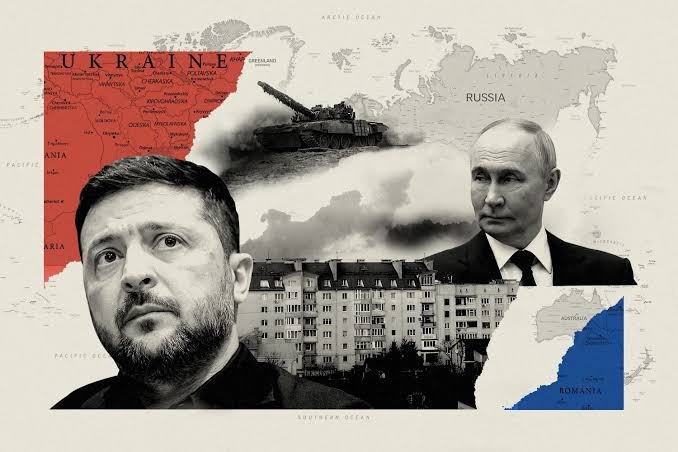
There should be a reminder about misinterpreted warnings. For instance, a non-nuclear attack should be treated as a nuclear attack and addressed as a misinterpretation. As a case in point, on November 2, 2026, Russia and Ukraine emergency apps were hacked and sent fake nuclear warnings to millions. To prevent this, states need Confidence Building Measures (CBMs). In the case of Pakistan and India, there are other agreements and a hotline. But when it comes to Cyber warfare, no new agreement exists.
Pakistan and India should sign cyber-related CBMs.
Cyber CBMs are agreements that prohibit hacking the early warning system, nuclear command, and radar of both countries. In the same way, nuclear commands should be kept separate from online and AI systems. However, humans should keep the last-resort decision-making, not AI. AI can make the work easy and can do surveillance 24/7, but AI can be fooled. When a hacker commands AI, AI will give fake results, a process called data poisoning.
Globally, rival countries have signed CBMs. Although they are voluntary, not in the form of law. For example, in 2013, Russia and the USA signed a cyber hotline between Putin and Obama, plus nuclear risk reduction centers for cyber. They can be considered a form of two-step authentication, but they can reduce fear between countries. According to the UNGGE 2015 rules, ‘states should not damage the critical infrastructure of another state’. Similarly, the UN OEWG (2021-2025) provides a global point of contact directory. It requires countries to share their CERT emails for direct contact during war and crisis. As a result, Pakistan and India agreed to the UN, but they never signed it bilaterally.
Pakistan and India may copy the OSCE and Russia-US model. Share Pakistan NCERT contacts and India CERT exchange emails and phone numbers. Create a cyber-hotline and DGMOs for cyber incidents.

Faridullah Khan
Faridullah Khan is an International Relations graduate of BUITEMS, Quetta, whose research focuses on climate change, strategic studies, nuclear arms, cyber warfare, regional livelihoods, traditional security and non-traditional security in Balochistan. His undergraduate thesis examined climate change and declining apple orchards in Kan Mehtarzai , Balochistan region. He previously interned at the Senate Secretariat of Pakistan at the ministry of Foreign Affairs and is currently an intern at the Balochistan Think Tank Network (BTTN).