Across South Asia, women have frequently built democracies from the street up, only to be systematically erased from the institutions they helped create.
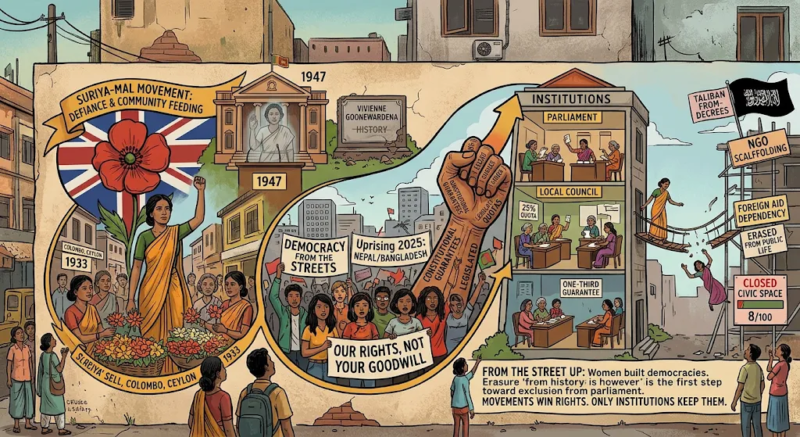
In November 1933, in British-ruled Ceylon, young organizers took to street corners selling a native orange bloom known as the suriya flower. It was an act of open defiance against the colonial poppy, whose funds neglected starving local veterans and their families. At the helm was a young activist named Vivienne Goonewardena. Her grassroots Suriya-Mal Movement fed communities through the deadly 1934–35 malaria epidemic and helped lay the foundations for Sri Lanka’s modern independent state. Goonewardena would go on to become one of the world’s earliest female ministers, yet today she has no national monument, barely appears in school textbooks, and remains unfamiliar to most young citizens.
This erasure is not just an insult to memorialization; it is a structural warning about power. When a movement’s memory dies, the rights it won are easily dismantled. Our region keeps learning the lesson the hard way: movements win rights, but only institutions keep them.
When Uprisings Meet Institutions
Street protests and mass uprisings do not automatically translate into political power for women. Without legal and constitutional structures, hard-won gains quickly evaporate.
In Nepal, a Gen Z uprising brought down a government in September 2025. Here, 76 people died, and it forced fresh elections held in March 2026. Yet in those elections, only 14 women won first-past-the-post seats out of 165. What holds the line for Nepali women is not the crowd; it is the constitutional one-third guarantee negotiated after 2006.
In Bangladesh, a mass uprising toppled a government, and then the February 2026 election produced 78 women candidates out of 1,981, and seven women in 300 directly elected seats. Women were on the front lines of the revolt and locked out of the institution it created.
Sri Lanka shows the reverse, and it is instructive. A legislated 25% quota at the local government level took women from under 2% to roughly a quarter of local councillors in February 2018. This is arguably one of the most effective victories for women’s political representation, precisely because it was written into law rather than left to goodwill.
What Happens When Rights are not Institutionalised
If Bangladesh and Nepal show how quickly civilian electoral politics sideline women, Afghanistan illustrates the terminal consequence of building rights on external goodwill rather than entrenched domestic statutory law.
When Kabul fell to the Taliban in August 2021, the world watched a desperate scramble on the tarmac as Afghan citizens, prominent women human rights defenders among them, fought to secure safe passage out of the country. In days, twenty years of hard-won progress vanished.
Five years on, the Taliban have issued more than a hundred decrees restricting women’s education, work and movement, and UN agencies describe Afghan women and girls as systematically “erased from public life”. Civic space there is rated closed, at 8 out of 100. Aid cuts are now finishing off the women-led organisations that remain: UN Women warns more than half could shut within a year.
We should be honest about what failed, and it was not only the Taliban. Too much of that progress sat in a parallel structure: foreign-funded, foreign-staffed, decided in Washington and delivered around local institutions rather than inside them. The problem was never funding. The problem was that the scaffolding was never bolted to the building. When they removed the scaffolding, nothing held. No safeguard, no domestic constituency, no law that a woman in Kandahar could point to and claim.
Two Failures, Not One
We have two habits to break, and they are intimately linked.
The first is the institutional erasure of movements. When state archives, school curricula, and national monuments treat feminist organizing as a sideshow to democracy rather than its engine, women’s political legitimacy is rendered disposable. If young citizens cannot name the women who built their country, post-uprising governments will never see women’s political leadership as foundational. Erasure from history is the first step toward exclusion from parliament.
The second is the “NGOisation” of our ambition. In response to this exclusion, movements retreated into organizations, organizations shrank into donor projects, and systemic statecraft was reduced to logframes. We grew adept at delivering grant-funded activities and abandoned the slow, unglamorous work of changing laws, party selection rules, and constitutional mandates—the only infrastructure that outlasts an authoritarian shift, a regime change, or an aid freeze.
Protecting democratic voices is not a rhetorical flourish; it is physical infrastructure. And we must build, codify, and hold infrastructure accountable at home.
The young people selling suriya flowers in 1933 understood the first half. Our generation’s job is the second: to make sure that what we win on the street ends up somewhere it cannot be taken away in a week.

Sharanya Sekaram
Sharanya Sekaram is a Sri Lanka-based political and gender policy analyst, co-founder of Everystory Sri Lanka, and a regional partner with the CIVICUS Asia Cohort of Communicators for Civic Action. Her research examines women’s political participation, constitutional mechanisms, and civic space across South Asia.