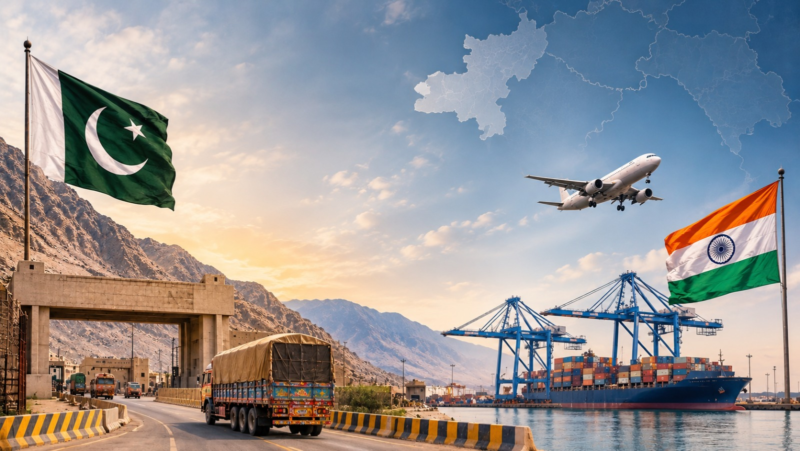
Afghanistan’s transit trade through Pakistan fell to $367 million in FY26 from nearly $5 billion in FY21. Afghan media reports put the collapse in exports reaching India via Pakistan at $454 million in 2024-25 against $7 million in 2025-26. New Delhi has offered two alternatives: an air freight corridor and Iran’s Chabahar Port. This article argues that Pakistan’s border closure has pushed Kabul toward India and Iran, but the 2026 Iran war has made those alternatives far less reliable than Indian messaging suggests. Neither is yet a substitute for the route Pakistan closed.
Why the Border Closed
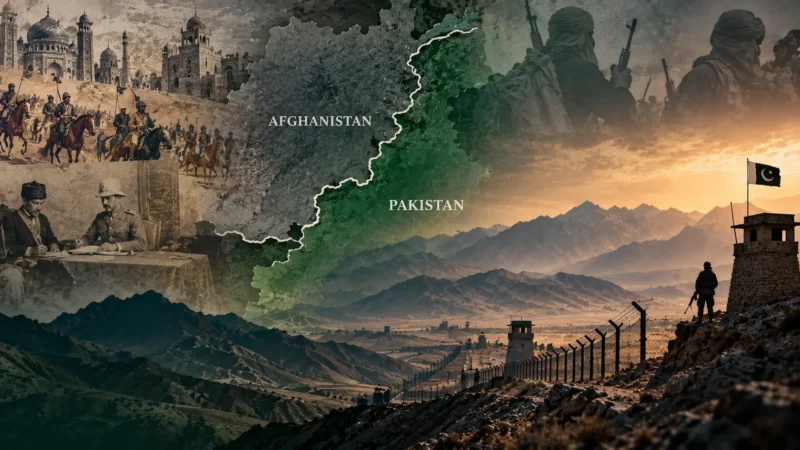
The rupture began in October 2025, when Afghan and Pakistani forces exchanged fire along the frontier. Torkham, Chaman and other crossings shut, and by mid-February 2026 Torkham had been closed to all movement and commercial activity for more than four months.
Pakistan’s rationale is security. Prime Minister Shehbaz Sharif said Pakistan had no choice because the Taliban could not commit to stopping militant groups operating from Afghanistan. Early in 2026, the Torkham crossing reopened for the repatriation of stranded Afghans, with an official saying trade would be restored gradually if things went well. By late summer, the head of the Afghanistan-Pakistan Joint Chamber of Commerce said the crossings were still closed to trade.
The security logic is real, but so is the cost. Pakistan’s exports to Afghanistan had risen 38.68 percent to $773.89 million in FY25, and business groups later reported bilateral trade falling by more than 50 percent. Closure also hands Pakistan’s competitors an opening.
Therefore, the strategic question is not whether Pakistan has legitimate security concerns, but whether an indefinite trade closure is the most effective way to address them. By restricting Afghan access to its territory, Islamabad can impose immediate economic costs, but it also creates incentives for Kabul to invest in alternative routes. The longer these arrangements operate, the greater the possibility that emergency adaptations become established trade practices. Pakistan risks converting a security dispute it can negotiate over into a longer-term loss of economic influence. A conditional reopening tied to verifiable security commitments would preserve pressure on Kabul without surrendering Pakistan’s position as a transit route.
The Air corridor: Real, but Narrow
India’s most visible response is airborne. After Afghan Commerce Minister Nooruddin Azizi’s November 2025 visit, Indian officials said the Kabul-Delhi and Kabul-Amritsar corridors had been activated. Reported fares were $1 per kilogram for Afghan exports and 80 cents for Indian goods on Ariana flights. By June 2026, Ariana had moved to daily Kabul-Delhi passenger and cargo flights.
The corridor suits the right goods. Before 2020, Afghan exports to India of $400-450 million a year were dominated by dried fruit and other high-value perishables, while pharmaceuticals dominate Indian exports. But I found no published tonnage or value data for the 2025-26 corridor. The only benchmark is the earlier, 2020 air corridor, which reportedly moved some 10,640 tons of produce worth over $20 million in its first months.
Costs are rising. In September 2026, reports said closed land routes, expensive air freight and limited alternatives were hurting Afghan exporters, with the West Asia war cited for climbing freight costs. Afghanistan’s chamber of commerce is asking India for dedicated cargo flights for fruit exports. That request suggests current capacity falls short. The distinction is between maintaining trade and replacing a transit system. Air freight can preserve access to the Indian market for selected high-value goods, particularly perishables whose value justifies the additional transport cost. It is less suited to replacing the broader range and scale of commerce previously moving overland. The absence of published tonnage and value data also prevents a reliable assessment of how much displaced trade the corridor has absorbed. India has demonstrated that an alternative route can operate; it has not yet demonstrated that this route can replace Pakistan’s former role at comparable scale and cost.
Chabahar: from Sanctions Problem to War Zone
Chabahar was always meant to carry the bulk trade. Its sanctions history was already precarious: US sanctions were reimposed on 29 September 2025, India won a six-month conditional waiver, and that waiver expired on 26 April 2026. Days before, Business Standard reported India moving to divest its stake in the Chabahar free-zone subsidiary to an Iranian entity, with a guarantee of return once sanctions ease. I could not confirm whether that transfer was completed.
The war has since overshadowed the sanctions question. After US-Iran talks in Islamabad failed in April, Washington announced a naval blockade of Iran. Within days, a US warship interdicted two oil tankers that had left Chabahar. The blockade was lifted on 18 June as part of a temporary ceasefire, but a later report says US forces reimposed it, alongside strikes on Chabahar’s maritime infrastructure. Iranian press reporting dates the current blockade to mid-July. An Indian maritime think tank concluded the blockade and Hormuz risks have effectively militarized the maritime space in which Chabahar operates.
The corridor India presents as sanctions-proof is therefore exposed to sanctions, a blockade and air strikes at once. This distinction matters because access to a port is not the same as access to a reliable trade corridor. Chabahar’s strategic value depends on more than India’s ability to invest in or operate port facilities: it also depends on predictable maritime access, manageable commercial risk and the ability to move goods through the wider transit network. When sanctions uncertainty combines with military disruption, the problem is not simply higher freight costs but the reliability of the entire route. Chabahar may remain a valuable long-term strategic option for India, but its potential should not be confused with its present capacity to absorb trade displaced from Pakistan.
Reading the Numbers
The headline trade figure tells a story of rerouting, not growth. India-Afghanistan trade stood at $907.85 million in 2025-26, and India’s exports of $253.63 million trailed imports of $654.22 million. Reporting on 2025 data found that India overtook Pakistan as Afghanistan’s top export destination. But total bilateral trade that year was about $992 million, slightly below 2024. India has gained a position without expanding the market. The distinction is between destination-market access and transit substitution. India’s position as a leading destination for Afghan exports demonstrates that commercial relationships can adapt when Pakistan’s routes become unavailable. It does not establish that India’s transport alternatives can handle the displaced volume, reproduce the cost advantages of overland trade or provide equivalent reliability. A change in the destination of Afghan exports is therefore not, by itself, evidence that the underlying transit problem has been solved. The relevant test is whether alternative routes can sustain trade at a comparable scale, cost and level of reliability—not simply whether bilateral trade continues.
Pakistan’s Leverage
Pakistan’s role is more complicated than a closed border implies. It hosted the April US-Iran talks, and Iranian media have reported Qatar and Pakistan mediated discussions after Field Marshal Asim Munir’s Tehran visit. Iranian traders have also increasingly used Pakistani ports as alternatives since the blockade began. Iran International reported that Pakistan suspended commercial activity at two Iran crossings on 17 October, though normal traffic has not been independently confirmed.
Pakistan sits at the junction of Afghan and Iranian trade at the moment; both are squeezed. That is a strategic asset the closure partly forfeits. A calibrated reopening, tied to verifiable security arrangements, would restore Pakistan’s relevance to Kabul while India’s alternatives remain impaired. This is analysis, not a sourced claim, and the security case for caution remains legitimate.
Conclusion
India’s routes to Kabul are real, but their existence should not be mistaken for their ability to replace Pakistan’s transit role. The air corridor remains constrained by cost and capacity, while Chabahar’s reliability is exposed to sanctions and military disruption. Pakistan has therefore not been displaced as a transit option so much as temporarily bypassed under conditions that carry their own risks. Yet this does not guarantee that Islamabad will recover its former position. The longer the closure persists, the greater the incentive for Afghan traders to establish alternative commercial relationships. Pakistan should pursue a calibrated reopening tied to verifiable security arrangements, preserving its transit relevance while addressing the concerns that prompted the closure. Otherwise, a measure intended to exert immediate security pressure could accelerate a longer-term erosion of Pakistan’s economic leverage.

Sherzimah Akbar
Sherzimah Akbar is a Research Officer at the South Asia Times and graduated from International Islamic University, Islamabad. Her research interests include Indian defense and military modernization, maritime strategy, South Asian security, India–Pakistan relations, and the Indo-Pacific.