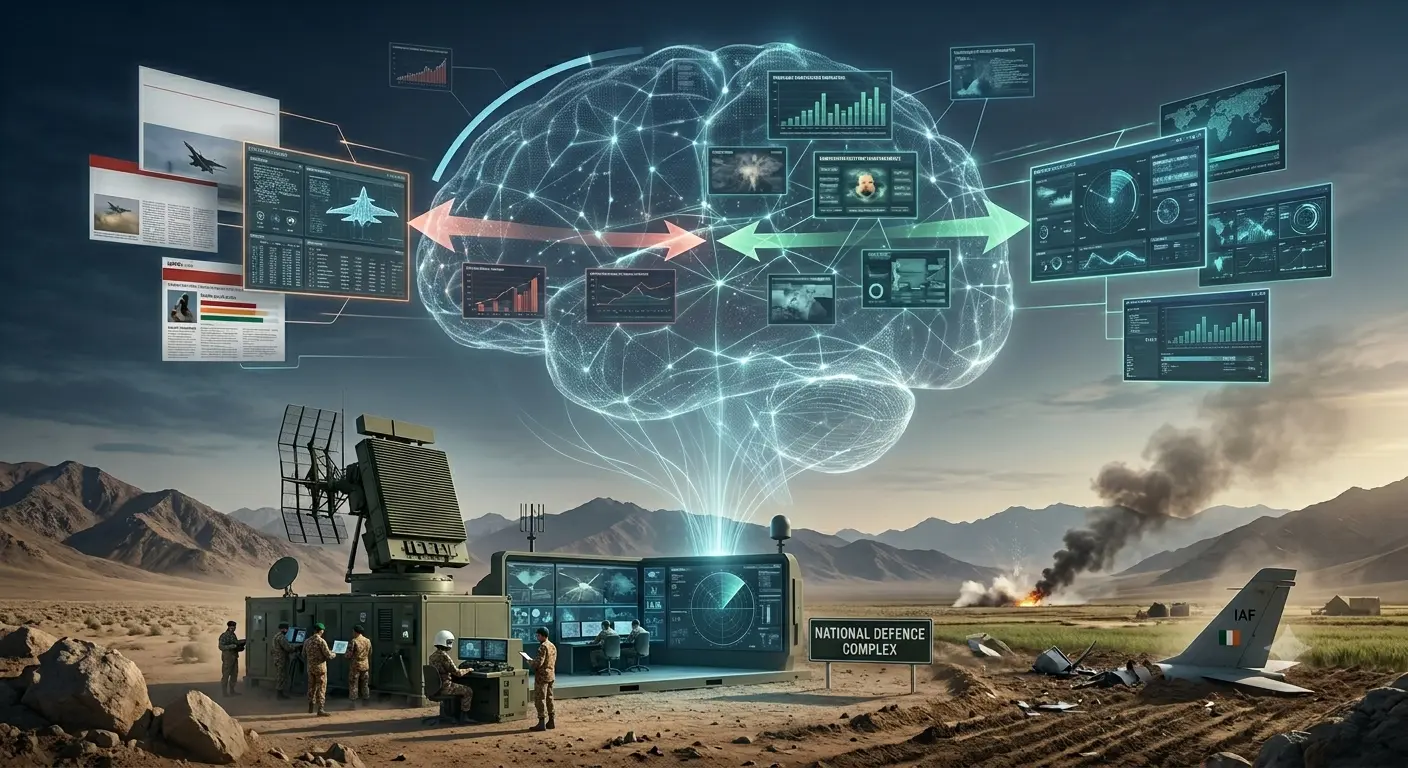
In today’s modern warfare landscape, missiles and military manoeuvres are no longer the only decisive factors; narratives, perception management, and digital influence campaigns have become equally crucial. Marka-e-Haq clearly demonstrated this shift, proving that modern war happens in the ‘kinetic’ and ‘informational’ domains. Marka-e-Haq went beyond the conventional contestation of information. It revealed a broader battle over cognition, where the goal was not just to shape what people see, but how they process, interpret, and emotionally react. As Joseph Nye observed, “In the information age, the mark of a great power is not just whose army wins, but also whose story wins.”
In security studies literature, cognitive warfare is defined as the strategic use of information, psychological techniques, and digital tools to influence how people think, perceive reality, and make decisions. It shapes beliefs and behaviour by exploiting cognitive biases and the digital ecosystem. Unlike traditional propaganda, it works subtly and continuously, using social media and networked communication to shape opinions and undermine collective cohesion or an opponent’s resolve.
Pakistan’s response in Marka-e-Haq reflected a disciplined alignment between kinetic action and cognitive strategy. Kinetically, India initiated hostilities, while Pakistan responded in a calibrated manner. During the engagement, PAF, under the leadership of Air Chief Marshal Zaheer Ahmad Baber Sidhu, downed seven Indian jets and one drone through integrated multi-domain operations. Cognitively, Pakistan maintained a consistent and credible narrative, focusing on maintaining credibility and public trust rather than offensive cognitive warfare. It used evidence-based communication, and treated cognition as a tool for crisis management and national resilience.
By contrast, India’s cognitive warfare effort was driven by the intent to shape public perception of the war, i.e., to project invincibility and to undermine Pakistan’s operational effectiveness. However, the losses inflicted by the PAF directly disrupted this narrative, challenging established perceptions within Indian strategic thinking on military superiority, escalation control, and crisis dominance. The operational setbacks translated into a parallel cognitive battle, where managing perceptions became essential for sustaining domestic morale and political standing. For that, India used hyper nationalist media and AI-driven disinformation to shape public perception. This links directly to cognitive warfare, which aims to control perception by shaping how events are interpreted, influencing how reality is understood and acted upon by domestic and external audiences.
A study of 150 Indian media items found that 70 per cent framed Pakistan through terrorism related narratives, while 60 per cent relied on emotional patriotic imagery and militarised symbolism to reinforce nationalist sentiment. Research revealed that 32 per cent of the false reports were based on reused footage and 16 per cent on manipulated audiovisual material, such as deepfakes. Sentiment analysis also showed the dominance of anger and triumphalism in India’s coverage, suggesting a conscious effort to emotionally manipulate the audience and shape interpretations of the war. In terms of cognitive warfare, it was not only misinformation; it was “shaping perception” by the dissemination of emotionally charged, selectively framed information. This, however, did not last long; inconsistencies, cross-verification, and reporting by international media revealed a growing disparity between the constructed narrative and operational reality. Ultimately, this exposed the failure of India’s intended cognitive warfare effort to sustain influence, as narrative control was repeatedly undermined by battlefield realities, resulting in an inconsistent and unsustainable information posture.
This was further reflected in the rapid and open contradictions among Indian officials, which quickly eroded the credibility of its strategic communication. India’s Chief of Defence Staff (CDS) General Anil Chauhan admitted to IAF aircraft losses, contradicting prior claims by officials that none had been lost. Indian ACM Amar Preet Singh made a sweeping claim after two months of the war that the IAF shot down six PAF fighter aircraft, which was not only far from reality but also did not align with the previous statement of the CDS. This reflects a strategy of narrative confusion, a form of political face-saving against the humiliation faced in the operational realm, solely for domestic perception management.
Conversely, Pakistan’s response was more institutionally disciplined and cognitively effective. Unlike sensationalism and emotionally driven narratives, Pakistan’s tri-services spokesperson engaged through formal press briefings and official communication channels, supported by operational detail and verifiable evidence. This was crucial cognitively, as the objective extended beyond informing audiences to reassuring the domestic population and reinforcing institutional trust. The episode illustrates that contemporary conflicts are shaped as much by informational credibility as by kinetic outcomes, with competing cognitive frames subjected to evidentiary scrutiny. In this context, Pakistan’s operational claims gained increasing traction in external assessments, while India’s narrative credibility progressively eroded.
Ultimately, Marka-e-Haq shows how modern warfare quickly moves from battlefield to the domain of cognition, where perception, credibility, and interpretation prove critical factors in strategic contestation. When faced with facts and scrutiny, Pakistan maintained credibility, while India failed to hold its position. The key takeaway is that cognitive advantage is not derived from the volume of messaging, but from the constant alignment of claim, evidence, and observable reality. The growing centrality of cognitive domains in modern conflicts, therefore, requires necessary preparedness, including robust real-time verification systems, disciplined strategic communication, and greater societal resilience to misinformation, with cognitive security built into the architecture of national deterrence.
The views expressed are solely those of the author and do not necessarily reflect the editorial position of South Asia Times.

Ezba Walayat Khan is a Research Assistant at the Centre for Aerospace and Security Studies (CASS), Lahore. She can be reached at [email protected].