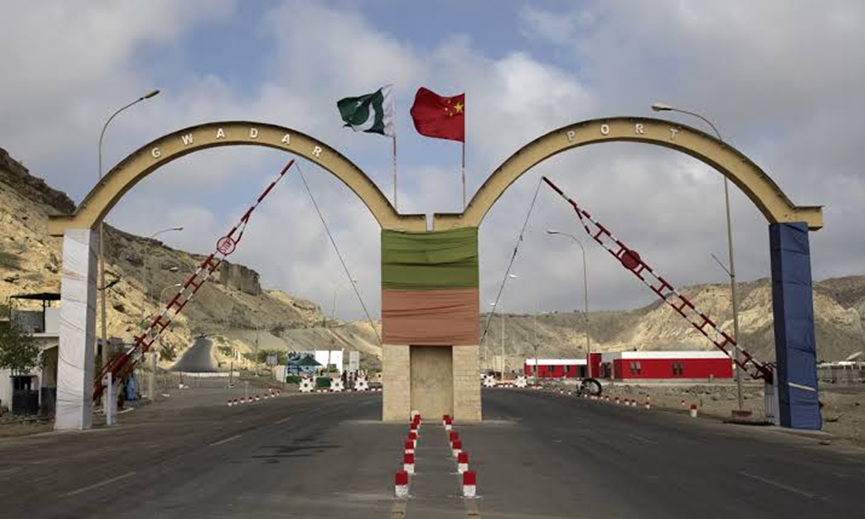
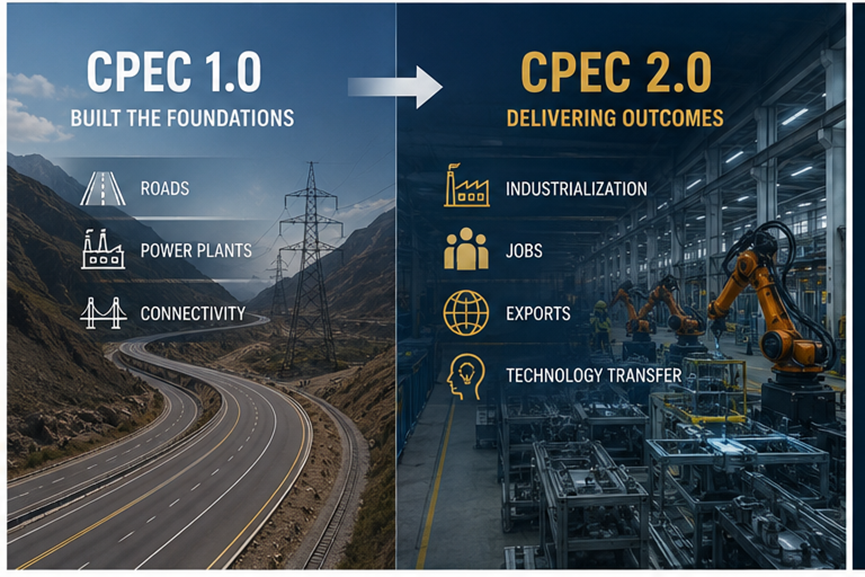
CPEC 1.0 was visible in Pakistan’s landscape. roads were built, power plants came online and connectivity infrastructure expanded all over the country.
CPEC 2.0 presents a different and more difficult test as its success will not be measured primarily by kilometres of roads constructed or megawatts added to the national grid, but by what Pakistan is able to produce, export and sustain through the industrial transformation that the second phase promises.
The May 2026 Pakistan-China Joint Statement reaffirmed the commitment of both countries to the high-quality development of the upgraded CPEC 2.0.
It also emphasized industrial parks, industrial cooperation, third-party participation, skills development and the security of industrial and supply chains. At the same time, Pakistan and China are working within a broader 2025–29 framework, giving the next five years a practical window in which the ambitions of CPEC 2.0 must translate into measurable economic outcomes.
This makes Special Economic Zones (SEZs) particularly important. If CPEC 1.0 was about building the foundations, SEZs are where those foundations are expected to generate economic activity.
The four priority zones are ,Rashakai, Allama Iqbal Industrial City, Dhabeji and Bostan. These zones remain central to Pakistan’s industrial cooperation agenda. Yet their progress also illustrates why CPEC 2.0 cannot be assessed simply through announcements, initiatives,agreements or the development of industrial land.
Official updates show that development remains at different stages across these zones: Bostan’s first phase has been completed and opened for industrial plot allocation, while development continues at Dhabeji and Allama Iqbal Industrial City.
The more important question is what comes next.
An SEZ becomes economically meaningful when plots become factories, factories generate production, production creates jobs and competitive industries begin to generate exports and transfer technology. All of these factors would contribute to substantial revenue generation and strengthen Pakistan’s overall economic base.
The chain is straightforward.
There are already signs of the implementation challenges that need to be addressed to get the utmost benefit of CPEC 2.0 .
In Rashakai, for example, authorities have previously had to intervene over land pricing, electricity tariffs and other issues affecting the operations of Chinese investors.
Such difficulties highlight a broader problem, as attracting industrial investment requires more than developing physical infrastructure. Investors need reliable energy, predictable regulations, efficient administration, skilled labour, competitive costs, and confidence that policies will remain stable over the long term.
This is where CPEC 2.0 becomes an institutional test for Pakistan. The government cannot expect SEZs alone to generate industrial transformation. Pakistan needs to build the ecosystem around them: vocational and technical skills, reliable electricity and logistics, streamlined customs and taxation procedures, access to finance, export-oriented industrial policy and stronger links between Pakistani and Chinese businesses.
The April 2026 CPEC review itself emphasized the need to align the 2025–29 action plan with CPEC 2.0 and, importantly, to ensure that existing agreements and MoUs produce “tangible results on the ground.”
The security dimension is equally important. Economic security and physical security are increasingly interconnected in the CPEC environment. An industrial zone cannot attract sustained foreign investment if companies perceive their personnel, assets and supply chains to be vulnerable.
The May 2026 Joint Statement explicitly linked CPEC’s economic expansion with security, with Pakistan committing to targeted measures to ensure the safety of Chinese personnel, projects and institutions, while China committed to deeper security and counterterrorism cooperation with Pakistan.
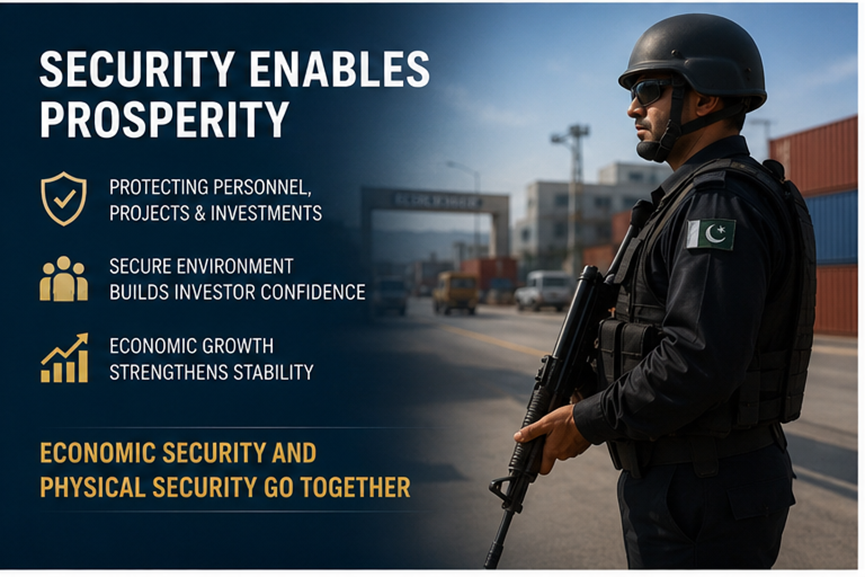
This means that protecting CPEC should not be understood only as a matter of guarding individual projects. Pakistan must create a broader environment in which Chinese and other foreign investors can operate predictably. Security around industrial zones, transport corridors, ports and supply chains will directly influence the commercial viability of CPEC 2.0.
At the same time, successful industrialization can itself contribute to stability by creating employment, developing local skills and generating economic opportunities in regions where socioeconomic grievances can intersect with security challenges.
The challenge, however, is to avoid treating economic development as an automatic solution to insecurity. Investment does not by itself eliminate security threats. Rather, economic development and security must reinforce each other. A secure environment encourages investment, while productive investment can strengthen state capacity, employment and local economic resilience.
For CPEC 2.0, this relationship will be particularly important in areas where major infrastructure and industrial projects intersect with existing security pressures.
Pakistan therefore enters the second phase of CPEC with an opportunity but also a deadline. The government has already identified industrialization, private-sector participation and business-to-business cooperation as important elements of the upgraded corridor.
The March 2026 CPEC review also described Phase II as a strategic shift toward industrialization, innovation and inclusive growth. The task now is to demonstrate that this shift is occurring beyond policy documents.
By 2029, the question should not be how many MoUs were signed, how many plots were developed or how many investment proposals were announced.
It should be whether factories are operating, whether Pakistani workers are acquiring new skills, whether domestic firms are entering Chinese-linked value chains, whether exports are increasing and whether investors consider Pakistan a sufficiently secure and predictable place for long-term production.
CPEC 1.0 built the foundations. CPEC 2.0 must prove what those foundations can produce. Its five-year test is therefore ultimately a test of Pakistan’s ability to convert infrastructure into industry, investment into production, and security into the confidence required for sustained economic growth.

Your go-to editorial hub for policy perspectives and informed analysis on pressing regional and global issues.