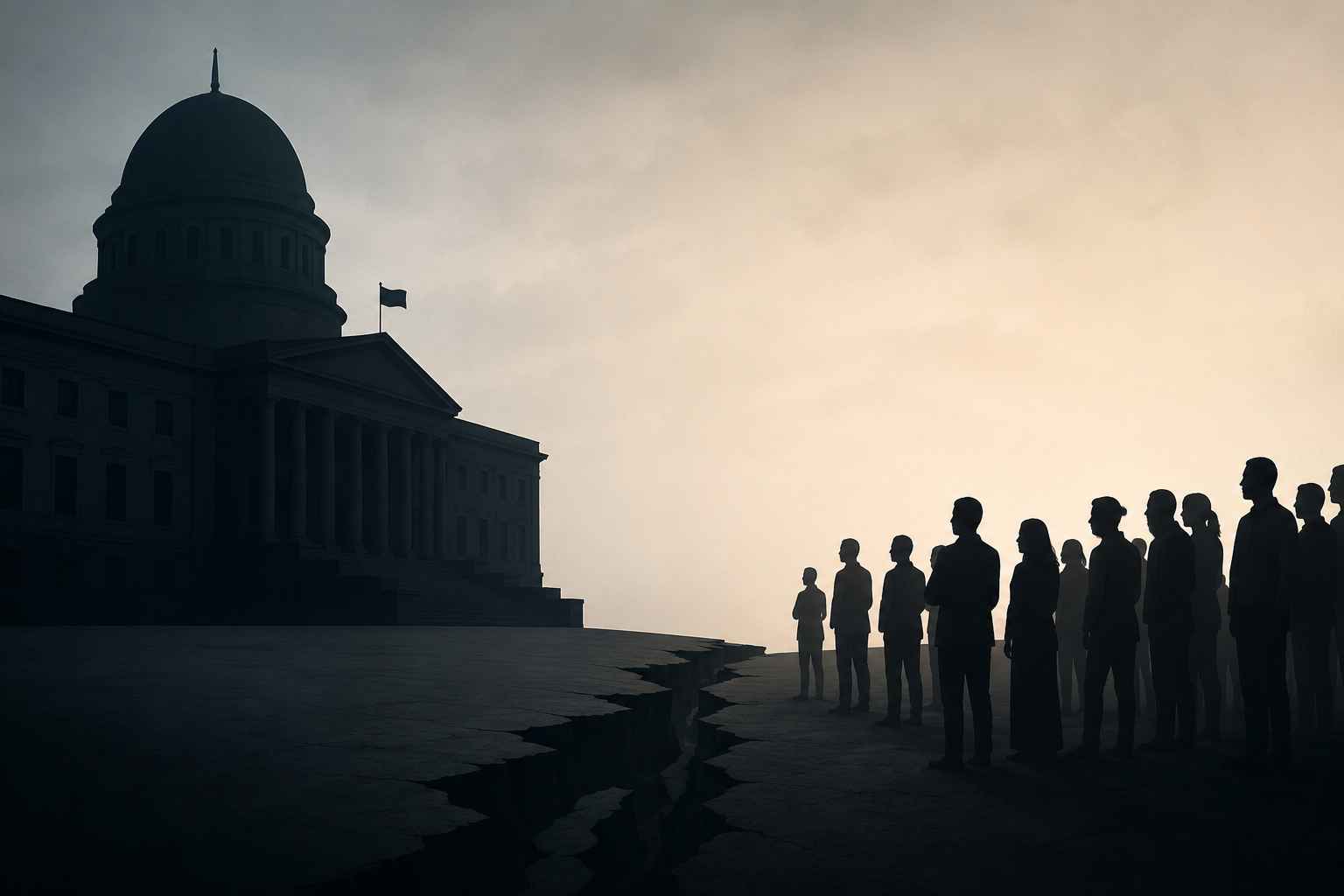
A society does not remain stagnant and immature. As education grows, information is available, economic and social relationships are growing in number, and citizens are becoming more aware of their rights, expectations and dignity, society calls for something more from the state: fairness, accountability, representation and equal treatment. This is not an example of disorganization. It’s a sign of political maturity. The issue is that societies don’t mature. The issue is that they can grow up quicker than the institutions that were created to regulate them: when the gap becomes meaningful, it can yield not stability but distance.
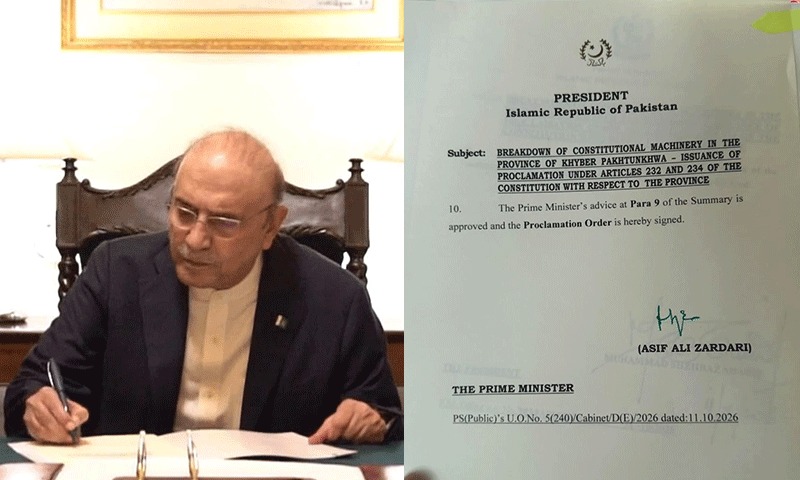
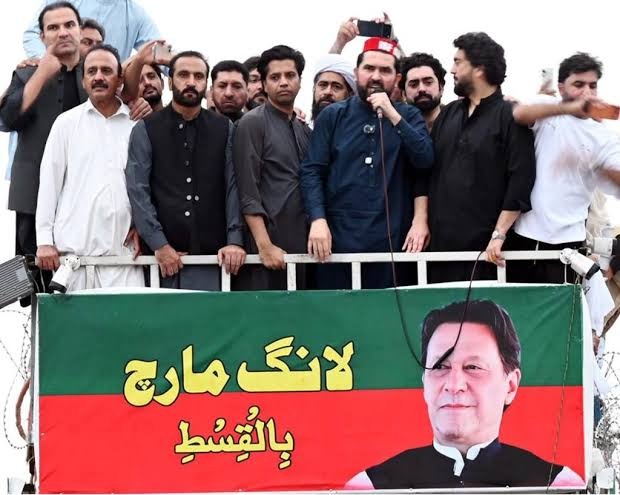
In Pakistan, the situation seems to be getting worse and worse. It has a changing society. Some of its institutional processes operate as if society itself has not. Institutional reactions, based on an older logic of control instead of accommodation, of obedience instead of dialogue, of coercion instead of persuasion, are still common when citizens step forward and raise the question of their constitutional rights. It is not just a conflict between the state and its citizens. At its heart it is an institutional immaturity challenge.
The level of change in Pakistan’s society is not in question anymore. The Pakistan Bureau of Statistics (PBS) Household Integrated Economic Survey (HIES) 2024–25 revealed that literacy among individuals aged 10 years and above has increased from 63 per cent to 70 per cent, and the percentage of people accessing internet has increased from 17 to 57 per cent, while the percentage of households with internet connection rose from 34 to 70 per cent.
These figures do not proclaim Pakistan’s high level of education or a fully digitally literate society. They show the extent of a social shift which is occurring—the shift in which citizens are more likely to have access to information, conflicting narratives, alternative political concepts, and models of international governance. The citizen no longer just receives the actions of the state. The citizen is increasingly desiring to have an input in shaping them. The status quo changes in the political relationship between state and society. The politically immaturity of society may be partly responsible for accepting authority in a society that is lacking in information, organization and confidence to oppose it.
A politically developing society starts asking the uncomfortable but needed questions, “Why?” Under what law? According to which principle? How is it that this right is extended to one citizen while denied to another? These aren’t necessarily questions against the state. They can be asked on the basis of Pakistan’s own Constitution, which provides the words: the right to treatment in accordance with the law (Article 4); the right to fair trial and due process (Article 10A); the right to speech (Article 19) and the right to information (Article 19A). Rights are not necessarily demands against the State. It is a demand that the state must keep its own commitments to the constitution, often.
The difference between institutional strength and institutional maturity is crucial here but the argument can otherwise devolve into an old, unhelpful complaint of Pakistan that it has “weak institutions. It has no institutions lacking. It’s full of legislatures, courts, administrative bodies, political parties, electoral bodies, law-enforcement bodies, and so on.
What is not clear is whether these institutions have acquired a degree of freedom from personal power of autonomy, professionalism, restraint and accountability. A state may engage in powerful coercive actions, like dispersing a demonstration, silencing a critic, or silencing dissent through administrative or legal measures, and yet be institutionally immature (Huntington, 1968). It is not the same to win people over to obedience and to build their legality.
An institution is grown-up when its rules endure beyond the life of the people who inhabit them, its procedures have meaning even when they are not being led by the same people, and it questions the legitimacy, and the constitutionality of a demand, rather than the person who makes it and whether it is convenient. The growth of institutions doesn’t demand that they bow down to any and all demands that society puts on them. It demands processing that demand can be accomplished via legitimate processes, not through automatic transformation into repression.
The threat starts exactly where the distinction ends: when institutions used to defer to begin wondering at a more aware citizenry and treat its queries as a threat. Once the demands are perceived as challenges to authority, the institutional reaction is likely to be from accommodation to coercion. But coercion, no matter how short the effect, will only be an effective way to extinguish behavior without addressing the problematic behavior that initially caused it.
This is not just a Pakistani dilemma. It has a long and instructive comparative history and three cases – none that is altogether similar to Pakistan’s – serve as a demonstration of how the mechanism works in other contexts.
Perhaps the most extreme example of a state that grew in the expectations of its citizens without growing its own political accommodation was Mohammad Reza Shah Pahlavi’s Iran. The Shah’s “White Revolution” of 1963 reallocated land, established literacy and health corps, increased legal rights for women and spurred rapid urbanization and westernization; within 15 years of its commencement, enrolment at all levels of education had increased several fold. Iran was creating a growing, middle-class educated populace, whose expectations of participation continued to grow.
Political institutions went in a different direction, however: the Shah had already suspended parliament and claimed nearly unlimited authority, and opposition was dealt with by the security forces, not through political negotiation. Social change occurred, and not the political system. Education, urban lifestyle and expectation changed.
How institutions responded was through control. The reason the answer was not enough was that a more educated, more urban, more open people stopped taking management without representation. It was not one revolution, but a cumulative sense of disaffection with the accommodationist state made increasingly worse by alienation and repression; and a sense that it is the “modernization” agenda that is driving a need for new demands for legitimacy.
The lesson to be learnt from Pakistan is not that literacy or Internet access spawns revolution. The absence of an equal strengthening of political voice when providing material and educational advancement is no source of loyalty that lasts forever — it can instead heighten expectations that then remain unsatisfied.
Tunisia does have a lesson, but it is more related and closer to Pakistan’s current demographic reality. Tunisia was for years on the books of international financial institutions as a success story of reform, with consistent economic growth, and positive social indicators under the leadership of Zine El Abidine Ben Ali. During the same time, however, the country had a large, ever more highly educated youth population—by 2010, some 42 percent of Tunisians were under 25—and the opportunities to education did not lead to political or even economic inclusion.
By 2008, levels of youth unemployment in the region were near 25 percent and were highest among university graduates, raising a “socially dislocated” group of higher educated young people, according to regional analysts. Political institutions, on the other hand, were highly concentrated and dissent was kept under control by surveillance and selective repression rather than by representation.
The changes in society were education and connectivity, as early as the social media platforms could be used to organize. The way institutions responded was by engaging in what has been termed “authoritarian upgrading” – superficial liberalization to maintain the existing control structure. The reason the answer was not enough was that an educated and networked people refused to take the terms on which the old “stability-for-obedience” trade was made.
These grievances were not caused by the self-immolation of one street vendor in December 2010, but were instead the result of a combination of factors that had built up over years, leading to Ben Ali’s downfall within weeks. Again, it was a combination of economic and political factors that made this grievance into a mass movement, with the mismatch between social expectation and institutional accommodation being one of the factors.
A third scenario, exemplified by the last ten years of the Soviet Union, is a situation where institutions try to survive in a new society but they do so too late and without a proper institutional structure to cushion the impact of the changes. By the 1980s, the USSR had a very literate, urbanized, educated populace, who had lived for years in a system legitimized by ideology and controlled information (Mironov, 1991). After 1985, glasnost and perestroika were introduced by Mikhail Gorbachev, opening the floor for a public critique of a system that at this point had its citizens trained for this task.
The Chernobyl catastrophe of 1986, when openness was purportedly being guaranteed, was the first, and the next, and the next, and the next incident of the state’s past lies, weakening a legitimacy secured by deference and faith in ideological beliefs. Without any institutional frames of rules and accountability to guide expectations towards the political, Gorbachev’s reforms only hastened the dissolution of the Soviet state, which had already begun by 1991.
The lesson is not just that institutions can’t keep up with the rising expectations if they’re done with coercion, but that institutions can’t simply generate legitimacy at the last minute when the distance between society and the state is already too vast.
Delaying reform for too long becomes the conditions of collapse. None of these cases can be interpreted as a prophecy of Pakistan and none should be seen as a prophecy of Pakistan. Structurally, the monarchy in Iran and the post-independence ruling party in Tunisia are far from the constitutional, multiparty system that Pakistan has, with its courts, its media, its provincial assemblies and its seemingly competitive politics.
Societal maturation creates growing demands for fairness, accountability and participation, which, if these expectations are interpreted as challenges to authority rather than as signs of a different citizenry, leads to attempts to control, not accommodate, them, causing the citizens to feel alienated and leading to reduced compliance to the system, which in turn results in a legitimacy deficit.
When social maturation leads to rising demands for fairness, accountability and participation, and if these demands are perceived as a threat to authority rather than as a sign of a different citizenry, then citizens try to control or accommodate these demands, which leads to feelings of alienation and in turn to reduced compliance to the system, which results in a legitimacy deficit.
Society grows up, calls for rights and fairness, personalized institutions interpret these calls as challenges and respond with coercion, legitimacy wanes, alienation increases and the gap between state and society expands further. All three of the above cases went through some variant of this loop.
For now, Pakistan’s tale is not of institutional failure, but of institutional habits — and you can see them. The personalization, informal force and selective enforcement of the law, and the intolerance of dissent, are the tools they have embezzled from a past, less politically aware society and used for a present one that is no longer like that. When citizens call for transparency, suspicion creeps in. Representational demands elicit the feeling of pressure.
When they complain about something unfair, they are likely to be considered as trouble makers. Challenging a decision is to see insubordination. None of this, however, means that all grievances are legitimate, all protests peaceful, or all criticisms accurate; states have a legitimate duty to maintain order and to protect the rights of others, and the maturity of an institutional system is defined by its capacity to distinguish dissent from disorder, criticism from subversion, political opposition from an existential threat. It is not permissiveness in general, it’s a discernment that institutional maturity demands.
It’s also where the definition of “pro-state” needs to be revisited. People who think that the citizens should accept all government decisions and actions without question are defending the power of the state. The only problem is that if such advice creates alienation and distrust of citizens to institutions, it is protecting authority in the short term, and is slowly undermining the legitimacy of the state.
On the other hand, the petitioner, who is a citizen and seeks the state to fulfill its own Articles 4, 10A, 19 and 19A, is not opposing the state, he is only calling upon it to be what it is. The truly pro-state posture isn’t one of subservient to those in power.
No less than the protection of the long-term legitimacy of the state, constitutional order and social cohesion, and that needs institutions that are mature enough to have a difference of opinion without making every difference of opinion an assault on their very existence. And when institutions keep asking people to be loyal to them, and they do not show justice to them in return, the state can find out that the biggest danger to its legitimacy has not been the demands of the society for its rights, but the immaturity of the institutions that were replying.
Pakistan doesn’t need a society that slowly becomes oblivious of politics, so that its institutions remain comfortable. It requires more mature institutions as it is now a mature society and can read the message behind the decisions.
The solution to the dilemma is not to force society to become politically immature. It is to make institutions come forward. A state is not made weaker by its citizens asking it questions; it is made weaker by its citizens failing to ask it questions.
What the Pakistani state will do in the coming years will not be measured by the strength of its institutions when it comes to reacting against society’s resistance, but by how well it can “absorb” that resistance, and in absorbing it, recapture the confidence that can only be won by cooperation.

Abdul Muhaymin Farooq
Abdul Muhaymin Farooq holds MPhil in Political Science from the University of the Punjab and BS in International Relations from GCUF. He can be reached at abdulmuhayminfarooq@gmail.com.