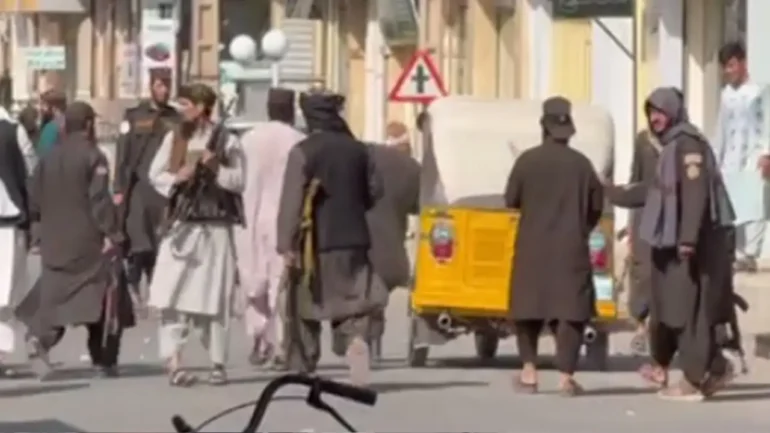
There is a moment in the life of every authoritarian system when the architecture of repression begins to reveal not the strength of the regime but the depth of its failure. Herat, in the second week of June 2026, has produced that moment with uncomfortable clarity. Residents gathered outside the Taliban governor’s office, not armed, not organized as a military force, but present, vocal, and refusing the silence that five years of systematic violence has attempted to impose upon them. They chanted “Woman, Life, Freedom.” They demanded the right to education and the right to work. They called their ruler a dictator. The Taliban’s response was to deploy tanks, rockets, and hundreds of heavily armed fighters against them, transforming one of Afghanistan’s most historically significant cities into a militarized zone in which gunfire accompanied the dispersal of civilian demonstrators. This is not governance. It is occupied by a regime that has forfeited any claim to legitimacy it might once have sought to establish.
The sequencing of events matters analytically. Only days before these protests, Taliban morality police had conducted mass arrests of women and girls in Herat for alleged dress code violations. On 9 June, when residents took to the streets to demand their release, Taliban security forces opened live fire. A child was killed. Multiple people were injured. The Taliban denied everything. And then, in defiance of every calculation the regime had made about the deterrent effect of lethal force, Herat’s residents came back. They returned to the streets, in greater numbers, with louder slogans and in the direct line of sight of the same forces that had shot at them days before. The significance of that return cannot be overstated. It represents a public determination to resist that survives even the demonstration of lethal consequences, and it exposes the central miscalculation at the heart of Taliban governance: that sufficient violence produces sufficient compliance.
It does not. It produces, as the documented record of authoritarian systems across history consistently demonstrates, a different calculus among the governed, one in which the cost of silence begins to approach the cost of resistance, and in which repression generates the very resistance it was designed to prevent. The slogan “Death to the dictator” chanted on the streets of Herat is not merely a rhetorical expression. It is a precise diagnostic of how Taliban rule is now perceived by a significant portion of the Afghan population: not as legitimate Islamic governance, not as the restoration of order after years of conflict, but as coercive personal dictatorship sustained entirely by the deployment of armed force against unarmed citizens.
The scale of underlying grievance that feeds these protests is not abstract. More than 2.2 million Afghan girls remain locked out of secondary and higher education by Taliban decree. Women face systematic exclusion from employment, restrictions on unaccompanied movement, and the constant surveillance of morality squads empowered to detain them for the angle of a headscarf. These are not peripheral policy disputes. They are the deliberate elimination of an entire gender from participation in public, economic, and intellectual life. The cumulative weight of these policies sustained across five years with consistent enforcement and no meaningful reform has produced in Herat a level of public frustration that tanks and rockets cannot resolve, because tanks and rockets cannot address the underlying conditions that generate it.
The Taliban’s deployment of heavy military assets against civilian protesters also illuminates something significant about the regime’s own assessment of its position. Governments that enjoy genuine popular legitimacy do not require armored vehicles to manage expressions of public discontent. The militarization of Herat in response to unarmed demonstrators is an implicit admission that the regime understands its authority to rest not on consent but on coercion and that it recognizes, at some level, the fragility that this dependence creates. The greatest threat to Taliban rule is not emerging from external adversaries or armed opposition networks. It is emerging from the accumulated alienation of millions of Afghans for whom the Taliban’s ideological project offers nothing except restriction, humiliation, and fear.
Herat is not an isolated protest episode that can be managed through sufficient shows of force and then forgotten. It is an expanding fault line between a regime that has chosen permanent militarized repression as its governing philosophy and a population whose aspirations for education, opportunity, and freedom from fear have not been extinguished by five years of systematic attempts to eliminate them. That fault line will widen. The only question is what the international community chooses to do while it does.

Your go-to editorial hub for policy perspectives and informed analysis on pressing regional and global issues.