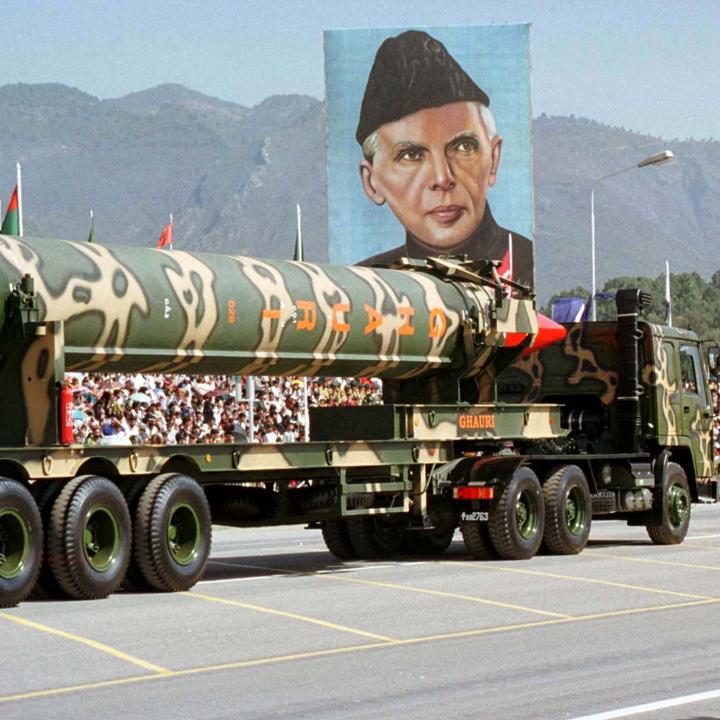
“If India builds the bomb, we will eat grass or leaves, even go hungry, but we will get one of our own. We have no other choice” Zulfiqar Ali Bhutto
Chagai hills, five blasts, Pakistan becomes the seventh nuclear power in the world. A mere seventeen days after neighbouring India had shocked the world with its first nuclear tests since 1974, Pakistan’s response came as a surprise to many observers. Many wondered how a poor country recovering from catastrophic wars and national dismemberment could devote its limited state resources to acquiring such potentially destructive technology.2 It started with power plants, not warheads. May 2026 marks the twenty eighth anniversary of Pakistan’s nuclear tests. The strategic choice to go nuclear was made in the aftermath of the loss of East Pakistan in 1971. On 24 January 1972, Z.A Bhutto convened a meeting of his top scientists in Multan and launched his nation irrevocably on the nuclear path.3
The nuclear journey was not an easy one. Those opposed to the Pakistani nuclear program used all stratagems including denial of technology, economic sanctions, military threats, political coercion, and a rabid vilification campaign to block Pakistan’s inexorable advance.
The Pakistani leadership refused to buckle under pressure resulting in the persistence, faith, and belief that nuclear deterrence was essential for national security got us the bomb in the teeth stiff opposition.
To understand the heart of the Pakistani quest, this article examines these questions. What conditions sparked the shift from a peaceful quest to acquire nuclear energy into a full-fledge weapons program? How was the nuclear program organized? How did Pakistan overcome the many technical hurdles encountered in the process of developing nuclear weapons? What role did outside powers play in Pakistan’s nuclear decisions?
THE RELUCTANT PHASE:
Pakistan’s nuclear trajectory was shaped not by a singular decision to acquire weapons, but by a fifteen-year institutional build-up under the logic of development, contested by rival elite visions of national security. The Pakistan Atomic Energy Commission, established in 1956, initially operated within the constraints of Eisenhower’s – Atoms for Peace- program, which provided training and a 5-MW “swimming pool” research reactor but withheld power reactors and heavy water technology due to proliferation concerns. This inaugurated what Feroz Hassan Khan terms the “reluctant phase,” in which technical capacity developed absent political sanction for weaponization.
The decisive institutional transformation occurred under Dr. Ishrat Hussain Usmani, appointed Pakistan Atomic Energy Commission(PAEC) chairman in 1960 with the backing of Zulfikar Ali Bhutto and Abdus Salam. Recognizing that “without a trained workforce, Pakistan could not move ahead,” Usmani prioritized human capital. He instituted merit-based recruitment of fifty science graduates annually, enrolled them as Officers on Special Training, and dispatched them for doctoral work to Argonne, Oak Ridge, Harwell, and Chalk River under USAID and Atoms for Peace fellowships. By 1967, approximately three thousand Pakistani nuclear science students were studying domestically and abroad, while PINSTECH trained one hundred plant engineers per year. To house this cadre, Usmani conceived the Pakistan Institute of Nuclear Science and Technology at Nilore — designed by Edward Durell Stone as “the Taj Mahal of Nuclear Pakistan” — which reached criticality with the PARR-1 reactor on December 21, 1965.4 By 1992, PINSTECH would employ over two thousand scientists and become, in Munir Ahmad Khan’s assessment, “the leading nuclear center in the entire Muslim world.”5
Parallel efforts secured Pakistan’s first power reactor. Despite Foreign Office objections to IAEA safeguards not imposed on India’s CIRUS reactor, Pakistan signed a turnkey contract with Canadian General Electric on May 24, 1965, for the 137-MW KANUPP. Approved in 1964 and financed through Canadian loans, KANUPP went critical in August 1971. Between 1960 and 1968, Ayub Khan’s government allocated 724 million rupees to nuclear development, with 400 million directed to KANUPP, reflecting a developmentalist orientation toward energy, agriculture, and medicine.6
Yet this civilian infrastructure was politicized. Two camps emerged in the 1960s. Cautionists, including Manzur Qadir and Altaf Gauhar, argued that nuclear energy served development, not deterrence, and that weapons pursuit would jeopardize U.S. aid and World Bank funding. Enthusiasts, led by Bhutto, Aziz Ahmed, and Agha Shahi, contended that China’s 1964 test, India’s unsafeguarded facilities, and the impending NPT created a “now or never” moment.7 Agha Shahi recalled: “When the Indians got this CIRUS reactor… we became concerned.” Ayub, however, practiced “non-decision.” He rejected Munir Khan’s 1965 proposal to spend $150 million on a bomb, telling him Pakistan was “too poor” and could “buy it off the shelf” if needed.8 His 1967 diary condemned nuclear weapons as “incompatible” with territorial nationalism and “a deadly danger to the survival of the human race.”9
The rift between Ayub and Bhutto proved determinative. Dismissed in 1966, Bhutto declared that “if India has the bomb… we are going to be subjected to nuclear blackmail.” Usmani, though instrumental in building the scientific base, clashed with Bhutto and was removed from PAEC in 1972. The institutions, laboratories, and personnel he assembled under the rubric of reactors would thus be inherited by Bhutto for the explicit pursuit of deterrence after 1971, completing the transition from – Atoms for Peace – to the bomb.
The secret nuclear R&D Program:
The 1971 war and India’s 1974 “peaceful nuclear explosion” dismantled what Feroz Hassan Khan terms Pakistan’s “reluctant phase.” The dismemberment of the state and the shock of Pokhran transformed the Pakistan Atomic Energy Commission from a developmental agency into the covert architect of deterrence. Prime Minister Zulfikar Ali Bhutto, who placed PAEC under direct control upon assuming power, inherited only one IAEA-safeguarded reactor, KANUPP, but initiated a policy of pursuing “everything that the reluctant Ayub had shelved.” PAEC was directed to recall scientific talent, exploit open resources, and acquire technological ability through every available avenue.
Commissioning KANUPP epitomized the contradictions of this transition. The 1971 war stripped PAEC of half its trained workforce, as Bengali scientists faced distrust and most were forced to leave. Canadian technicians also departed after Indian naval attacks on Karachi.10 The 1974 declaration of Ahmadis as non-Muslims removed another cohort from classified work. Yet these losses catalyzed indigenization. When Canada halted fuel supplies in 1976, PAEC scientists deemed it a “blessing in the long run,” compelling domestic production of uranium oxide. To manage expanding classified projects, PAEC created the Directorate of Technical Development to procure equipment for explosive lenses.
Simultaneously, Munir Ahmad Khan launched a secret R&D program to replicate India’s CIRUS reactor. A team under Dr. Sardar Ali Khan, including Sultan Bashiruddin Mahmood and Pervez Butt, produced preliminary designs within eight months. The rationale was structural: KANUPP’s uranium oxide fuel was unsuitable for weapons-grade plutonium due to impurities, whereas CIRUS used uranium metal. Mahmood dismissed claims about diverting KANUPP’s spent fuel as a “myth” under IAEA safeguards, making an unsafeguarded reactor essential.
India’s May 18, 1974, test at Pokhran ended ambiguity. Using plutonium from the Atoms for Peace–supplied CIRUS, India detonated a ten-kiloton device fifty miles from Pakistan. GHQ, still reeling from 1971, was “baffled.” Bhutto responded by declaring Pakistan would “never let Pakistan be a victim of nuclear blackmail” and wrote Indira Gandhi that a nuclear test was “no different from the detonation of a nuclear weapon.”11 At the IAEA on June 8, 1974, Pakistan rejected the peaceful-military distinction, warning that the test had “opened the floodgates.” Canada terminated cooperation despite Pakistan’s compliance with safeguards.
With Western suppliers imposing embargoes, PAEC institutionalized -jugaadh-, a culture of improvisation. Ishfaq Ahmad recalled: “We could pick up pieces of junk and put them together and make it work… If we needed a belt for the starter and didn’t have one, we substituted with a bicycle chain.” When Canada refused heavy water, Mahmood designed the “SBM-Probe” for CANDU leaks. Barred by COCOM, Pakistan turned to China, which taught reverse engineering despite lacking experience with Western power reactors.
Financing came through Bhutto’s Islamic diplomacy. In Libya he befriended Gaddafi, and by 1973 officials were negotiating nuclear cooperation in Paris. Libya provided $100–$500 million, including up to 450 tons of Nigerien yellowcake between 1976 and 1982.12 In return, Pakistan trained Libyan scientists at PINSTECH for $100 million. In February 1975, Bhutto approved $450 million for fuel cycle facilities: the Baghalchor uranium mine, the Chemical Production Complex at D.G. Khan, and a centrifuge plant.
Domestic infrastructure matured rapidly. AEMC’s pilot plant concentrated ten thousand pounds of ore daily. The Baghalchor facility, expanded fourfold by Mahmood, included an ore mill and solvent extraction units. At Kundian, PINSTECH established the Kundian Nuclear Fuel Complex to extract zirconium from Baluchistan sand, processing twenty-four metric tons of uranium oxide into fuel annually. The Chashma plant, completed August 1980, saved $40 million yearly. By 1980, Pakistan produced yellowcake, UF6, uranium metal, and KANUPP fuel indigenously.
To anticipate future tests, Ishfaq Ahmad was inducted into PAEC in 1976 to build a seismic network and locate a test site. He selected Chagai in September 1974. The Special Development Works, created in 1976 under Brigadier Muhammad Sarfaraz, prepared Balochistan sites under direct Army Chief supervision. Thus, between 1971 and 1979, embargoes, crises, and improvisation converted Atoms for Peace infrastructure into the material foundation of deterrence. The reluctant phase was over; the route to nuclear ambition had become the route to the bomb.
The Nuclear Test Decision:
On May 11, 1998, at 3:45 p.m., India conducted three nuclear tests at Pokhran, declaring itself a de facto nuclear power and claiming a thermonuclear capability. 13 The tests immediately shifted the regional strategic balance, with Indian Home Minister L.K. Advani warning Pakistan of the consequences and BJP leader Krishan Lal Sharma asserting that India could now take control of Azad Kashmir. 14 In Pakistan, the news was received with shock. General Jehangir Karamat, Chief of Army Staff, ordered an immediate assessment, and by 5:00 p.m. all principal staff at General Headquarters were summoned. Major General Zulfiqar Ali Khan, Director General of the Combat Development Directorate, called Samar Mubarakmand of the Pakistan Atomic Energy Commission to evaluate the Indian data. Mubarakmand responded with “Congratulations,” explaining that India’s tests had now given Pakistan the chance to conduct its own. 15 The military simultaneously raised air defenses across all strategic sites, bracing for possible preventive strikes from India or Israel, based on long-held threat perceptions.
Prime Minister Nawaz Sharif, who was visiting Uzbekistan, cut his trip short and returned to Pakistan on May 12. He met General Karamat, who advised that the response to India’s tests was a national decision of historic significance and should be formalized through the Defense Committee of the Cabinet with all stakeholders present. The DCC convened on May 13 at 10 a.m., chaired by Sharif and attended by the service chiefs, Finance Minister Sartaj Aziz, Foreign Minister Gohar Ayub Khan, and heads of PAEC and Khan Research Laboratories. Meanwhile, external pressure mounted rapidly. President Clinton phoned Sharif urging restraint and promising “handsome dividends” for taking the high moral ground. Clinton found Nawaz Sharif’s response to be like “the guy wringing his hands and sweating”. 16 Deputy Secretary Strobe Talbott and CENTCOM Commander General Anthony Zinni were dispatched to Islamabad, but Pakistani officials viewed their visit as coercion and recalled the earlier American push for “freeze, cap, and roll back.”
After the U.S. team left on May 16, Sharif held a secret DCC meeting and gave the green light to proceed with the nuclear test. Instructions went out immediately: the tunnels at Ras Koh and Kharan were secured by 12 Corps, the Air Force maintained combat air patrols, and the Civil Aviation Authority readied PIA aircraft to ferry scientists to Baluchistan. On May 18, Sharif personally summoned PAEC Chairman Dr. Ishfaq Ahmad and told him in Urdu, “Dhamaka kar dein,” meaning “Carry out the explosion.” 17 The test was set for 3:00 p.m. on May 28. On the morning of the test, an air alert was declared over all military installations following a Saudi intelligence tip-off about a possible Israeli strike. Washington contacted the Israeli Defense Force and arranged direct communication with Pakistan’s ambassador to defuse the situation. All seismic data links to the outside world were switched off, and the test site was evacuated except for the firing team. At 3:16 p.m. Pakistan Standard Time, Chief Scientific Officer Muhammad Arshad, who had designed the triggering mechanism, pushed the button after saying “All Praise be to Allah.” Thirty seconds later, five nuclear devices detonated in the Ras Koh Hills, turning the granite mountain white from deoxidization and sending a shock wave that was detected by seismic stations worldwide. Observers at the site shouted “Allah-o-Akbar” as a huge cloud rose over Chagai.
In the aftermath, Dr. Samar Mubarakmand publicly emphasized that the tests were an indigenous achievement, stating that “nobody in the world, no matter how friendly he is to Pakistan, has ever helped Pakistan” and that the technology was not borrowed. 18 The PAEC described the mission as having boosted national morale while validating two decades of scientific work and cold tests. The Foreign Ministry called it “Pakistan’s finest hour,” and the country celebrated becoming the world’s seventh nuclear power and the first in the Islamic world, even as it prepared for the sanctions and international isolation that would follow.
After tracing this trajectory from Ayub’s reluctance to today’s triad, I would argue Pakistan becoming a nuclear state was a miracle. No other power acquired capability under such obstacles — embargoes, betrayal by suppliers, no great-power patron — then built robust command-and-control amid Western cynicism and internal militancy.
Ayub Khan dismissed the bomb in 1965 as unaffordable. Yet Zulfikar Ali Bhutto’s 1972 vow to “eat grass or go hungry” became national policy. For that long-term vision, Bhutto deserves recognition, as do Zia-ul-Haq for sustaining the program through sanctions and Afghan war pressures, and Nawaz Sharif for authorizing the 1998 tests that ended ambiguity. Each leader, despite different politics, refused to compromise on what they saw as survival.
From 1947 onward, India was perceived as existential. The nuclear program reflects what happens when a state prioritizes sovereignty over economic comfort. The cost is visible: even as the arsenal grew, Pakistan endured stagflation, the 2022 floods, and IMF cycles. Bhutto’s prophecy of grass and hunger has been lived by millions.
The May 2025 war proved this point with brutal clarity. Triggered by the April 22 Pahalgam attack, India launched _Operation Sindoor_ on May 7, striking nine sites across Pakistan and Azad Kashmir. What followed was four days of aerial combat, missile exchanges, and drone warfare — the first drone battle between two nuclear states. Pakistan’s response, _Operation Bunyanum Marsoos_, targeted Indian airbases and S-400 sites. A U.S.-brokered ceasefire held by May 10, but not before explosions at Nur Khan airbase raised American fears the conflict could “quickly go nuclear” given its proximity to Strategic Plans Division HQ.
If Pakistan had not developed nuclear capability, I could say with certainty that May 2025 would have become a war of survival. The hatred India harbors for Pakistan is historical and ideological. Without the bomb, Pakistan would not exist on the map this long — annexation, not coexistence, was always on their cards. It is only atomic power that imposes limits. It is only the nuclear deterrent that forced restraint last year and allowed Pakistan to protect itself.
In the post–October 7th world, doctrines of non-proliferation ring hollow where force dictates terms. For Pakistan, the 1998 tests remain the most consequential achievement for sovereignty. But deterrence has not bought stability. In 2026, with political polarization, economic default risk, and India’s counterforce rhetoric, the bomb secures the state. It has not secured the people.
REFERENCES:
See M.A. Chaudri, “Pakistan’s Nuclear History: Separating Myth from Reality”, Defence Journal 10 (May 2006).
ZA Bhutto, If I am assassinated, (New Delhi: Vikas) p 137.
See John Wilson Lewis and Xue Litai, China Builds the Bomb (Stanford University Press, 1988)
Shahid ur Rahman the Long Road to Chagai (Islamabad: Print Wise Publication, 1999) p 18.
Nawaz, Crossed Swords,192.
Munir Ahmed Khan, “Medal Award Ceremony”, speech at the Pakistan Nuclear Society, PINSTECH Auditorium, Islamabad, March 20, 1999.
Hassan, Eating Grass.
Henry D. Sokolski, “The Nuclear Non-Proliferation Treaty”.
Munir Ahmad Khan, “Medal Award Ceremony”.
Craig Baxter, ed., Diaries of Field Marshal Muhammad Ayub Khan 1966 to 1972 (New York: Oxford University Press, 2007), 55.
Hassan, Eating Grass, p 107.
“The Prime Minister of Pakistan, Z.A. Bhutto’s reply”, June 5, 1974, printed in Pakistan Horizon 27, 3.
Wyn Q. Bowen, Libya and Nuclear Proliferation: Stepping Back from the Brink, Adelphi Paper #380 (London: International Institute for Strategic Studies, 2006), 30 – 31.
Thomas Reed and Danny Stillman, The Nuclear Express: A Political History of the Bomb and Its Proliferation (Minneapolis, MN: Zenith Press, 2009), 241.
See Sartaj Aziz, Between Dreams and Realities: Some Milestones in Pakistan’s History (New York: Oxford University Press,2009) 193-194.
Samar Mubarakmand, “A Science Odyssey: Pakistan’s Nuclear Emergence,” speech to the Khwarzimic Science Society, Centre of Excellence in Solid State Physics, Punjab University, Lahore, November 30, 1998.
President Clinton’s remarks cited in Strobe Talbott, _Engaging India: Diplomacy, Democracy, and the bomb_ (Washington, DC: Brookings Institution, 2004), 57.
Azam, “When Mountains Move”.

Noor Afza holds a Bachelor's degree in Political Science and is currently a Fellow at Teach For Pakistan. Her research interests lie in the intellectual history of Muslim South Asia, political thought, and state-society relations.