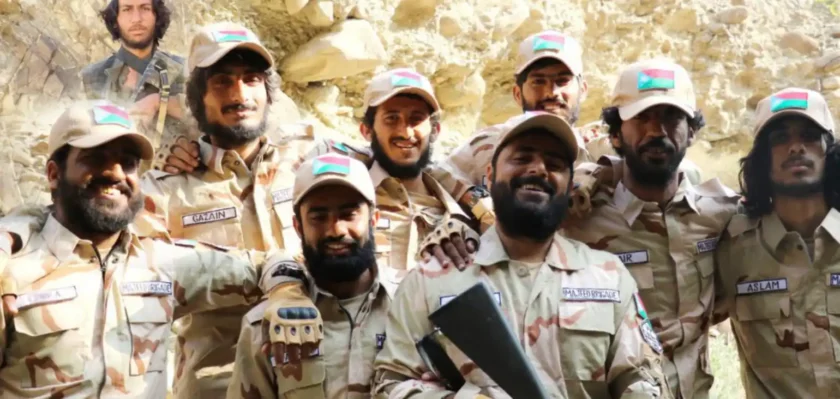
In modern political discourse, liberation is a rhetorical tool to achieve one’s aims. It reminds people of being freed from empires and evokes sympathy. For the same reason, some political entities misuse it; for example, in Pakistan’s Balochistan province, the Balochistan Liberation Army used the narrative of liberation to justify asymmetric warfare tactics.
However, BLA’s operational evolution reveals a divergence between its liberating rhetoric and terrorist activities. These violent activities included terrorist attacks on non-combatants, economic disruption and regional proxy dynamics.
This article argues that the prevailing characterization of the Balochistan Liberation Army (BLA) requires conceptual disaggregation. The article also argues that the BLA is often called a so-called separatist group, a label that describes what the group wants but not how it pursues it.
In the BLA operational framework, separatism is an aim, and terrorism is a method. Looking at what BLA has actually done rather than what it claims to want, the group meets the international threshold for a terrorist organization. So in 2006, the government of Pakistan formally proscribed the Balochistan Liberation Army as a terrorist organization. It is necessary to situate the organization’s framework within its historical and political origins.
Genesis and Historical Evolution: The Formation of the Balochistan Liberation Army
In early 2000, the armed separatist group known as the Balochistan Liberation Army emerged. The group’s ideology is based on ethno-nationalism rather than religious motivation. The Balochistan Liberation Army aims to target the Pakistani military and establish a Baloch state out of regions divided among three states. These include the Pakistani province of Balochistan, the Iranian province of Sistan and Baluchestan, and Afghanistan’s southern provinces of Nimruz, Helmand, and Kandahar.
Since the 2000s, the organization has grown more violent and well-equipped. Its attacks increased over the decade, especially after the killing of Nawab Akbar Bugti in a military operation in August 2006, which may be considered by Baloch as a turning point.
Moreover, in 2018, the BLA experienced an internal rift that split it into two operational factions: BLA-Azad and BLA-Jeeyand, led by Aslam Baloch and Bashir Zeb.
This showed a shift within the group, which mainly changed from guerrilla skirmishes towards suicide operations and urban terrorist cells.
Tactical execution vs Political Discourse
A legitimate movement of right and political struggles seeks dialogue with institutions to address the socio-economic grievances. In contrast, the BLA has consistently rejected the pathway of cooperation with the Pakistani government in terms of dialogue; instead, it chooses to enforce its agenda by intimidation and bloodshed of civilians.
The group’s operational framework shows an explicit shift toward soft-target intimidation. Instead of traditional guerrilla warfare with state security apparatuses, the BLA frequently carries out mass executions of non-combatants.
For instance, a prime example of this tactical execution is coordinated attacks across Balochistan, where gunmen offloaded passengers from buses, checked their national identity cards and executed non-Baloch workers in cold blood.
Targeting laborers based on their ethnic identity is not an act of political liberation; rather, it is ethnic profiling and terrorism.
The Majeed Brigade: The Weaponization of Extreme Asymmetric Terror
One of the prominent pieces of evidence that showed the BLA as a terrorist organization is its specialized elite wing: the Majeed Brigade. The Majeed Brigade was formed specifically to conduct fidayeen, suicide attacks on targeted areas. The Majeed Brigade directly adapted the tactics of Al-Qaeda and ISIS rather than traditional anti-colonial rights movements. The Majeed Brigades specialize in high-profile operations.
These included the subjugation of civilian infrastructure, such as the Quetta Railway Station attack, exploiting vulnerable youth through radicalization, and deploying educated young men and women as human bombs to escalate societal terror.
Moreover, the Majeed Brigade coordinated urban sieges for mass casualties and to instill panic among the residents. This showed that the adoption of suicide bombing and weaponizing human life to achieve political leverage destroys the term liberation in their name.
Global Consensus: International Rejection of the Balochistan Liberation Army
The global community also identifies the BLA as a violent entity. In addition, major international bodies and sovereign states have officially designated the BLA as a terrorist organization on empirical evidence of its operations.
Pakistan has officially proscribed the BLA under the Anti -Terrorism Act. United States designated the BLA as a Specially Designated Global Terrorist (SDGT) entity in 2019. Furthermore, the U.S. State Department designated the Majeed Brigade as a foreign terrorist organization while highlighting the Majeed Brigade’s specialized role in global terrorism.
| Country | Designation / Position toward BLA | Key Implication |
| Pakistan | Officially proscribed the BLA under the Anti-Terrorism Act. | Criminalizes the organization and enables legal action against its members, financing, and support networks. |
| United States | Designated the BLA as a Specially Designated Global Terrorist (SDGT) entity in 2019. The Majeed Brigade was designated as a Foreign Terrorist Organization (FTO). | Restricts financial activity and underscores the group’s involvement in terrorism beyond Pakistan’s borders. |
| United Kingdom & European Union | Listed the BLA as a terrorist organization, subjecting it to restrictions on financing and associated activities. | Limits the group’s ability to operate, raise funds, and pursue international advocacy through its networks. |
| China | Recognizes the BLA as a violent security threat to regional stability and the safety of Chinese engineers | Reinforces China’s security concerns regarding attacks on Chinese personnel and projects, particularly those linked to CPEC. |
Critical Analysis: Framing the Balochistan Liberation Army
In security studies, an armed group is determined by its self-proclaimed narrative and its operational conduct.
In a case study of the BLA, the BLA frames its campaign as ethno-nationalist resistance against state resource allocation and for self-determination. Through the title “Liberation Army”, the BLA seeks to claim moral legitimacy. However, in the contemporary international counter terrorism framework, an entity is identified by its tactics.
So, in the case of BLA tactics, there is systematic use of targeted assassinations and suicide bombing through Majeed Brigade. Thus, this tactical divergence differs from what its name suggests and what it has chosen for itself.
Transition from Guerrilla Skirmishes to Asymmetric Terror
The BLA’s evolution highlights a structural shift from guerrilla skirmishes to modern asymmetric warfare. From a historical background, Balochistan unrest was driven by tribal elders (Sardars) engaging in localized, low-intensity skirmishes with state authorities.
In the contemporary situation in Balochistan, operational command shifted toward radicalized, middle-class commanders who integrated suicide-bombing squads (fidayeen) into their strategy. Also, by weaponizing human bombs and intentionally targeting soft civilian targets, urban transport hubs, and foreign technical workers, the group crossed the threshold from political rebellion to violent non-state extremism.
Economic Sabotage and proxy dynamics in geopolitical framework
A critical evaluation of the group must look beyond domestic political discourse to examine its geopolitical role. The BLA’s targeted attacks on vital infrastructure, including power grids, rail networks, and China-Pakistan Economic Corridor (CPEC) projects, aim to isolate the region economically.
State security assessments and official dossiers emphasize that the organization acts as a foreign-backed proxy designed to impose strategic costs on Pakistan and deter foreign direct investment. Relying on external support networks, safe havens, and foreign intelligence sponsorship transforms the group from an indigenous political movement into a weaponized regional proxy.
Conclusion
A critical understanding demonstrates that methodology defines an organization, not its declared title. While the BLA uses the language of political separatism to build local sympathy and recruit, its operational reliance on civilian slaughter, suicide tactics, and economic sabotage firmly aligns it with violent non-state terrorism.
Political grievances can be addressed through constitutional mechanisms, socio-economic investment, and democratic integration; however, the deliberate targeting of non-combatants invalidates claims to legitimate political resistance.
This tactical reality explains why major international actors—including the United States, the United Kingdom, the European Union, and China officially proscribe the BLA as a designated terrorist organization.

Noor ul Sabha
Noorulsabha is a researcher in Strategic Studies and International Relations, with academic interests in South Asian security, strategic competition, India–Pakistan relations, India–China relations, and regional security dynamics. She holds an MPhil in Strategic Studies from the National Defence University, Islamabad. Currently a Research Intern with the India Program at the Institute of Regional Studies (IRS), Islamabad. Her research focuses on regional geopolitics, security studies, and the strategic implications of evolving great power and regional rivalries.