The movement, which is actually called Ansar Allah (انصار الله ) — roughly meaning “supporters of God” — emerged in the 1990s. It became known as the Houthis after its founder and leader, Hussein Badr al-Din al-Houthi. He criticized the Yemeni government of the time, the United States, and Saudi Arabia, and called for a Yemen free of foreign influence.
Clashes took place between his supporters and Yemeni security forces, and he was eventually killed by Yemeni troops in 2004. He was succeeded by his younger brother and current leader, Abdul-Malik al-Houthi. Among other things, his followers demanded greater autonomy in Saada Province near the border with Saudi Arabia, where their main stronghold was located.
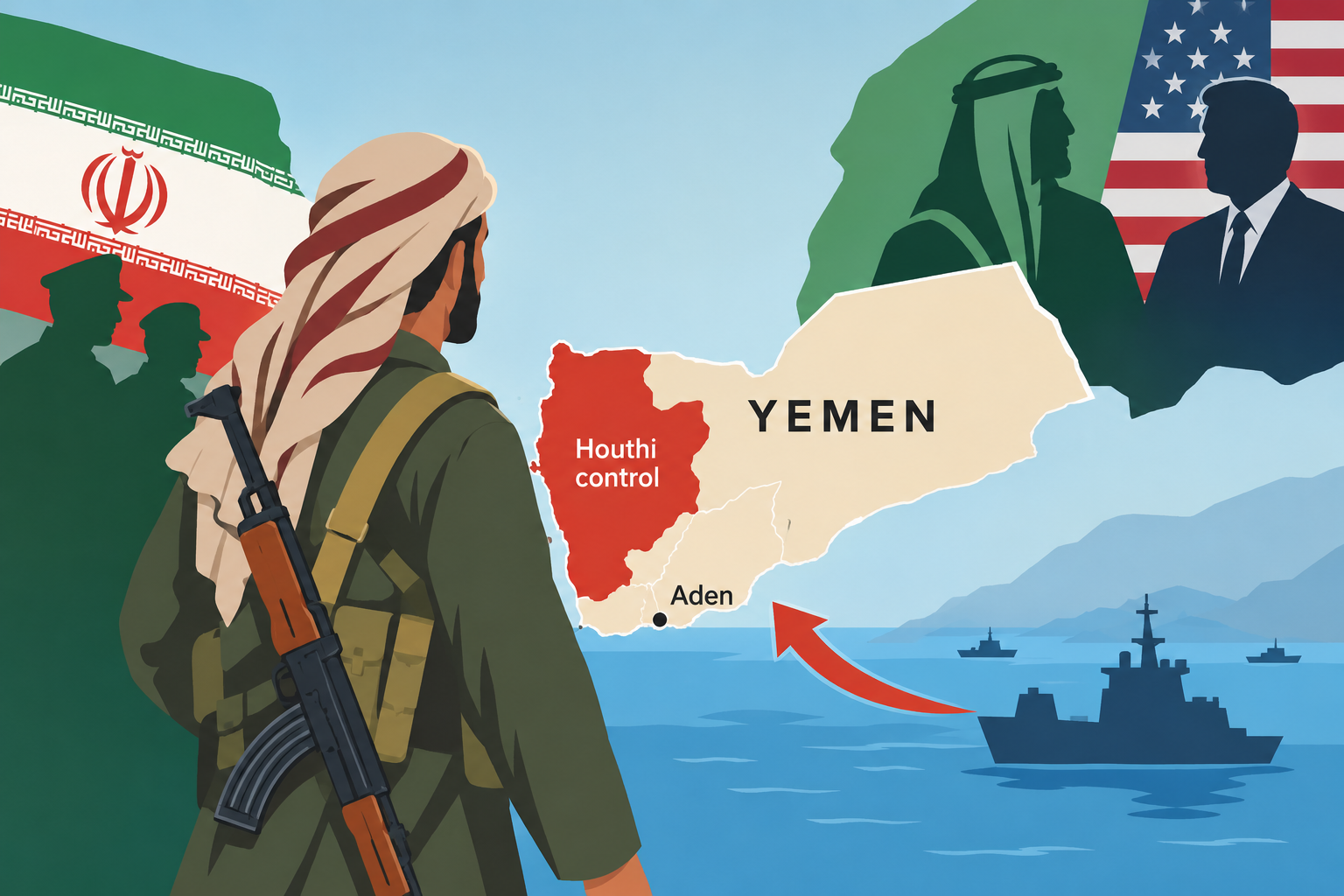
Iran also took notice of the movement’s growing influence and began supporting it. During the Arab Spring, the movement’s supporters launched an armed advance into other parts of the country. A coalition led by Saudi Arabia and the United Arab Emirates was formed against them. However, it failed to eliminate them.
On the contrary, the Houthis captured a large part of the country, including the capital, Sana’a. A rift developed between the Saudis and the Emiratis, and the UAE began supporting separatist movements in the south of the country.
In 2023, China brokered an agreement between Iran and Saudi Arabia under which Iran put pressure on the Houthis to stop advancing and attacking Saudi Arabia. This agreement remained in force until the most recent period.
It can therefore be said that this really is an independent movement with its own Yemeni project, which Iran supports and utilizes. The Houthis, in turn, use Iran to achieve their own objectives — it is mutually beneficial.
The Houthis would like to control the entire country. They have now effectively gained control of the entire Red Sea coastline. Fighting is taking place in Marib, Al Jawf, and Taiz. The Houthis launched a major offensive, which was partially slowed by Saudi bombing.
If they managed to conquer these provinces, they would then advance on Aden, the capital of southern Yemen, where the internationally recognized government is based. If Aden fell, they would have the country under their control. Achieving such an objective, however, will not be easy.
In Aden and some other parts of the south, separatist tendencies and efforts to break away from the northern part of the country are growing stronger. The Houthis are not particularly popular there.
Houthi Tactics
The Houthis are proceeding cautiously and are not taking major risks. Over years of warfare, they have learned a great deal and have developed military tactics of their own. They have managed to modernize and modify some older Soviet weapons.
The latest offensive was clearly planned and prepared well in advance. They launched it at a moment when nobody expected it. By occupying a large part of the coastline, they also cut government forces off from some of their foreign support. Marib Province is crucial for any further advance, and the Houthis are therefore currently focusing on it.
After gaining control of the south of the country, they were bombed by the Saudis. At that point, they disappeared and appeared to have withdrawn — in reality, however, they had merely gone into hiding. This is their tactic. They are now building tunnels and shelters in which they will be partially protected from further bombardment.
They have used this method in all the territories they have conquered: immediately after taking control, they fortified themselves and built shelters. If they are to be driven out of newly occupied territory, this must be done as quickly as possible. The longer they remain in an area, the more they will fortify it and strengthen their positions.
The Houthis’ advance was facilitated by many previous events. Following the overthrow of long-serving President Ali Abdullah Saleh in 2012, the country struggled to achieve stability. The Houthis therefore captured the capital two years later.
Internal divisions and conflicts emerged within government circles, which the Houthis exploited. In some areas, the government army had to fight extremists from al-Qaeda, the Islamic State, and other organizations. In the south, it also faced separatist groups. The army was therefore exhausted and weakened. The Houthis also received support from Iran.
Cooperation with Iran and Its Allies: The Regional Dimension
Although this is an independent Yemeni movement, it would have struggled to achieve such successes without Iranian support. Efforts to block weapons deliveries and control the country’s coastline so that the Houthis could no longer receive Iranian weapons ended in complete failure. Iranian instructors were also active there in addition to weapons supplies.
Training took place not only with the assistance of trained Iranian Revolutionary Guard fighters on Yemeni territory, but also in southern Lebanon and Iraq. Saudi media have in the past shown footage of Hezbollah instructors in Yemen who trained the Houthis and provided them with instructions.
Shortly before the beginning of the Houthi offensive, one Iranian aircraft after another was landing at the airport in the capital, Sana’a. Iran was evidently sending weapons to the Houthis and preparing them for the planned offensive. The Saudi air force therefore bombed Sana’a airport at that time in an attempt to prevent the aircraft from landing. The Houthis described the bombing as a violation of previous agreements and ceasefires and officially cited it as the reason for launching their offensive.
When the Houthis began attacking Saudi oil facilities and other installations, pro-Iranian groups in Iraq also joined in, and some attacks on Saudi Arabia were launched directly from Iraqi territory. It is therefore evident that, although each pro-Iranian regional movement has its own program and project, there is close cooperation, mutual support, and carefully planned coordination among them.
The attacks on Saudi Arabia also have a regional dimension. Saudi Arabia is the largest and strongest country in the region and therefore a significant player. If this country gives in, weakens its cooperation with the United States, or calls on the United States to withdraw its troops and close its military bases on Saudi territory, other states will very likely follow. In exchange for Iranian support, the Houthis are therefore helping Iran to build a strong position and exert pressure on the Saudis — and consequently on other countries in the region — to accept its terms.
Saudi Arabia has even accused the Houthis of attacking the holy city of Mecca. The Houthis strongly deny this, but it must be acknowledged that such an attack would make sense from their perspective. Symbolically, it would challenge the legitimacy of the Saudi ruling family and its sovereignty over the Muslim holy sites in Makkah and Medina.
This would be an extremely dangerous and risky step; the Houthis risk turning other Muslim countries against them and provoking the anger of the majority of Muslims. It would be as if they were indirectly saying: Saudi Arabia must either give in and accept an agreement on Iranian terms, or its legitimacy will be threatened.
A military solution is almost impossible for either side. The Houthis do not have the capacity to directly attack Saudi Arabia and threaten the ruling family. Saudi Arabia and other countries will have no interest in embarking on another dangerous adventure in Yemen, a country that nobody has yet managed to occupy successfully and where no one has ever truly prevailed. The only solution, therefore, will once again be negotiations between Iran and the Saudis.
And What About the Rest of the World?
The world is, as always, shocked, outraged, and who knows what else. World leaders are not sparing words of criticism or offers of solidarity. Yet after previous bitter experiences, nobody wants to enter the fight against the Houthis or even Iran.
Shortly after the beginning of the Houthi offensive, and during their advance along the Red Sea coast, representatives of the United States held talks with representatives of the Houthis at the U.S. Embassy in Muscat, Oman.
The Houthis accepted the American demands and promised not to attack American ships or targets. They even promised to leave Israeli ships and targets alone; which sounds absurd given their previous promises to destroy Israel.
They declared that their sole target was Saudi Arabia, paradoxically the heart of the Muslim world. The United States therefore decided not to become further involved.
Most major and minor players in the region and around the world have adopted a similar position toward the current situation, despite the fact that fuel prices, and consequently the prices of other commodities, are rising sharply. It is as though nobody knows what to do next and nobody has the appetite to do anything anymore.
For the United States and the Western world, this represents a complete loss of influence and position. Not only have they failed to protect their allies in the Gulf, but their military bases have become a problem and a burden for these countries.
Very few people are likely to take Italy’s statement that it is prepared to send warships to the Red Sea seriously. Similar words were previously spoken by Emmanuel Macron in connection with the Strait of Hormuz — yet French ships did not even approach the strait, apparently to make sure nothing happened to them.
The countries of the region are partly trying to find their own solutions. Egypt, Turkey, Oman, and other states are entering the picture and attempting to mediate negotiations with the Houthis as well as with Iran. In one way or another, negotiations will eventually have to take place.
China is once again entering the picture. Saudi Arabia and Qatar have asked China for assistance and for help in mediating negotiations. It appears that China may ultimately benefit the most from the entire situation, and future agreements and the new security architecture in the region will depend to a considerable extent on China.
The situation in the region will certainly become part of the meeting between Donald Trump and Xi Jinping in Washington on September 24. Whether a solution can be found and whether this meeting will produce conclusions that influence further developments in the region and the world remains a major question.
There is even speculation that Xi Jinping could cancel the trip and thereby send Trump a strong signal that the Chinese side is setting conditions: the United States must stop military support for Taiwan and cease imposing sanctions on countries and companies trading with Iran.
It is very difficult to predict whether Xi Jinping will actually cancel the trip and whether the talks with Donald Trump will be successful. What is certainly clear, however, is that we are witnessing major shifts in the global balance of power.
The old world as we knew it is gradually coming to an end, while the new one is still taking shape. This uncertain transitional period is causing upheaval and conflicts in various parts of the world, including the Strait of Hormuz and the Red Sea. Let us hope that a solution can be found and that the situation will at least partially calm down — although this certainly will not be easy.
This article was originally published in Czech at Asiaskop

Tomas Strnad
I'm citizen of the Czech Republic, fluent in 9 foreign languages, with long time experience in diplomacy, security and intelligence institutions as well as international business. I attach my CV as well just for your information.