Nearly five years since the Taliban retook Kabul in August 2021, the question of what, if anything, has changed under the movement’s rule remains unresolved.
In July 2025, Russia became the first country to formally recognize the Islamic Emirate of Afghanistan as its legitimate government, breaking the informal international consensus against recognition and reopening a debate that had appeared largely settled.
Yet the substantive benchmarks that Western and regional states once attached to recognition an inclusive, representative government, respect for the rights of women and girls, and credible action against groups such as the Tehreek-e-Taliban Pakistan (TTP) operating from Afghan soil remain largely unmet.
The gap between the Taliban’s expanding diplomatic footprint and its unchanged domestic governance is the central puzzle behind what has come to be called “Taliban 2.0.”
This shift matters directly for Pakistan. Islamabad has consistently argued that recognition, if it comes, should be a collective regional decision rather than a unilateral one, even as it maintains the most extensive on-the-ground engagement with Kabul of any neighbouring state. At the same time, Pakistan continues to bear the security cost of TTP sanctuaries that the Taliban has been unwilling or unable to dismantle. Russia’s move raises the possibility that other states, regional or otherwise, may follow, potentially without Kabul having addressed any of the concerns that originally justified withholding recognition.
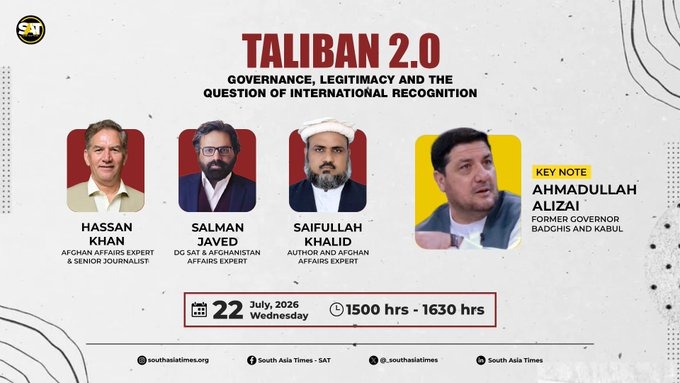
South Asia Times (SAT) has organized a webinar titled “Taliban 2.0: Governance, Legitimacy, and the Question of International Recognition” on 27 July 2026 to examine whether the Taliban’s rule has meaningfully evolved since 2021 or whether its diplomatic outreach amounts to rebranding without reform.
The discussion assessed the strategic implications of Russia’s recognition for the wider international consensus, what conditional engagement has actually achieved five years on, and how Pakistan should calibrate its own posture toward Kabul given its unresolved security concerns.
The discussion generated policy-relevant perspectives on how Pakistan and regional states should structure future engagement with the Taliban, whether the conditionality framework built around human rights and counterterrorism still has leverage, and what recognition or continued non-recognition would mean for regional stability going forward.