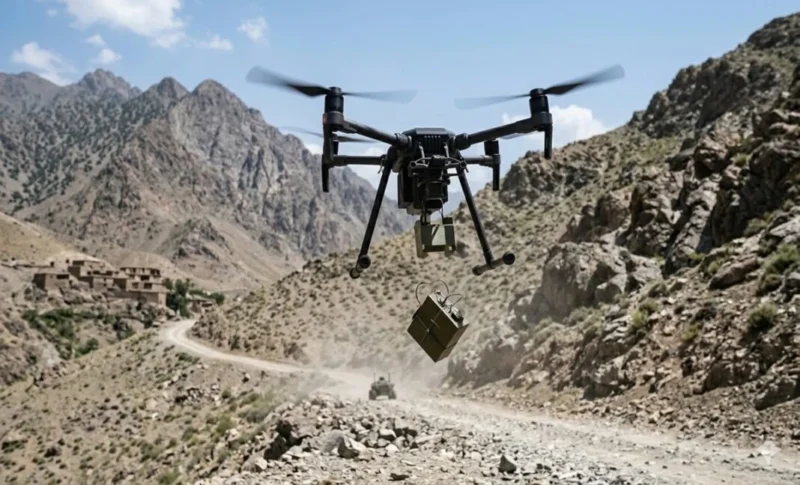
For decades, the dynamics of violence in Pakistan’s North-West rested on an obvious asymmetry. The state had aircraft, artillery, satellite surveillance and successive layers of intelligence networks, while the militants used concealment, ambush and the suicide vests.
Over the hills of Khyber Pakhtunkhwa, this asymmetry has now delicately turned upside down, not through a new weapon system, but through an off-the-shelf quadcopter that costs just a few hundred dollars.
The key shift is not merely that militants have learned to build drones, but that they are increasingly adapting them for asymmetric warfare. The reason is that a capability the state used to control, namely aerial surveillance, real-time observation and targeting assistance has become as cheap as a hobbyist’s gadget.
The numbers represent a real shift, not a temporary tactical trend. In December 2025, the Pakistan Army publicly reported about the Tehreek-e-Taliban Pakistan launching about 405 drone attacks during the year and KP Police reported that the province recorded some 246 drone attacks; Bannu district alone saw 215 quad copter attacks.
In January 2026, Bannu police documented twenty of such attacks in a single month, in which nine civilians were killed and nineteen policemen were injured. The province suffered more than sixty attacks in just two weeks by mid-July 2026, despite police reporting that it had blocked 341 attempts in the first six months of this year. This incident is not one of these gadget mishaps, but it is those campaigns that are being run sustainably.
Its most obvious manifestation was in Bannu on 9 May 2026, when a coalition under the name Ittehad-ul-Mujahideen Pakistan attacked a police compound with an estimated 1,200 to 1,500 kilograms of explosives in a vehicle bomb attack, before it was followed by quadcopter attacks and a ground assault led by over a hundred fighters that killed at least twenty one security personnel. The drone was just a weapon in a multi-faceted attack that included suicide bombings, small arms fire and planning by carefully coordinated infantry.
The rationale behind this shift lies in the changing economics of warfare. A commercial quadcopter retails for a couple of hundred dollars. While, defence against them requires ground-control infrastructure, radar and electro-optical sensors, jammers, anti-drone guns, forensic teams capable of examining captured drones and extracting intelligence, and trained personnel to operate these systems within an institutional framework designed to counter a platform that can be bought for the price of a toy.
To this end, KP Police set up Pakistan’s first UAV Division in March of 2025, created UAV ground control stations in all the districts of the province, equipped Peshawar and Bannu with anti-drone guns and counter-drone systems and opened an “Innovation Centre” in Nowshera for forensic analysis of the captured drones.
The fact that while this high-cost institutional development is happening, sixty new attacks in two weeks of mid-July 2026 depicts that the defender is spending too much while still unable to catch up with the attacker.
This threat is different from previous militant action in three ways. First, surveillance; where a drone can observe checkpoints, patrol schedules, convoys, before gunshots are fired and working as an intelligence-gathering device.
Secondly, the precision; because a bomb is indiscriminate and can kill anyone in close proximity whereas a drone can be used to identify and trace a specific target. Third, force protection: security forces are now having to protect themselves from ground, roadside and airborne threats; a point brought home by the Express Tribune’s reporting on mud, grass and makeshift roofing being used at Bannu and Mohmand checkpoints, while militants overhead are using thermal imagery and night vision.
Pakistan’s counterterrorism approach has increasingly incorporated a Counter-UAS philosophy, particularly in responding to the growing use of drones by militant groups. This approach emphasizes a sequence of “detect, identify, track, attribute, disrupt, and exploit.” Punjab has followed KP’s lead by setting up its own district anti-drone units. In May 2026, the Ministry of Defence Production brought together private manufacturers to promote the development of a domestic unmanned-systems manufacturing sector.
In parallel, companies such as Woot-Tech Aerospace, Sysverve Aerospace and the new aerospace division of Alsons Group have begun developing locally produced systems, including loitering munitions, interceptor drones and engines, reducing reliance on foreign components. TWTD Heavy Industries announced the P-905 counter-drone system based on the interceptor in July 2026. This is a serious and rational institutional response but it is also, by definition, far more expensive than the threat to which it is designed to respond.
The Afghan dimension adds another layer to the analysis, because the conventional “militant sanctuary” explanation alone does not fully explain the evolving drone threat. Afghanistan’s evolving security environment now involves three-way dynamics among the Taliban government, the TTP and its cadres, and Islamic State-Khorasan Province (ISKP), with implications for the increasingly contested aerial and drone environment of the country. Afghan troops claimed to have attacked Pakistani military posts and shot down Pakistani drone aircraft in retaliation to a Pakistani raid on TTP leader Noor Wali Mehsud and the Taliban’s cross-border strike in Kabul in February 2026, shortly after the outbreak of the war in October 2025.
The Pak Army claimed to have shot down four drones from the Afghan Taliban, which were fired into Balochistan province by July.
After drones and suicide bombers, Taliban have little in the way of meaningful power to fly, one security analyst in the United States summed up their situation simply: “One of the poor men’s air forces of the Taliban is the drone, along with its own familiarity with the terrain and the suicide bomber.”
In other words, Afghanistan is not merely the geography from which Pakistan’s militant drone threat emerges; it is itself an active arena of conflict in which multiple militant and state actors operate.
Islamic State-Khorasan brings an additional, more complex dimension to this landscape. While the TTP’s primary objective remains the overthrow of the Pakistani state, ISKP has a documented record of indiscriminate and high-profile attacks against the Pakistani Taliban and has also threatened the Afghan Taliban.
These overlapping conflicts contribute to what can be described as a “regional drone ecosystem” i.e. an environment in which simple, low-cost drone technology can move across civilian, law-enforcement, militant and state applications. The same basic quadcopter can therefore serve as an agricultural tool, a police surveillance platform, a militant weapon, or a component of interstate military competition.
This arms race is not necessarily drone-versus-drone; it is an iterative process of militants getting hold of commercial platforms, the state deploying jammers and interceptors, the militants adapting their methods and sourcing and the state improving its sensors.
As Pakistan’s rupee weakens and the cost of imports rises, defence-sector analysts have increasingly drawn parallels with Ukraine’s experience, strengthening the case for greater reliance on domestic defence production in Pakistan.
The state, as a unit retains far greater resources and conventional defence capabilities, but its response involves higher costs associated with procurement, training, regulation and institutional coordination.
All of the above exist at a much lower cost to the militant networks; commercial availability, adaptability, deniability and low unit cost. A state can never outspend its opponent who can spend less than the price of an interceptor system.
That is what Pakistan should avoid doing: using every new militant drone as an excuse to purchase a more expensive countermeasure instead, rather than layered, modular and low-cost defenses that can take repeated attacks without ruining the response.
The answer is not to restrict drones as a technology, given their legitimate civilian and economic uses, but to strengthen Pakistan’s ability to detect, attribute and counter malicious drone activity while protecting civilian use.
This requires better detection systems, layered counter-drone capabilities, clearer regulation and continued development of domestic drone technology. The objective should not be to match every drone with another drone, but to ensure that low-cost systems cannot impose disproportionate security costs.

Muti Ur Rehman
Muti Ur Rehman is a Research Intern at the Islamabad Policy Research Institute (IPRI) and an MPhil Scholar in Strategic Studies inNational Defence University, Islamabad. His research interests focus onemerging technologies and their implications for strategic security, withparticular emphasis on artificial intelligence, nuclear deterrence,cognitive warfare and strategic stability in South Asia. His work examineshow technological developments are reshaping deterrence, information environments, decision-making and the evolving security dynamics of theregion.