Between 1 and 27 November 2026, a diversity has emerged in the operations of resistance groups against the Taliban in various parts of Afghanistan. Compared with last month, October, the number of operations appears relatively lower, but the trend is very clear: the resistance groups are now focusing on quality rather than quantity. Their targets are becoming larger and more consequential, and they are returning successfully even after targeting places of major strategic importance. Attacks for two consecutive days in Kandahar near Mullah Haibatullah’s palaces and on Haibatullah’s special force, the killing of a senior GDI officer, and continuous attacks on corps headquarters and military installations are enough to prove that the resistance against the Taliban is gaining strength. In terms of numbers, results, the importance of targets and expansion across territory, it is a calculated movement advancing faster than a normal pace.
Impact of the Resistance on the Taliban:
Fear in the Taliban’s behavior, rapid changes in the structure of the government, and Mullah Haibatullah coming out of his place of refuge to consolidate his religious standing and to reshuffle his ranks — all of these are an indication that the resistance has made them lose their wits, because of which they are compelled to change their strategy as well as to replace their pawns. The first indication is that, for the first time, Haibatullah has offered the resistance leadership a place in the government. In his address in Kabul on 17 November, Haibatullah said, “Those sitting outside, come and become part of the government.” Although the resistance leadership has rejected this offer, this offer from Haibatullah, who until yesterday called his government alone the representative of all Afghans, shows that his nerves are giving way. Seeing power slipping from their hands, they are turning to the path of sharing it.
The second major sign of the resistance’s success is that pawns are being replaced. Previously, the head of Haibatullah’s special force and the police chief of Kandahar was one and the same person, Mullah Abdul Wahid Talib, who is distinguished by being one of the old, experienced men of the Taliban and is also a member of al-Qaeda’s shura. Now, after the resistance became stronger in Kandahar, Mullah Haibatullah has removed Abdul Wahid Talib from the post of police chief of Kandahar and kept him only as the head of the Haibatullah Force, so that he can focus with greater single-mindedness on Haibatullah’s security.
2. The Basic Picture of the Figures
Looking at the figures, 53 attacks were recorded in 27 days. This comes to roughly two attacks per day on average, but the reality is somewhat larger than this. Of these 27 days, 16 days were such that only one attack took place, on two days (15 and 22 November) no report came in, and only four days (5, 7, 10 and 23 November) were such that four or more attacks took place. On these four days, 24 attacks took place, that is, 45 percent of the total, and they included a claim of 37 killed, that is, about 43 percent of the total. In other words, the resistance’s activity is not proceeding at a uniform pace but is concentrated into a few coordinated days, when one organization, especially AUF or NIF, carries out operations in several provinces at once and releases them in a single report.
| Measure | Result |
| Total attacks | 53 |
| Affected provinces | 21 |
| Taliban killed | 87 |
| Wounded | 20 |
| Attacks without casualties | 12 (23%) |
| Days on which no attack took place | 2 (15 and 22 November) |
| Daily average | About 2 attacks, 3.2 killed |
Another important figure is that in 12 of the 53 attacks, that is, 23 percent, there were no fatalities. Most of these were rockets at corps headquarters, bombs on vehicles and fire on posts. This shows the difference between the capacity to carry out an attack and the capacity to inflict damage. Even though the casualties are not confirmed, these attacks are more effective and larger in significance, because they directly challenge the Taliban’s strength and target their centers of power, which is increasing the fear of the ruling power.
3. The Evolution of the Month: Four Weeks, Four Different Colors
| Period | Days | Attacks | Killed | Attacks per day | Killed per day |
| 1 to 7 November | 7 | 17 | 18 | 2.4 | 2.6 |
| 8 to 14 November | 7 | 18 | 32 | 2.6 | 4.6 |
| 15 to 21 November | 7 | 9 | 15 | 1.3 | 2.1 |
| 22 to 27 November | 6 | 9 | 22 | 1.5 | 3.7 |
The first week (1 to 7 November) was a week of introductory and widespread activity. More than half of the 17 attacks were against specific individuals, especially in Arghandab district of Kandahar, where AUF targeted one official each time, three times during the week. In the same week, rockets were fired at the Herat (207 Al-Farooq Corps) and Kandahar corps headquarters, but there was no loss of life in either, as if the aim were merely to prove presence. The greatest loss came on the very first day in Badakhshan, where in a rocket attack on the convoy of an official of the Ministry of Mines, 6 guards were killed and 5 wounded. On 5 and 7 November, AUF and other organizations carried out four and five attacks in a single day, showing that they can be active in several provinces simultaneously.
The second week (8 to 14 November) was the most intense: 18 attacks and a claim of 32 killed, that is, 4.6 killed per day. The center of this week was 10 November, when 10 attacks took place in a single day and a claim of 18 killed emerged. This included AUF’s operations in five provinces (Ghor, Kabul, Ghazni, Jawzjan, Sar-e-Pul), the killing of two alleged spies in Ghor, an attack on a post in Nimroz (4 killed, 7 wounded), the killing of a granite mine official in Bamyan, and the recovery of 7 bodies in the Shaba Valley of Panjshir. At the end of the week, on 14 November, three attacks took place in Kapisa, Kabul (Qara Bagh) and Lashkar Gah. After that, no report came in on 15 November, which seems like a silence following the intensity of this week.
The third week (15 to 21 November) was the lowest in the number of attacks (9) but the most important in terms of targets. On 17 November, a patrol party was fired upon near the Arg in Kabul; on 18 November, the deputy of the GDI’s counterintelligence wing and his two guards were killed in Paghman; on 19 November, in an attack on the camp of Haibatullah’s special guard unit in Mandigak (Haibatullah’s palace) in Kandahar, 4 personnel were killed; and on 21 November, rockets were fired at a post in Sarai Mullah (Haibatullah’s headquarters) in Kandahar. This week shows that, despite the reduced quantity, the resistance has tried to change the quality and has struck the head of the snake.
The fourth week (22 to 27 November) is still ongoing. There was no report on 22 November, then on 23 November five attacks took place in a single day: four operations in Sar-e-Pul, Faryab, Ghor and Paktia, and the major claim at Band-e-Amir in Bamyan. On 24 November, a training center in Tagab, Kapisa; on 25 November, a security post in Sayyid Karam, Paktia (4 killed); on 26 November, the camp of the 217 Omari Corps in Baghlan (4 killed); and on the morning of 27 November, the killing of a member of the staff of the Chief of Staff of the Ministry of Defense in Kabul. The number of attacks is lower than in the second week, but the death rate (3.7 per day) is better than that of the third week, which indicates that the attacks are now becoming relatively larger.
Looking at these four weeks together, no simple trend over time emerges, that is, it cannot be said that activity is continuously increasing or decreasing. It is more accurate to say that there are fluctuations in numbers, but a change is coming in the level of targets and the style of operations: ordinary personnel and corps in the first week, expansion in the second week, high-level targets in the third week, and in the fourth week a diversity of targets from Kabul to Baghlan.
4. The Organizations: Who Is Doing What
| Organization | Attacks | Share | Killed (claimed) | Wounded | Killed per attack |
| AUF | 21 | 40% | 20 | 6 | 0.95 |
| NIF | 17 | 32% | 44 | 5 | 2.6 |
| NIFAF | 6 | 11% | 5 | 7 | 0.8 |
| AFF | 3 | 6% | 5 | 2 | 1.7 |
| Green Unit | 3 | 6% | 2 | – | 0.7 |
| Responsibility not claimed | 2 | 4% | 8 | – | 4.0 |
| ANLF | 1 | 2% | 3 | – | 3.0 |
| Total | 53 | 100% | 87 | 20 | 1.6 |
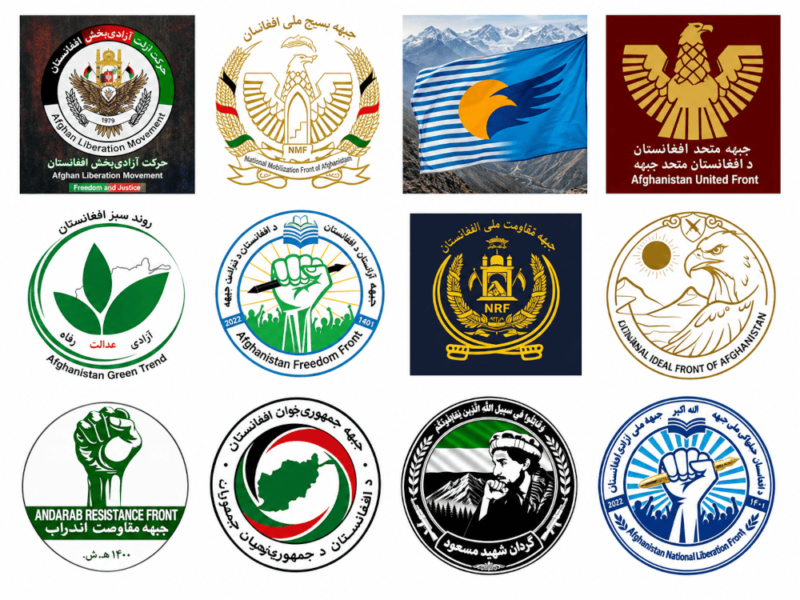
The Afghanistan United Front leads in the number of attacks: 21 attacks, a 40 percent share, and a presence in 10 provinces (Kandahar, Ghor, Zabul, Helmand, Logar, Sar-e-Pul, Parwan, Ghazni, Jawzjan, Kabul). Its style is the most distinct: almost every attack is based on the killing of a specific individual, and the number killed per attack is less than one. This organization carries out continuous small operations rather than large explosions, and often releases them in the form of a cumulative 24-hour report containing the names of several provinces. The reports of 5 and 10 November are the best examples of this. Its greatest success is the killing of the GDI counterintelligence deputy in Paghman on 18 November. Arghandab district of Kandahar remained its permanent target, where four attacks took place during the month.
NIF (Jabha-e-Milli-e-Istiqlal) is second in the number of attacks (17) but first in claimed fatalities (44, that is, half of the total). Its strategy differs from that of AUF: fewer attacks, but large and symbolic targets. Examples are: a rocket attack on the convoy of the Ministry of Mines (6 guards killed), an attack on the camp of Haibatullah’s special guards in Kandahar (4 killed), Sarai Mullah, the attack on Band-e-Amir, the tourist site in Bamyan, and a rocket attack on the camp of the 217 Corps in Baghlan.
NIFAF (Jabha-e-Arman-e-Milli) carried out 6 attacks, of which 4 resulted in no casualties (Herat 207 Corps, Marjah in Helmand, Lashkar Gah 215 Corps, near the Arg in Kabul). This organization targets corps headquarters and convoys with rockets and fire, that is, its work is more about pressure and message than damage. Its only major operation was in Chahar Burjak, Nimroz, on 10 November (4 killed, 7 wounded). On 17 November, a claim of a “clash” nears the Arg (Presidential Palace).
AFF (Afghanistan Freedom Front) has three operations: Kapisa (3 killed), Qara Bagh in Kabul (1 killed, 2 wounded) and Pech Dara in Kunar (1 killed). All three are in its traditional areas and all three are confirmed. Its share in your data is small.
The Green Unit, ANLF and the unclaimed incidents play secondary roles, but there are important points in them. The attribution of one of the Green Unit’s 3 claims (Kabul, 10 November) turned out to be wrong, one (Bamyan, 16 November, a claim by the Green Trend) was a local disturbance, but the killing on 27 November of a member of the staff of the Chief of Staff of the Ministry of Defense is confirmed and important. ANLF carried out a major clash (3 killed) in Laghman on 4 November and then was not seen again. The two incidents without a claim of responsibility (the killing of a close associate of Sirajuddin Haqqani in Baghlan and the recovery of 7 bodies in Panjshir) together make 8 fatalities, and the average per attack is 4, that is, the highest. Who is behind these two incidents is not known; they could be resistance groups, internal disputes within the Taliban, or local enmities.
At the organizational level, three basic conclusions emerge from this month. First, the resistance is not a single movement but a collection of several groups that make claims that are separate from one another and at times contradictory. Second, each group has built a particular identity of its own: AUF continuous targeted killings, NIF large symbolic attacks, NIFAF rockets and pressure, AFF posts in traditional areas. Third, two claims over a single incident and the difference in the attribution of the 23 November operation (NIF in your data, whereas AUF in the public report of Kabul Tribune) show that communication and coordination among the groups are weak. Afghanistan International, too, in its October report, had mentioned division and a lack of coordination.
5. Geography: The Map of the Provinces
The attacks took place in 21 provinces, but their distribution is not uniform. Below is the picture first by region and then of the most affected provinces.
| Region | Provinces | Attacks | Killed |
| South | Kandahar, Helmand, Zabul, Nimroz | 14 | 23 |
| Kabul and surroundings | Kabul, Parwan, Kapisa, Logar, Laghman | 13 | 16 |
| West and center | Ghor, Herat, Bamyan, Ghazni | 13 | 21 |
| North and northeast | Badakhshan, Baghlan, Panjshir, Sar-e-Pul, Jawzjan, Faryab, Kunar | 11 | 23 |
| Southeast | Paktia | 2 | 4 |
| Total | 21 provinces | 53 | 87 |
| Province | Attacks | Killed | Notable incident |
| Kabul | 8 | 7 | Killing of the GDI deputy (Paghman), fire near the Arg |
| Kandahar | 7 | 13 | Sarai Mullah, camp of Haibatullah’s guards, Arghandab |
| Ghor | 6 | 6 | Police, head of the Vice and Virtue department, two “spies” |
| Sar-e-Pul, Zabul, Helmand, Ghazni | 3 each | 2, 6, 0, 2 | In Zabul, 4 according to the source |
| Bamyan | 2 | 10 | Band-e-Amir (source: 4 to 5) |
| Badakhshan, Baghlan | 2 each | 6, 5 | Ministry of Mines convoy; 217 Corps |
| Panjshir | 1 | 7 | No one claimed responsibility |
The capital, Kabul, was the center of the most attacks this month, and the character of these eight attacks is completely different from clashes in rural areas. Here there was neither an attempt at seizing territory nor prolonged fighting, but operations such as safe houses of intelligence officers, personnel of Security Districts 5, 11 and 17, and killings at home. This gives an idea of the presence of urban networks that can move around inside the city. In Kandahar the number of attacks is low (7) but the claimed fatalities are the highest (13), which is the result of the focus on the center of leadership. Ghor is the province where continuity in the attacks is most prominent: six times in the month, in four different districts, and almost every time a local police official or a religious police official was targeted. This area generally remains far from national attention, so such continuous activity here is meaningful. In Helmand there were no fatalities in three attacks, that is, in the Taliban’s traditional stronghold the resistance’s presence is at the symbolic level. In Bamyan and Panjshir the numbers are low but the claims of fatalities are large, and in both there is a problem of confirmation.
At the level of regions, there are claims of 23 and 23 fatalities in both the south and the north, which shows that the resistance is not confined to any one region, but the role of the two is different: in the south, an attempt to send a message to the leadership, and in the north, large but fewer claims.
6. New Fronts: Where the Resistance Appeared for the First Time
Four provinces appear to be new in November: Nimroz, Laghman, Jawzjan and Faryab. Nimroz is the most important. The attack in Chahar Burjak on 10 November (4 killed, 7 wounded) is the one with the most wounded in a single incident and points to a new front in the border area of the southwest. In Laghman, for the first time a new group, ANLF, claimed a clash at a post on 4 November. In Jawzjan and Faryab, one operation each by AUF is an indication of its expansion in the northwest, although drawing the conclusion of a strong network from a single operation is premature. Bamyan is not new, but there two more incidents took place in November after the end of October, including the attack on the tourist site of Band-e-Amir, and this province, which is considered relatively calm in terms of resistance, is now repeatedly in the news.
According to ACLED, clashes were recorded in at least 28 provinces from January to October (14 in the same period last year), that is, the trend of expansion was already under way.
7. Big Names: Who Was Killed, Who Survived
| Date | Name / Position | Location | Organization | Outcome |
| 1 November | Maulvi Abdul Mutaeen Saeed, survey assistant at the Ministry of Mines | Badakhshan | NIF | Safe; 6 guards killed |
| 7 November | Qari Tur Jan alias Tayyab Badri, close associate and guard of Sirajuddin Haqqani | Baghlan | Unknown | Killed |
| 7 November | Qari Zabih Irfan, intelligence officer | Kabul | NIF | Killed |
| 18 November | Ruhullah Samim, deputy of the GDI counterintelligence wing, and 2 guards | Kabul (Paghman) | AUF | All three killed |
| 19 November | 4 personnel of Haibatullah’s special guard unit | Kandahar | NIF | Killed |
| 23 November | District head of Vice and Virtue; intelligence official | Ghor; Sar-e-Pul | NIF | Killed |
| 27 November | Qari Fazaluddin, member of the staff of Chief of Staff Fasihuddin Fitrat | Kabul | Green Unit | Killed |
The biggest name among these incidents is that of Ruhullah Samim, who was the deputy of the GDI’s counterintelligence wing. His killing is special in that the target is the very institution whose job is to act against the resistance. If the attackers knew the movements of such an officer, this raises a serious question about the Taliban’s internal secrecy. The other names are small in terms of rank, but their importance lies in the fact that they were close to the Taliban’s highest circles: Sirajuddin Haqqani’s personal guard, Haibatullah’s special guards, the Chief of Staff’s staff. Access to three different powerful circles appears to be the result not of a single group but of several networks. On the other hand, it is also a fact that in November no minister, corps commander or provincial governor was killed, and in the convoy on 1 November the real target survived. That is, the resistance’s reach has grown but the upper leadership has so far remained safe.
8. Strategic Targets and the Nature of the Attacks
| Nature | Number | Share |
| Targeted killing of specific individuals | About 23 | 43% |
| Attack on a post, outpost or camp | About 17 | 32% |
| Convoy or vehicle | 7 | 13% |
| Rockets at corps headquarters | 3 | 6% |
| Other (safe house, patrol party, Panjshir) | 3 | 6% |
The selection of targets appears planned and falls into four circles. The first circle is that of leadership and symbolic centers: Sarai Mullah in Kandahar (described as Mullah Omar’s house and a high-security zone), the camp of Haibatullah’s guards in Mandigak, and the patrol party near the Arg in Kabul. Here the aim is less about damage than about showing that even the Taliban’s center is not safe. The second circle is that of the military structure: the 207 Al-Farooq Corps in Herat, the Kandahar Corps, the 215 Corps in Lashkar Gah and the 217 Omari Corps in Baghlan. There were no fatalities in the first three attacks, but the 26 November attack in Baghlan is confirmed with 4 fatalities, which means that the impact of rocket attacks may increase. The third circle is that of intelligence, which the most consistent target remained: Security Districts 5, 11 and 17 of Kabul, the intelligence vehicle in Ghazni, Jawzjan, Sar-e-Pul and Sar-e-Pul’s personnel. The fourth circle is that of supply and the economy: three fuel tankers of the Ministry of Defense were burned in Ghazni, the Ranger vehicle of the 219 Brigade was targeted in Badakhshan, and the granite mine in Bamyan and the convoy of the Ministry of Mines were attacked. This last point is important, because minerals are a source of the Taliban’s income. The attack on a tourist site like Band-e-Amir raises a separate question: the identity of those killed there (Taliban personnel or ordinary people) require independent verification.
The weapons include rockets, magnetic landmines (Ghazni), explosives (Paktia), hand grenades (Kabul and Kapisa), heavy weapons and pistols. These are all relatively low-cost and easily obtainable means, which enable even a small cell to carry out an operation.
10. Effects on the Taliban
The deepest effect is in the field of intelligence. Access to information such as the addresses of safe houses, the homes of officers, the number of their guards and their movements indicates that the resistance is receiving information from inside the Taliban or from people around them. For the Taliban this is not merely the loss from one attack but a crisis of trust, because every colleague begins to look like a potential informant. The second effect is on security arrangements: when Sirajuddin Haqqani’s associate, Haibatullah’s guards and the staff of the Ministry of Defense are targeted, the leadership has to increase its security, which draws resources toward Kabul and Kandahar and makes lower-level personnel in smaller provinces more vulnerable. The repeated killing of police personnel in Ghor is a sign of this very weakness. The third effect is psychological: fear, shirking of duty or a tendency to resign may arise among lower-level police and intelligence personnel, and questions may arise among the local population about the Taliban’s grip. At the military level the threat is still limited: no district or city has been permanently lost, and the seizure of the post in Sar-e-Pul was temporary. There is also an economic aspect, because mineral convoys and fuel transport were targeted. The Taliban publicly call these groups “mischief and corruption” and downplay the importance of the attacks; according to some reports they also accuse Pakistan of sheltering these groups, for which there is no evidence in your data. According to a public report, on 17 November Haibatullah offered posts to the opposition; this could be a sign of political flexibility under pressure. In response, a harsh crackdown, arrests, a purge of intelligence and local recruitment are expected, which also increases the risk of pressure on the general population.
11. Future Prospects
| Scenario | Likelihood | What will happen |
| Continuation of targeted operations | High | 1 to 3 small attacks daily, in Kabul, Kandahar, Ghor, Ghazni and Sar-e-Pul; a few symbolic incidents each month |
| Harsh Taliban response | Medium to high | Searches, arrests, reshuffles in intelligence; attacks fewer in the short term, but local resentment increases |
| Increase in coordination and intensity | Medium | Joint operations, consolidation in new provinces (Nimroz, Laghman, Jawzjan), more days like 10 November |
| Internal disarray among the groups | Low to medium | Multiple claims over a single incident, wrong attributions, exaggeration; damage to credibility |
The weather will also play a role. In winter, operations generally decrease in the northern mountainous areas (Badakhshan, Panjshir, Nuristan), while targeted killings may continue in urban and southern areas. This is a historical trend; confirmation of it this year will come in the next few weeks. There are risks for the resistance groups as well: harm to ordinary civilians (at a place like Band-e-Amir), extrajudicial killings on the allegation of “spying” (Ghor) and exaggerated claims can weaken their credibility and public support. The important indicators to watch over the next 4 to 6 weeks are: attacks on more senior officers of the GDI or the Ministry of Defense, renewed attacks in Nimroz, Laghman, Jawzjan and Faryab, security measures or changes of personnel in Kabul and Kandahar, attacks in more than five provinces on a single day, and reports of cracks or defections within the Taliban are also possible.
12. Conclusion
In the first 27 days of November, the resistance operations were nationwide but of low intensity, and their real strength appeared not in numbers but in the selection of targets. Of the 53 attacks, about half were against individuals linked to intelligence, the police and the leadership. The direction of the month appears to be moving from quantity to quality: corps and ordinary personnel in the first weeks, the GDI deputy, Haibatullah’s guards and the Ministry of Defense staff in the last weeks. For the Taliban the immediate threat is not of military defeat but of internal security, secrecy and trust. On the other hand, the weaknesses of the resistance are also clear: a lack of coordination among the groups, exaggeration in claims (three big NIF claims were reduced by half), 23 percent of attacks being without result, and the top leadership remaining safe so far. In the coming weeks it will have to be seen whether this series becomes an organized campaign or whether the Taliban’s response suppresses it.
Saifullah Khalid
A senior journalist, editor, security analyst, and columnist with 35 years of experience. Since 2001, he has extensively covered political and strategic developments in Afghanistan and Central Asia since 1991. He has authored 4 books , 2 on Afghanistan. In 1994, he authored a book on Afghanistan titled Main Ne Kabul Jaltay Dekha (I Saw Kabul Burning), and in July 2026, he published his book Taliban Ka Asli Chehra (The Real Face of the Taliban) in Urdu.