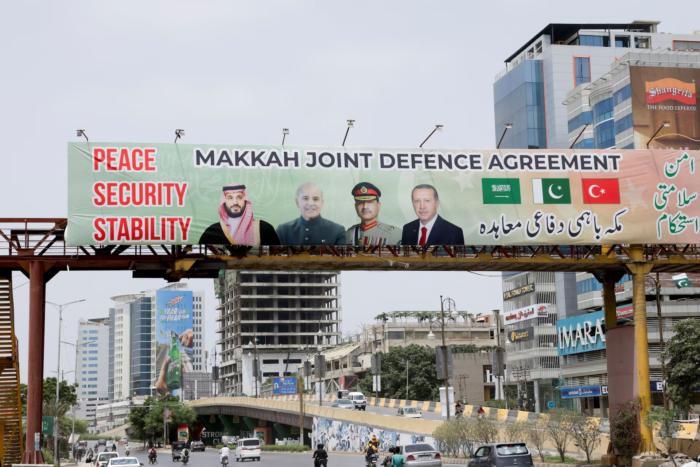
The foreign and defense ministers of Pakistan, Saudi Arabia and Turkiye will meet in Islamabad to discuss the practical implications of their collective defense commitment in the face of continuing political and military instability around Saudi Arabia.
Pakistan’s Defense Minister, Khawaja Asif told foreign media that the officials from three member countries will discuss the conflict between Saudi Arabia and Houthi fighters in Yemen.
“Continuous turmoil south of Saudi Arabia will obviously be one agenda point in the meeting and it is very important” he said. At the same time the Pakistani Defense Minister also said, “The possibility of some conflict, or aggression from the Israeli side exists, so we need to close our ranks, the countries of this region,” Khawaja Asif said.
In such a situation what does the Makkah Defense Agreement mean for regional security. And how can the three countries translate their political commitments into practical mechanisms for collective defense?
The agreement has been described by Foreign Minister, Ishaq Dar as defensive and not confrontational. Its collective defense provisions are significantly important: Attack on one member state will be considered an attack on all member states.
Then in its last meeting at Istanbul, the three member countries agreed to set up a permanent secretariat for an appointment of a Pakistani military official as Secretary General of the pact. In this way it became clear that the agreement was fast acquiring institutional foundation through regular diplomatic, political and military consultations.
Pakistani officials have indicated that in today’s meeting instability around Saudi Arabia would be discussed. Saudi installations and cities have been under attack from Houthi militia for quite some time now.
It appears from official assertions that the member countries of the Makkah Defense Agreement have already decided what will be the shape of practical collective defense arrangement.
It seems clear that collective defense arrangement clearly provides for defending Saudi Arabia against aggression, but it doesn’t provide for crossing Yemen’s international border or for intervening in Yemen.
Khawaja Asif’s statement about the threat of Israeli aggression is significant and it provides an opportunity for discussing why regional countries are so concerned about collective security.
In the past senior Pakistani officials have been issuing statements that described the Makkah Agreement as a response to the evolving security situation in the region. The three member-states have expressed commitments to collective deterrence, de-escalation, restraint and peaceful resolution of crises.
The real test or importance of the Pact will become visible after a clear picture of how practical arrangements for consultation, military coordination, deterrence and crisis management will emerge on the scene.
In the August 31st Joint statement, the three member states have also already committed to defense industry cooperation, joint development of military technology and other types of joint institutional development.
The question is whether these commitments will translate into permanent regional defense mechanisms while the three countries preserve the concept of sovereignty and international law.

Your go-to editorial hub for policy perspectives and informed analysis on pressing regional and global issues.