International human rights reporting derives its authority from independence, methodological rigor, and a willingness to interrogate all sides of a conflict equally. That credibility weakens when access constraints, political realities, and armed actors shape what can be documented, and, more importantly, what remains invisible.
This challenge has become increasingly apparent in reporting on the Afghanistan-Pakistan conflict.
Over the past year, a noticeable pattern has emerged. Casualty assessments produced by the United Nations Assistance Mission in Afghanistan (UNAMA) have become the principal evidentiary foundation for reports issued by Amnesty International, Human Rights Watch, and numerous international media outlets.
The figures themselves are not inherently questionable. The concern lies elsewhere. They are generated within an environment where independent verification is severely restricted and where access to affected areas is largely mediated by Afghanistan’s de facto Taliban authorities.
When one constrained source gradually becomes the common reference point for an entire ecosystem of reporting, methodological caution should increase, not diminish.
Yet the opposite appears to be happening.
The international narrative has become increasingly focused on civilian casualties resulting from Pakistan’s cross-border counterterrorism operations, while paying comparatively little attention to the security environment that produced those operations in the first place.
The result is an incomplete account of a conflict involving multiple armed actors, cross-border militant networks, and a civilian population caught between them. That omission matters.
Pakistan experienced one of its deadliest years in recent history as terrorist violence surged following the Taliban’s return to power in Afghanistan.
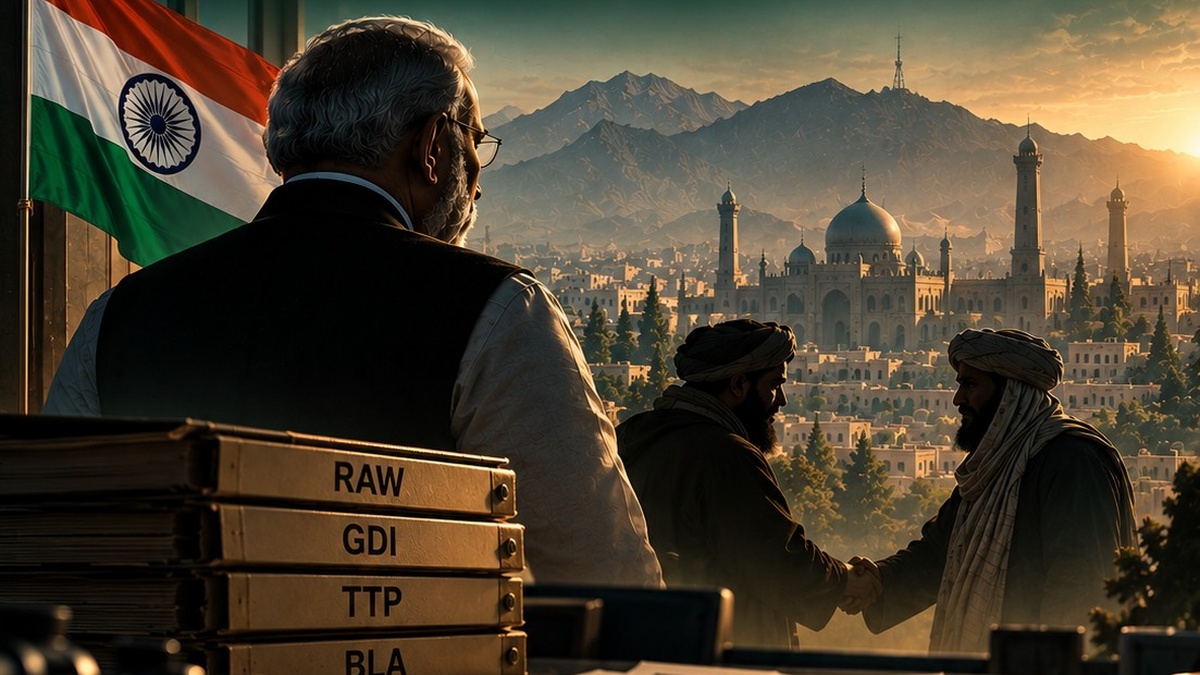
Independent monitoring organizations, including the Centre for Research and Security Studies (CRSS), the International Crisis Group, and the Armed Conflict Location & Event Data Project (ACLED), have documented a sharp escalation in attacks by Tehreek-e-Taliban Pakistan (TTP), alongside growing casualties among civilians and security personnel.
The operational links between militant sanctuaries across the border and attacks inside Pakistan have become a recurring feature of regional security assessments.
These developments deserve the same analytical attention afforded to the consequences of Pakistan’s military response.
Instead, international discourse often treats the conflict as though it begins with an airstrike rather than with the terrorist attack that preceded it.
Equally troubling is the limited attention given to the Taliban’s own conduct during military operations. Militant organizations have historically embedded themselves within civilian infrastructure precisely because such locations complicate military targeting and generate political costs for their adversaries. Afghanistan has not been immune from this practice.
Throughout decades of conflict, armed groups operating in the country, including the Taliban, have repeatedly been accused of locating personnel, weapons, logistical assets, and command functions within or adjacent to civilian areas.
When armed actors deliberately position themselves among civilians, the legal and humanitarian consequences become significantly more complex than casualty figures alone can capture.
Civilian protection remains an absolute obligation under international humanitarian law. That obligation applies equally to states conducting military operations and to non-state armed groups whose tactics knowingly expose civilians to danger.
Yet international reporting frequently devotes extensive analysis to one side of this equation while offering comparatively limited scrutiny of the other. This imbalance risks creating a misleading moral asymmetry.
The March 2026 strike on Kabul’s Omid Drug Rehabilitation Centre illustrates the problem. Amnesty International concluded that it found no evidence supporting Pakistan’s assertion that military assets were present at the site. Yet the organization also acknowledged the practical constraints under which its investigation was conducted, relying primarily on satellite imagery, remote analysis, and limited visual material rather than unrestricted physical access.
Such investigations undoubtedly contribute valuable information. They should also acknowledge the limitations imposed by operating in territory where independent forensic verification depends upon permission from the very authorities whose conduct may itself warrant scrutiny.
An absence of independently verifiable evidence under such circumstances should not automatically be interpreted as definitive proof that military use never occurred.
More broadly, the international community must confront an uncomfortable methodological reality.
Today’s human rights reporting inside Afghanistan increasingly depends upon an operating environment controlled by a government that remains internationally isolated, restricts independent journalism, suppresses civil society, and tightly regulates external access.
That reality does not invalidate every finding produced under those conditions. It does, however, require considerably greater transparency about the limitations affecting evidence collection.
Instead, reports frequently move from cautious observations to categorical legal conclusions with a confidence that the underlying evidentiary environment may not fully justify.
This is not merely an academic concern. International organizations shape diplomatic debates, influence sanctions discussions, inform media narratives, and increasingly provide the factual foundation upon which governments formulate policy. Methodological blind spots therefore have real geopolitical consequences.
None of this diminishes the importance of investigating civilian casualties. States exercising military force must remain accountable under international humanitarian law, regardless of the adversary they confront. Pakistan is no exception.
But accountability cannot become selective.
A credible human rights framework must examine the full chain of violence. The terrorist networks operating from across borders, the deliberate use of civilian environments by armed groups, the recruitment practices of militant organizations, the sanctuary they enjoy, the attacks they launch, and the military responses those attacks provoke.
Ignoring one half of that chain does not produce impartial reporting. It produces an incomplete narrative.
Ultimately, the question is larger than Pakistan or Afghanistan.
Human rights institutions command global trust because they are expected to resist political convenience and methodological shortcuts alike. That trust depends not simply on documenting civilian suffering, but on ensuring that the architecture of evidence itself remains independent of the actors controlling access to conflict zones.
When international organizations become structurally dependent upon information gathered under conditions shaped by one belligerent, skepticism is not an attack on human rights, it is a necessary safeguard for their credibility.
The people of Afghanistan and Pakistan deserve reporting that reflects the full complexity of their shared conflict, not a narrative confined by the checkpoints through which information is permitted to pass.

Your go-to editorial hub for policy perspectives and informed analysis on pressing regional and global issues.