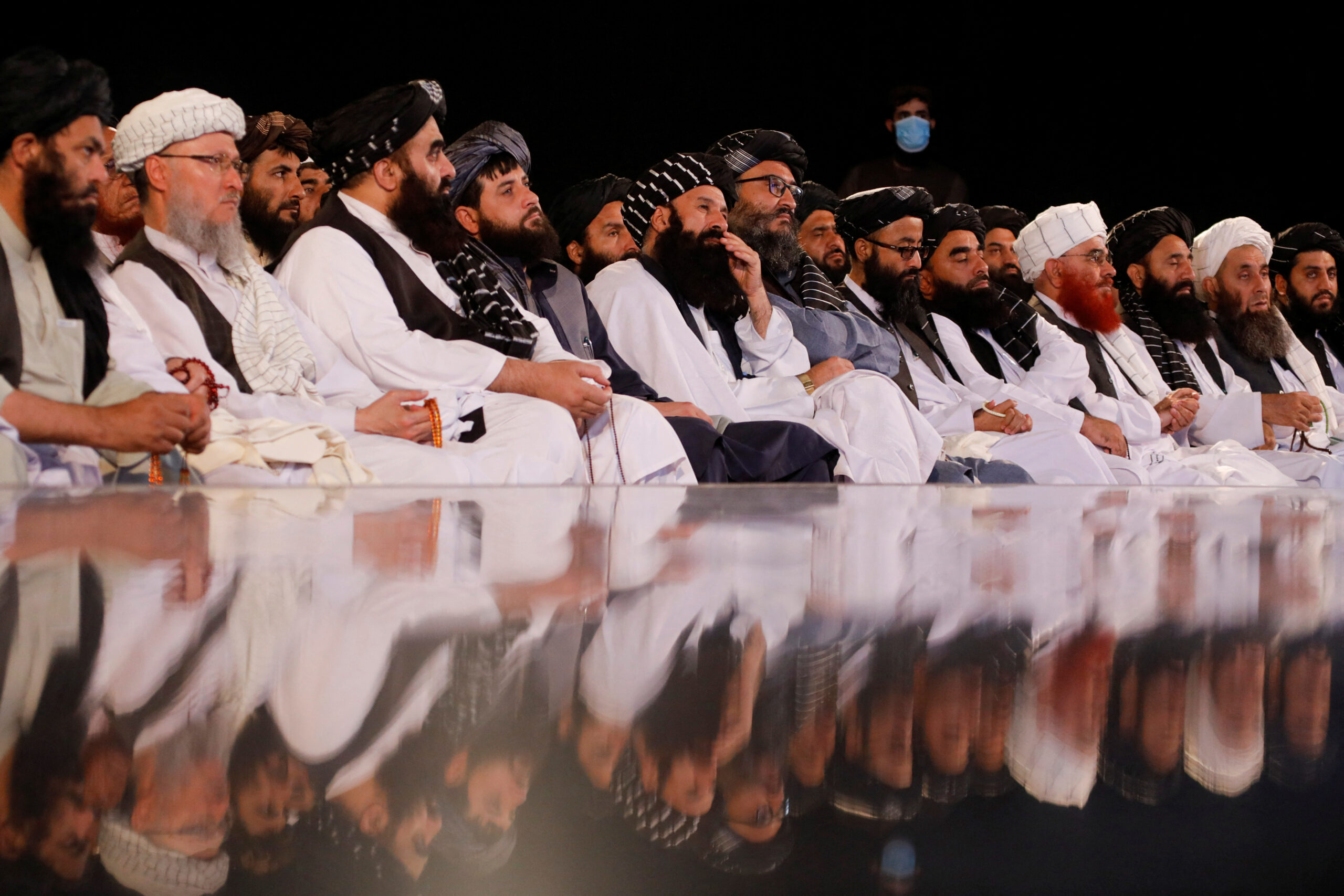
The Taliban’s approach reflects a duality seen in many political orders: uncompromising religious rigidity inside the country, coupled with practical engagement abroad.
Their domestic governance is shaped by an insistence on enforcing what they call “pure Islamic rule,” while their foreign policy reflects a transactional realpolitik driven by economic need and political survival. The result is a system that applies rigid morality inward but negotiates with remarkable agility outward.
Nowhere is this clearer than in the regime’s treatment of Afghan women. Afghanistan remains the only country in the world with a nationwide ban on girls’ secondary and higher education, excluding an estimated 1.1 million girls from classrooms. Women have been pushed out of most jobs, barred from public spaces, and subjected to suffocating restrictions that UN officials describe as unprecedented in modern times. UNAMA head Roza Otunbayeva warned that even “the sound of a female voice outside the home” is treated as a moral violation.
When criticised, Taliban officials insist that the world simply “misunderstands Sharia,” accusing international observers of ignorance. Taliban spokesperson Zabihullah Mujahid has condemned foreign concern as an “insult to Islamic law,” reaffirming that nothing will deter the regime from “upholding and enforcing Sharia.” In a society that is overwhelmingly Muslim, why must the public be perpetually disciplined back into religion?
Analysts note that the answer lies not in theology but in political survival. For the Taliban’s ruling clerics, Sharia is less a jurisprudential system and more a mechanism of control. The Taliban worldview positions the mullah not as a teacher but as an overseer whose authority depends on the perpetual existence of sin, deviation, and ignorance. Under this logic, no Muslim society can ever be devout enough unless it is fully obedient and silent.
This Sharia absolutism has long been used as a veil, camouflaging economic collapse, unemployment, poverty, and governance failures. Rather than address hunger, corruption, joblessness, or ethnic discrimination, the regime reframes Afghanistan’s crises as spiritual deficiencies. Taliban leaders have even warned that God would “punish Afghans” who feel ungrateful under Islamic rule, an attempt to deflect blame from the leadership’s inability to meet basic governance standards.
Beyond symbolism, the policies follow suit: bans on women’s work across more than 20 sectors, public floggings, shuttered media outlets, and over 1,000 recorded incidents of journalist detentions or restrictions since 2021. Sharia, in this domestic context, becomes a tool of intimidation, not a platform of justice or public welfare.
Yet the same regime that treats domestic dissent as a threat to Islamic purity adopts a noticeably different tone when engaging foreign powers, particularly those accused of oppressing Muslim populations.
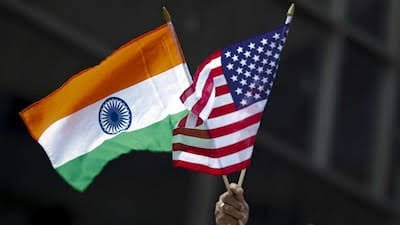
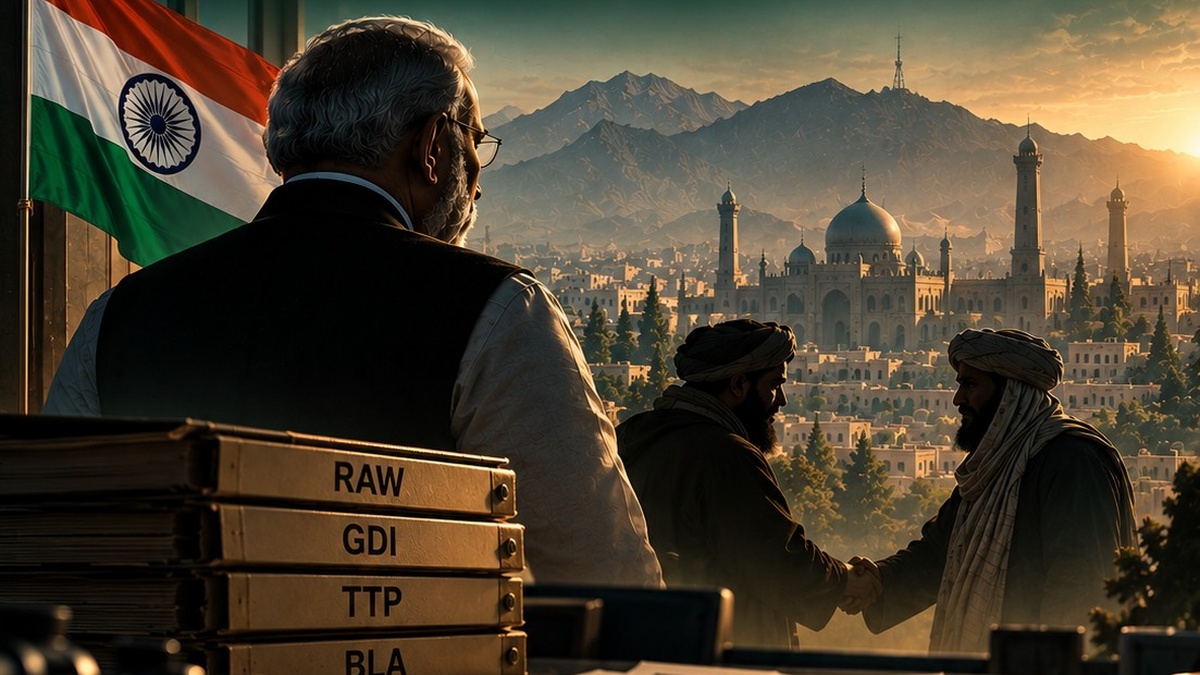
In January 2025, India’s top diplomat Vikram Misri met Taliban Foreign Minister Amir Khan Muttaqi in Dubai, marking the highest-level contact since 2021. The Taliban expressed interest in expanding political and economic cooperation, especially through Chabahar, India’s strategic port project in Iran to bypass Pakistani routes. Analysts, including Michael Kugelman of the Wilson Center, called the meeting a “diplomatic triumph” for the Taliban, noting that Delhi had effectively granted them a degree of de facto legitimacy.
Yet in this outreach, the Taliban’s rhetoric about global Muslim solidarity disappears. There is no mention of Gujarat 2002, the demolition of Muslim homes in Kashmir, or the bulldozer-led evictions that Indian civil society has documented in recent years. The regime that punishes Afghan women for speaking in public is noticeably subdued about the treatment of Indian Muslims. Economic incentive, not ideological brotherhood, shapes its approach.
The same pragmatism guides relations with Russia despite Moscow’s violent campaign and occupation of Chechnya, which claimed tens of thousands of Muslim lives in the 2000s, Taliban delegations continue to attend Moscow Format meetings, negotiate energy deals, and discuss imports. For a movement that claims to defend the global ummah, these partnerships reveal a selective moral compass.
The inconsistency becomes even more pronounced in the Taliban’s handling of the Tehreek-e-Taliban Pakistan (TTP). While enforcing Sharia domestically with harshness, the regime adopts a softer tone towards the TTP, framing their presence as a matter for “mediation” rather than enforcement. This is despite a 60% surge in TTP attacks in Pakistan since 2021 and repeated UN monitoring reports identifying the group’s leadership operating on Afghan soil. Here again, political calculus, not Islamic principle, drives policy.
Why this selectivity? The explanation is pragmatic. Domestically, ideological rigidity secures obedience and suppresses dissent. Internationally, survival requires flexibility: trade, aid, diplomatic recognition, and access to regional infrastructure. The Taliban employ Sharia as a tool where it strengthens internal authority and quietly set it aside where it obstructs external engagement.
This duality carries long-term risks. Governance built on selective morality erodes credibility, alienates citizens, and deepens Afghanistan’s isolation. For regional actors, including Pakistan, India, Iran, and Central Asia, it creates uncertainty about the Taliban’s commitments and reliability.
Ultimately, Afghanistan’s path to stability rests on consistency and accountability. The international community will need to navigate the Taliban’s contradictions with realism, avoiding both moral indulgence and strategic naivety. And for the Taliban themselves, a durable future requires recognising what Islamic history has long taught: that justice, not coercion, is the true foundation of legitimate rule.
Disclaimer: The views expressed in this article are the author’s own. They do not necessarily reflect the editorial policy of the South Asia Times.

Amna Hassan is a research Coordinator at South Asia Times. With a Bachelor's in Political Science, her current academic interests include public policy, e-governance, and gender-focused development. Beyond her professional pursuits, she is also a freelance designer and researcher.