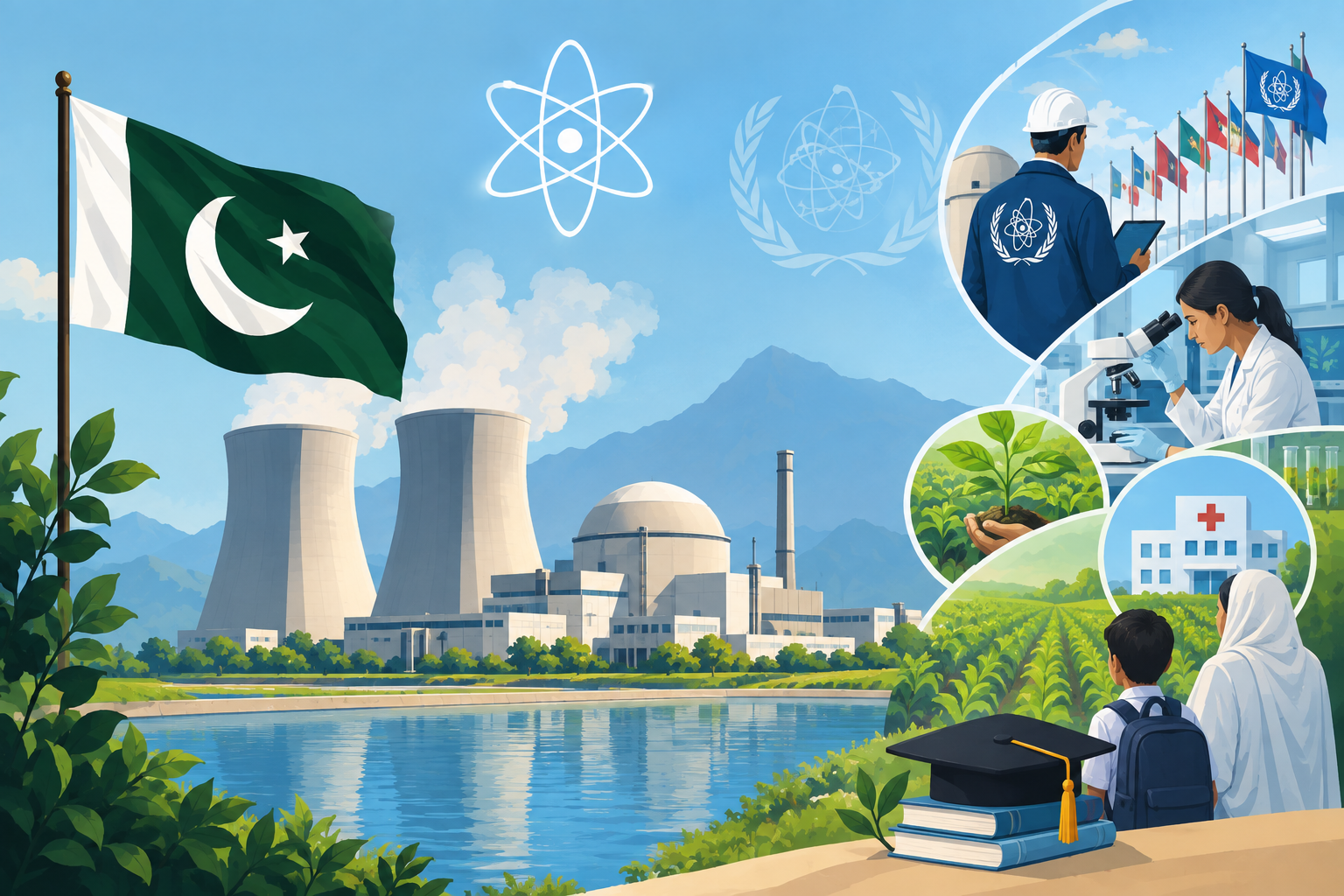
Pakistan’s nuclear programme, its exclusion from the Nuclear Non-Proliferation Treaty (NPT) and the uneasy strategic equilibrium with India are the three key elements which helped shape Pakistan’s nuclear status in the international perception.
But this dominant narrative hides another, however much less discussed: the seventy-year civilian nuclear program that has been developed, from the very beginning, within the very system of verification that international community relies on to distinguish peaceful programs from proliferation.
The real and the unreal should not be ignored and overlooked, and to make a serious judgment about Pakistan’s nuclear actions, both should be taken into consideration at the same time.
The civilian nuclear programme of Pakistan began almost decades earlier than its nuclear weapons programme. The Pakistan Atomic Energy Commission (PAEC) was formed in 1956 through an IAEA safeguards agreement (INFCIRC/135) that is a quarter of a century ahead of the Pakistani nuclear tests in 1998. PAEC constructed the Karachi Nuclear Power Plant, South Asia’s first commercial nuclear power plant, and brought it online in 1972.
The Chashma nuclear complex and the newer Karachi units K-2 and K-3 are part of a later safeguards agreement, INFCIRC/418, which brings all of Pakistan’s power reactors under “continuous IAEA material accounting and inspection. Pakistan’s civilian nuclear program isn’t just a claim by Islamabad; rather, it’s independently verified, one reactor at a time, by the same agency that verifies civilian programs in Japan, Canada and South Korea.
That verification sits on top of a regulatory system that has developed significantly since 2000. In 2001, the Convention on Nuclear Safety drew the Pakistan Nuclear Regulatory Authority (PNRA) away from PAEC and mandated it to license all nuclear installations in the country, implement radiation-protection standards and report on the safety of nuclear installations to other state parties to the convention periodically in order to subject Pakistan’s practices to peer review.
In 2016, Pakistan ratified the 2005 Amendment to the Convention on the Physical Protection of Nuclear Material, which broadened its legal responsibilities from material in international transportation to the physical protection of nuclear material and nuclear facilities in domestic use and, In the same year, at the fourth and last Nuclear Security Summit, Pakistan presented a national progress report on the implementation of its Nuclear Security Action Plan, a rare case of a non-NPT state voluntarily giving itself an inspection by a process largely developed by members of the NPT.
All institutions’ commitments are followed by institutional capacity. The National Institute of Safety and Security (NISAS) was set up in 2014 and has since provided over 30 trainings in physical protection, radiation detection and emergency response, attracting participants from around the region.
It is a peer designation, not a self-description, and it puts nuclear-security expertise in Pakistan on the map as an exporter of the region’s nuclear-security capability, instead of as the only ones that need to be looked at by the IAEA.
This institutional record is replicated in tangible development outcomes, such as the Pakistan government’s subsidised treatment for a significant proportion of the nation’s cancer patients at PAEC-run oncology centres, and mutation-bred crops that are able to withstand droughts, salinities and other environmental stresses, which have been developed by Pakistan’s nuclear agriculture institutes.
All of this does not mean that the more serious issues related to Pakistan’s nuclear stance are obviated, and a rational discussion will not be able to ignore them.
Along with India and Israel, Pakistan has so far been denied membership of the Nuclear Suppliers Group and its membership application for 2016 has been effectively suspended because of the disagreement between the US and Russia/China regarding how new members should be brought in, either on a country-by-country basis, the way India was in 2008, or on a criteria-based basis, the way Pakistan has always preferred.
More importantly, Pakistan, along with others, has refused to allow any negotiations on a Fissile Material Cutoff Treaty since 1998, arguing that a “freeze” of current nuclear stockpiles would embed Pakistan’s larger nuclear arsenal in the status quo.
Regardless of one’s position on this, it falls outside the civilian nuclear sector discussed above and it’s hard to argue that this is a sign of the failure of either the integrity of Pakistan’s IAEA-covered power plants, or their maintenance of the FMCT position, in light of how the two are governed, verifiable, and reported.
Any attempt to categorize Pakistan’s nuclear identity in simplistic terms misses the more instructive point: its strategic and civilian nuclear programmes operate under separate jurisdictions, and it is precisely the boundary between them, not any singular ‘character’ of the state, that seventy years of international negotiation have been designed to protect against diversion.
The policymakers and commentators who are concerned with the nuclear path followed by Pakistan should critically consider each in their own merits and not get the history of one obliterated by the other’s shortcomings. That distinction will not help clear up the region’s underlying strategic problems. However, this is the only ground on which a serious and evidence based discussions on the peaceful nuclear approaches of Pakistan may be held.