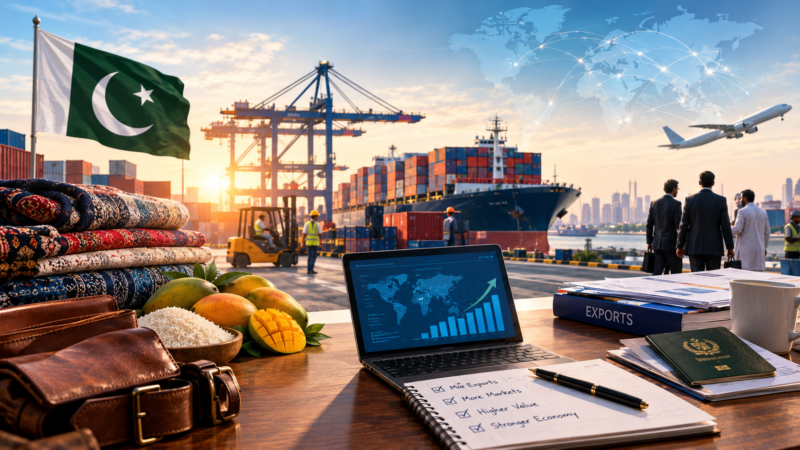
For decades, Pakistani leaders travelling abroad have repeated an appealing phrase: we want trade, not aid. The ambition is sound. But trade is not created by a slogan, and development assistance that improves infrastructure or skills can support export growth rather than contradict it.
The scale of the challenge is clear. Revised national accounts put Pakistan’s FY2025–26 economy at approximately US$450.4 billion. The Pakistan Bureau of Statistics’ provisional June trade release recorded annual merchandise exports of US$30.14 billion, down 5.93%, against imports of US$69.76 billion. The goods trade deficit was US$39.62 billion. These are merchandise figures, not total exports including services or the overall current-account balance.
I spent nearly four decades inside Pakistan’s government, including work connected with foreign trade in the Ministry of Commerce. I have seen export policy from the other side of the table: tariff discussions, market-access negotiations, trade officers, exporters, chambers, and development funds. What strikes me is how often familiar problems are diagnosed without sustained implementation following.
Pakistan needs a system that connects what overseas buyers demand with what its firms can competitively supply. That requires more than commercial promotion. Production costs, skills, standards, logistics, and predictable policy must support the same objective.
Build value and broaden the export base
Pakistan’s established exporters deserve support. The task is to improve what they sell while enabling new products and firms to reach international markets. Textiles and agricultural goods need not be dismissed as yesterday’s economy: better design, processing, productivity, and branding can raise their value. Diversification should build on capabilities while creating others.
Consider a mango. Growing it is only the beginning. Sorting, treatment, certification, cold storage, packaging, traceability, and reliable delivery determine which buyers can be served. The useful question is not merely how many tonnes Pakistan exports, but how much domestic value it captures after the costs of meeting those requirements.
The same attention belongs to services, including software and professional work delivered across borders. A strategy confined to containers and factories would overlook part of Pakistan’s export opportunity.
Sialkot offers a practical lesson in cooperation. Its airport’s institutional history records the role of the chamber and private-sector promoters in developing shared infrastructure. The lesson is to identify commercially justified facilities that groups of firms can use: testing laboratories, training centres, logistics services, or certification support. Each proposed cluster should be tested against actual buyers and demand.
Make commercial representation useful to firms
Pakistan’s overseas trade officers should serve as commercial scouts. They should know which imports are growing, who buys them, what standards apply, and where Pakistani suppliers could compete. Useful intelligence identifies buyers and entry requirements, rather than simply describing a country’s economic prospects.
Pakistan does not need to invent every analytical tool. The International Trade Centre’s market-analysis tools, including Trade Map and Export Potential Map, already help identify products and destinations. Commercial officers should combine such data with interviews, distributor contacts, and feedback about Pakistani suppliers. The resulting opportunities must reach firms able to act on them.
The Trade Development Authority of Pakistan should follow that process through. An exhibition is an activity; repeat sales are a result. Evaluation should trace qualified buyer contacts, samples, orders, subsequent exports, and firms’ continued presence in a market. Officials cannot control every purchasing decision, so assessment must distinguish their contribution from exchange rates, demand shocks, and firms’ own performance.
Small businesses need particular attention. Count first-time exporters, but also ask how many export again, enter another destination, or move into higher-value products. Support should address identifiable obstacles rather than become a permanent entitlement for established recipients.
Remove the penalties on competitive production
Commercial officers cannot sell away a factory’s cost disadvantage. Pakistan’s National Tariff Policy 2025–30 recognises anti-export bias and seeks a more predictable tariff regime, better access to imported inputs, and integration into global value chains. These objectives matter because exporters compete on the delivered cost and quality of their products.
Implementation requires published timetables and clarity about changes. Firms cannot build durable buyer relationships if they face repeated uncertainty over input duties, refunds, or operating costs. Policy should be assessed by the conditions exporters actually encounter, not the attractiveness of its announcement.
Market access also needs follow-through. The European Commission’s account of Pakistan’s GSP+ preferences explains both preferential tariffs and obligations concerning rights, labour, the environment, and governance. Protecting that access is important. Firms must also be capable of meeting buyers’ requirements consistently.
Attract investment that builds capabilities
Pakistan should seek investors that bring technology, management, training, and connections to international customers. Its Investment Policy 2023 already identifies high-quality, export-oriented investment as a priority. The next step is to connect investor outreach with specific production opportunities and credible implementation support.
Export sales alone are not a complete test of investment. Domestic production that competitively replaces imports can also help, as can stronger local suppliers. Assess domestic value added, imported inputs, technology transfer, and foreign-exchange costs as well as receipts. Large investment announcements should not stand in for those results.
Skills policy belongs alongside this agenda. Better training can strengthen firms at home and improve workers’ opportunities abroad. Remittances are valuable foreign-exchange inflows, but they are not export sales. Overseas recruitment should protect workers, recognise professional qualifications, and consider domestic shortages rather than treat migration as a substitute for productive employment at home.
Pakistan already has entrepreneurs, commercial institutions, and experience of international markets. Their presence does not guarantee success, but it provides a base on which to build. The priority is to connect demand intelligence with firm-level support, competitive production, and accountable delivery.
The government should publish a manageable set of measures: exporter entry and survival, product and market diversification, domestic value added, and results from publicly funded support. Then follow those measures over time. Only when more firms can win and retain overseas customers will “trade, not aid” become an economic strategy rather than a recurring diplomatic appeal

Qazi Zaheer Ahmed
The author is a retired BS-21 civil servant of the Government of Pakistan with over three decades of public service. He writes on geopolitics, economic strategy, and regional security, and is engaged in international trade and advisory work.