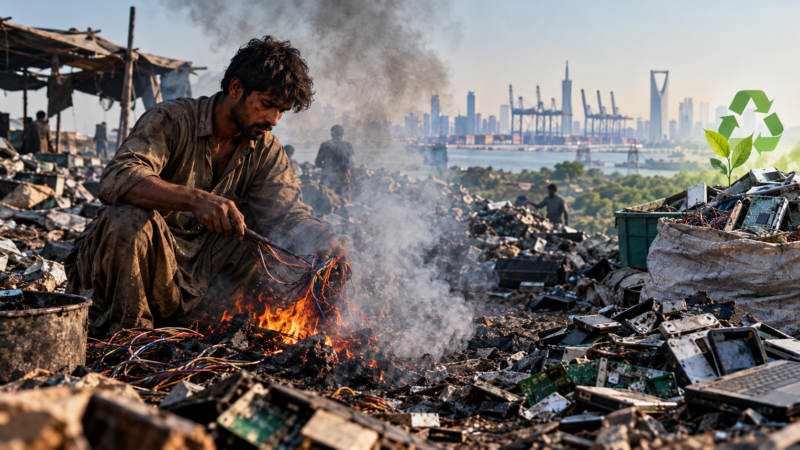
In a workshop in Karachi’s Shershah scrap market, a man burns insulated copper wire over an open flame. The smoke carries lead, cadmium, and dioxins into the air around him. He has no protective equipment. He does this because it is the only way he knows to recover the metal value from a discarded phone or laptop, and because no licensed facility exists in Pakistan where he could bring that device instead.
That workshop is not an outlier. It is the system.
According to the UN Global E-Waste Monitor 2024, Pakistan generated 559 kilotons of electronic waste in 2022, and the volume is rising by over ten percent a year as phone and appliance ownership expands. Of that total, 89.4 percent, roughly 85,300 tonnes annually, flow through Karachi. Lahore is a distant second at 6.1 percent. Neither city has a single licensed e-waste recycling facility. The entire national volume passes through informal dismantling operations.
This is usually framed as an environmental compliance problem. That framing is accurate but incomplete. What Pakistani urban centers such as Karachi actually lack is the infrastructure. The city manages over 85,000 tonnes of hazardous material annually with no designated processing site, no municipal collection point, no zoning provision for formal recycling, and no budget line for it at any tier of government. Informal clusters in Shershah and similar areas thrive because suitable alternatives are absent. In any functional urban system, a waste stream of this scale would be a public infrastructure question.
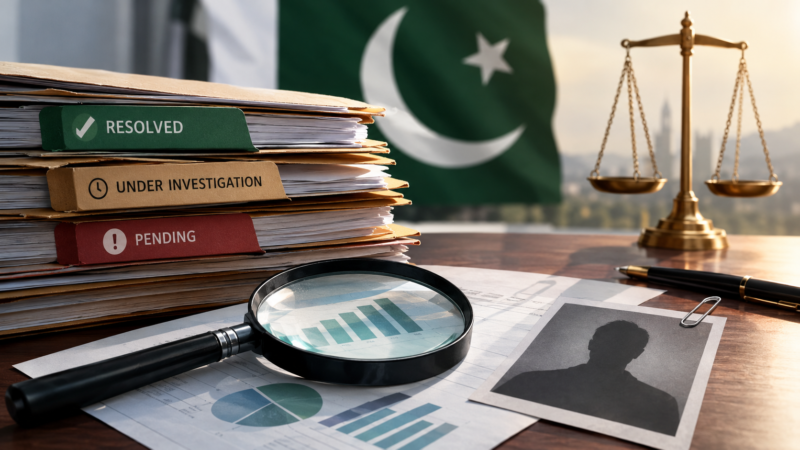
The legal position is not that Pakistan lacks environmental law. Four instruments currently apply to e-waste in some form: the Pakistan Environmental Protection Act 1997, the National Environment Policy 2005, the Import Policy Order, and the National Hazardous Waste Management Policy 2022. However, none of the four were written specifically for electronic waste. As a result, no specific legislation defines e-waste, no collection goals exist, and no single authority takes ownership of enforcement.
On July 8, 2025, the Ministry of Climate Change and Environmental Coordination convened a consultative meeting, acknowledged that Pakistan has no reliable baseline data on how much e-waste it generates or how it is handled, and formed a working group to address the gap. However, a year later, no draft rules have been published, and no pilot facility has been proposed.
The cost of this delay is not abstract. A discarded circuit board contains gold at concentrations of roughly 350 grams per tonne compared to 1 to 5 grams per tonne in conventionally mined gold ore. Extrapolating from the UN Global E-Waste Monitor 2024’s raw material valuations, Pakistan’s annual e-waste volume carries an estimated $800 million in recoverable material value, of which informal burning and acid extraction destroy a substantial share. Furthermore, exposure to these toxic procedures presents significant health hazards. PIDE’s 2023 survey of 312 informal recycling workers found e-waste exposure to be statistically linked to asthma, respiratory and pulmonary illness, skin and eye conditions, and inflammatory bowel disease.
Other countries have faced and overcome this problem in the past. India launched Extended Producer Responsibility rules in 2011 from a base of near-total informality. Its first-year collection targets proved too ambitious and were revised downward in 2018. China addressed the financing problem directly through a treatment fund that collects a mandatory levy from producers and importers and pays it to licensed recyclers, so funding follows the product rather than competing for an annual budget line. And Brazil, rather than trying to regulate its informal waste workforce out of existence, it gave collectors a defined legal role inside the formal system, with producers, government, and collectors each carrying assigned responsibilities.
Applied to Karachi, the equivalent steps are not difficult to name. The city’s existing scrap dealers could become the licensed collection network for a formal system. Given their existing operational footprint, they have a clear economic incentive to shift toward safe, high-yield recovery rather than destroying valuable materials through hazardous processing. Hence, formalisation doesn’t disrupt the market; rather corrects it.
What Pakistan needs is a dedicated set of E-Waste Management Rules that names a sole implementing authority and applies Extended Producer Responsibility as the funding mechanism. Moreover, we need to close the Import Policy Order’s classification loophole that allows e-waste to enter labelled as working secondhand equipment, and commission the baseline study the Ministry’s own working group identified as a precondition, starting with Karachi.
Every year, without this instrument, tens of thousands of tonnes are processed without protection, and the workforce is absorbing health costs that a licensed system would eliminate. The government has already identified this issue. What is required is a data-backed, dedicated system for an efficient e-waste recycling infrastructure.

Ussama Bin Sajjad Kiyani
Ussama Bin Sajjad Kiyani is a Staff Economist at the Pakistan Institute of Development Economics (PIDE) and is affiliated with the Center for Sustainable Futures (CSF). He holds an honors degree in Economics from International Islamic University Islamabad and brings hands-on experience in urban development, housing societies, and the real estate sector. His research interests include urban economics, sustainable and green infrastructure, housing policy, and smart housing technologies. In addition, he is actively engaged in examining the adoption of Artificial Intelligence (AI) as a transformative general-purpose technology, assessing its implications for economic growth, governance, and policy design. At CSF, he contributes to research at the intersection of urbanization, affordability, technological change, and policy innovation.