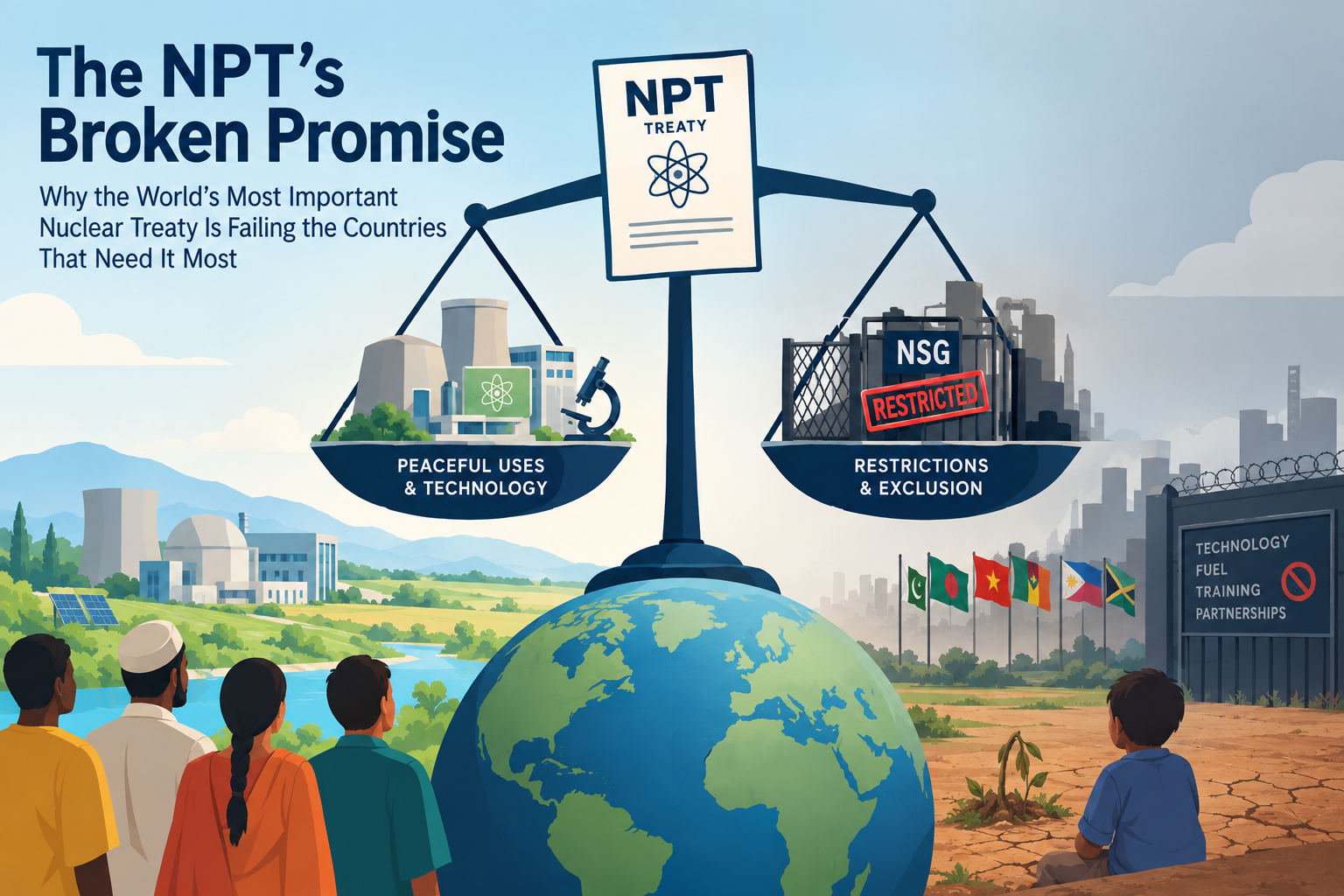
The Nuclear Non‑Proliferation Treaty was meant to guarantee every country access to peaceful nuclear technology. More than fifty years later, that promise has not fulfilled and now the consequences are becoming serious.
In 1968 NPT was signed and it stated that countries without nuclear weapons agreed they would never build them. In return, they were promised two things: first, nuclear‑weapon states would slowly move toward disarmament and second, that all countries would get access to nuclear technology for peaceful uses.
The first part not building weapons has mostly worked. Today, 189 countries are part of the NPT. But the second part, access to civilian nuclear technology has not been fulfilled.Article IV of the NPT clearly says that every member has an “inalienable right” to develop nuclear energy for peaceful purposes. It also says that countries with advanced nuclear technology should help others by sharing equipment, materials, and scientific knowledge. This wasn’t a small side promise. It was the main reason many countries agreed to sign the treaty.
Nations understood it as a simple exchange: we give up nuclear weapons and in return we get help building reactors, training scientists, and developing nuclear energy and medicine programs. But that exchange has not happened at least not at the scale or fairness that was promised.
So what went wrong?
Over time, a system that was supposed to share technology slowly became a system that restricts it. And those restrictions mostly affected developing countries.
The biggest example is the Nuclear Suppliers Group. It is a group of 48 nuclear‑capable countries that control global nuclear exports. It was created in 1974 after India used plutonium from a civilian reactor to test a nuclear device. Creating stricter export controls made sense at the time. A civilian program had been misused for weapons.
But here’s the issue: the NSG operates outside the NPT system. It is not officially part of the treaty. Its members choose themselves. Decisions are made by consensus among supplier countries. And in practice, its rules often act like a gatekeeping system making it very hard for developing countries to access technology even when they are legally entitled to it under Article IV. For example;
Ghana, it joined the NPT in 1970 and has followed the rules for over 50 years. It is working with the IAEA to build a civilian nuclear power program. Still, it faces major obstacles in getting reactor technology, training systems, and fuel agreements. Meanwhile, countries with strong strategic ties to major powers move ahead much more easily.
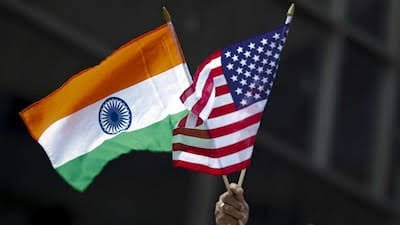
The clearest example of this double standard is the 2008 India‑U.S. Civil Nuclear Agreement. India is not a member of the NPT. It tested nuclear weapons in 1974 and 1998. It currently has around 190 nuclear warheads. Logically, such a country should face the strictest restrictions. Instead, in 2008, the U.S. signed a deal giving India access to civilian nuclear trade reactors, fuel, and cooperation. To make this possible, the U.S. convinced the NSG to give India a special exemption.
What message did that send to countries that followed the treaty rules? Simple: being loyal to the NPT does not guarantee cooperation. Strategic importance does. Bangladesh joined the NPT in 1979. It has no weapons program and no history of violations. Yet it struggled for decades to secure partnerships and is now building its first nuclear plant with Russian support.
Nigeria joined in 1968 and has followed all rules. Still, its nuclear energy goals remain limited due to funding and technology access problems. Vietnam, Jordan, Kenya, the Philippines — many countries have Article IV rights on paper, but in reality, access remains difficult.
Earlier, this issue was mostly about technology prestige. Now it’s about climate survival. The climate crisis has changed everything. The IPCC says nuclear energy will be important to limit global warming to 1.5°C. The International Energy Agency says global nuclear capacity must double by 2050 to reach net‑zero targets. The IAEA also projects major growth in nuclear power.
Nuclear energy is no longer optional it is a serious clean energy solution. It provides stable electricity with almost zero carbon emissions during operation. Now look at where climate change is hitting hardest: sub‑Saharan Africa, South Asia, Southeast Asia, Pacific Islands. These are the same regions where access to nuclear technology is most limited.
Countries that contributed least to global emissions are suffering the most and at the same time, they are being denied fair access to clean energy tools.
This is no longer just a nonproliferation issue. It is a climate justice issue.
Some argue that expanding nuclear access increases proliferation risks. That concern is understandable but it is often exaggerated and applied selectively. The IAEA already has strong safeguards. Countries under full safeguards agreements are regularly inspected. The Additional Protocol gives even more inspection authority, and over 140 countries have signed it.
The system is not perfect but it works. Denying technology to countries with clean records while giving special deals to non‑NPT nuclear‑armed states does not strengthen nonproliferation. It weakens trust in the system. Every time a compliant country is denied access, the credibility of the treaty drops
The risk of reform is manageable. The risk of continued double standards is much bigger. Fixing this doesn’t require rewriting the NPT. It requires actually implementing Article IV properly.
First, the IAEA’s Technical Cooperation Programme needs much more funding. It helps developing countries build infrastructure and train experts. Its budget is too small for global needs. Increasing it significantly would make a real difference.
Second, the NSG should operate with more transparency and alignment with NPT principles. Export decisions should be based on safeguards compliance and peaceful intent not politics.
Third, multilateral fuel supply systems should expand. The IAEA’s Low Enriched Uranium (LEU) Bank in Kazakhstan is a good start. If countries are guaranteed fuel supply, they will have less incentive to develop sensitive enrichment programs.
The NPT has been one of the most important international agreements ever made. It helped prevent a world with 15 or 20 nuclear‑armed states. But its survival depends on fairness. Non‑nuclear states did not sign the treaty as charity. They signed it as a deal. They gave up the most powerful weapon ever created. In return, they were promised cooperation and technology. Recent NPT Review Conferences have failed to reach agreement, largely because of frustration over unfulfilled commitments.If Article IV continues to be treated as optional, the treaty itself may weaken.
What has to be done?
- Nuclear‑weapon states must accept that Article IV is not optional. They should lead in expanding fair civilian nuclear cooperation.
- The NSG must become more transparent and consistent. Special exemptions for non‑members while compliant states struggle should end.
- The IAEA must be properly funded to support peaceful nuclear development.
- Developing countries must continue strengthening their regulatory systems and push collectively for fair implementation.
- And civil society and media must talk more about the technology‑sharing side of the NPT — not only about weapons. Because in the end, a treaty that keeps only half its promises cannot survive forever

Hira Bashir is an Associate Research Officer at the Center for International Strategic Studies, Azad Jammu & Kashmir. Her research focuses on the peaceful uses of nuclear technology. She can be reached on X at @HiraBK5090.