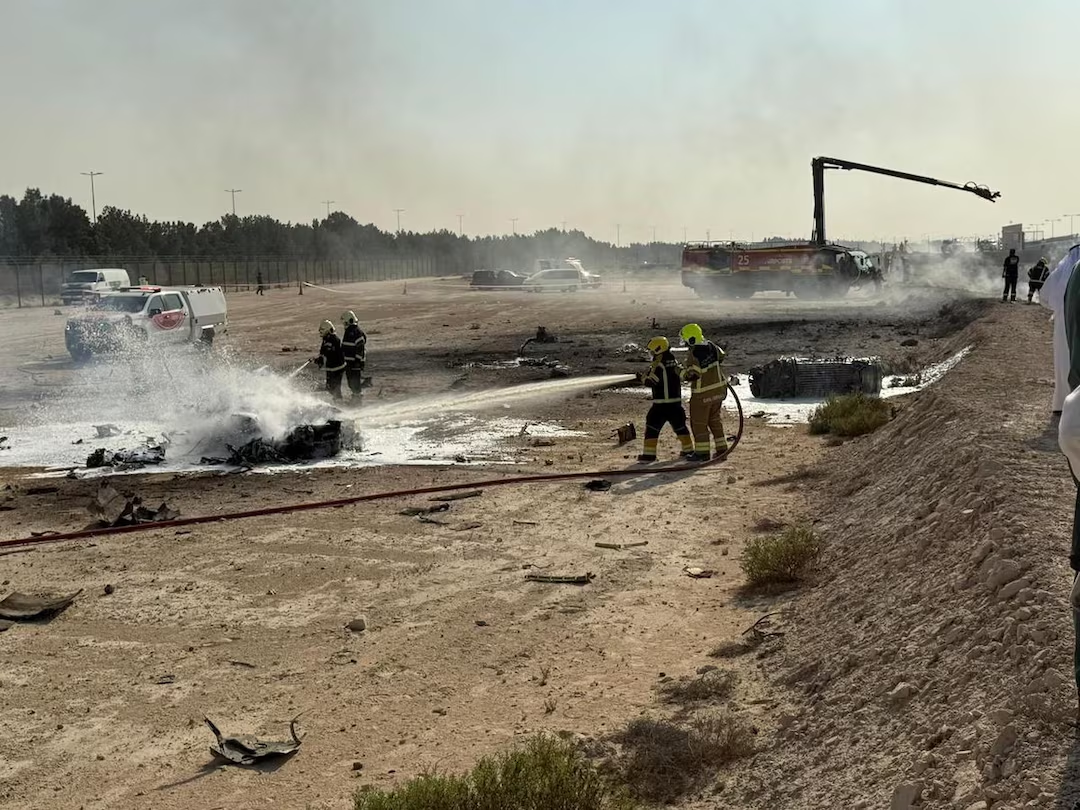
The accident involving an Indian Air Force Tejas Light Combat Aircraft at the Dubai Air Show on November 21, 2025 serves as a significant data point in the assessment of India’s indigenous defense capabilities. The crash which resulted in the fatality of the pilot constitutes the second loss of a Tejas airframe in under two years and challenges the platform’s safety record while raising questions about the trajectory of a project that has been in development for forty years. While the technical investigation into the cause is ongoing the strategic implications are immediate. The Tejas was deployed to Dubai to demonstrate operational maturity to potential export partners. Instead the incident has precipitated a domestic review regarding whether the program represents a successful indigenization effort or highlights systemic delays. To address this it is necessary to examine the statistical performance of the LCA program alongside the IAF’s historical operational challenges and the legacy of the fleet the Tejas was designed to replace.
The first crash in Jaisalmer in 2024 was dismissed by some as a one-off engine seizure but the second crash yesterday in Dubai occurring in front of the global aerospace elite suggests a pattern that can no longer be ignored. Critics have pointed to a disturbing metric regarding the flight hours to crash ratio. We must focus strictly on the verifiable operational flying hours which stand at approximately 900 hours. Losing two aircraft in such a short span of active operational service is statistically alarming for a modern 4.5 generation fighter. This record stands in stark contrast to its global competitors such as the French Rafale which logged over 30,000 flight hours before suffering its first crash. Similarly the American F-16 flew tens of thousands of operational hours before reaching any comparable attrition rate relative to its fleet size.
To understand why a crash in 2025 is so damaging one must rewind to 1983. The LCA program was sanctioned to replace the aging MiG-21s with a projected induction date of the mid-1990s. Instead the First Series Production aircraft was only handed over to the IAF in 2016 which is a staggering delay of over 30 years. In the world of military technology a three decade delay is not just late but represents total obsolescence. When the Tejas was conceived it was meant to compete with the F-16s of the early 80s. By the time it entered service the world had moved on to F-35s and stealth drones. The consequences of this delay were not merely budgetary but were measured in blood because the Tejas was not ready and the IAF was forced to extend the life of its MiG-21 fleet decades beyond its intended service. This decision birthed the infamous Flying Coffin era.
The MiG-21 is the ghost that haunts the Tejas program. A legendary interceptor in its prime had become a death trap for young Indian pilots by the 1990s and 2000s.The statistics are chilling as over 400 MiG-21s have crashed since their induction while killing more than 200 pilots and 50 civilians. The term Flying Coffin wasn’t just tabloid sensationalism but a statistical reality born of necessity. The IAF had no other lightweight interceptor because the Tejas was stuck in a bureaucratic loop of development hell hampered by sanctions post-1998 nuclear tests and a lack of domestic technological maturity. Every time a MiG-21 crashed in the 2000s or 2010s it was an indirect casualty of the Tejas program’s failure to deliver on time. The Tejas was supposed to be the savior that grounded the MiGs but instead it became the eternal coming soon project while pilots continued to fly vintage jets.
The skepticism surrounding the Tejas is also rooted in a broader critique of the IAF’s performance in recent conflicts. While the force is one of the largest in the world its combat efficiency in modern peer to peer engagements has been scrutinized.
In 1965 the IAF lost over 65 aircraft, often to inferior Pakistani Sabres equipped with better air to air missiles. In 1971 despite air superiority in the East the Western front saw significant losses of Sukhoi-7’s and Hunters to ground fire and interception. This pattern of technological struggle continued into Operation Safed Sagar in 1999 which exposed glaring gaps in the IAF’s capabilities. The loss of a MiG-21 and a MiG-27 in the early days of the conflict to a shoulder fired missile and engine failure forced a complete rethink of tactics. The IAF had to stop flying low and resort to high altitude bombing. It highlighted a dangerous vulnerability where the IAF’s workhorse fleets were ill equipped for mountain warfare.
The narrative of technical superiority was further punctured on February 27 2019. Following the Balakot airstrikes the Pakistan Air Force launched a counter strike named Operation Swift Retort. In the ensuing dogfight an IAF MiG-21 Bison was shot down and its pilot Wing Commander Abhinandan Varthaman was captured. The optics were disastrous because a vintage MiG-21 was forced into frontline duty due to the delayed Tejas and stalled Rafale procurements and was pitted against modern jets. The IAF was outgunned and outranged. The technical asymmetry admitted by IAF chiefs later was a direct admission that the delays in modernization spearheaded by the Tejas lag had left India vulnerable.
Perhaps the most stinging indictment came in May 2025 during the brief but intense engagement known as Operation Sindoor. A report submitted to the US Congress by the US-China Economic and Security Review Commission in November 2025 offered a sobering assessment of the conflict verifying the loss of multiple Indian aircraft including Rafales. The report highlighted how Pakistan effectively utilized Chinese supplied J-10C fighters to deny airspace access which challenged the invincibility of India’s premium imported fleets. If the Rafale which is widely considered superior to the Tejas could be downed in contested airspace it raises existential questions about the survivability of the indigenous LCA against similar modern threats.
The Dubai crash brings all these historical threads together. The Tejas Mark 1A variant currently being pushed is an attempt to salvage the project but questions remain about whether it is enough. The jet has faced criticism for its limited range and payload compared to its contemporaries. It is a Light Combat Aircraft but in modern warfare light often means limited. Its endurance is short meaning it requires more tankers and ground support to maintain a combat air patrol than a twin engine fighter like the Rafale. Furthermore the indigenous label is often debated because the engine is American and the ejection seat is British while the radar and weaponry on earlier variants relied heavily on Israeli and European tech. The Make in India hull often houses foreign organs. If those foreign supply chains are disrupted or if the integration of these diverse systems fails as suspected in recent avionics glitches the jet becomes a liability.
Ultimately the crash in Dubai is not just the loss of a metal bird but is a blow to the doctrine of Self Reliant India in defense. A crash rate of two aircraft in under two years for a small active fleet is statistically higher than the acceptable norm for peacetime operations. If the Tejas is to avoid the Flying Coffin moniker of its predecessor the IAF and Hindustan Aeronautics Limited must be brutally honest about the crash investigation. India needs a fighter jet that strikes fear into the enemy rather than its own pilots. Right now the Tejas is struggling to make that case.

Your go-to editorial hub for policy perspectives and informed analysis on pressing regional and global issues.