Originally published by The Express Tribune. Featured by South Asia Times (SAT) for informational purposes, with attribution to the original author and publisher.
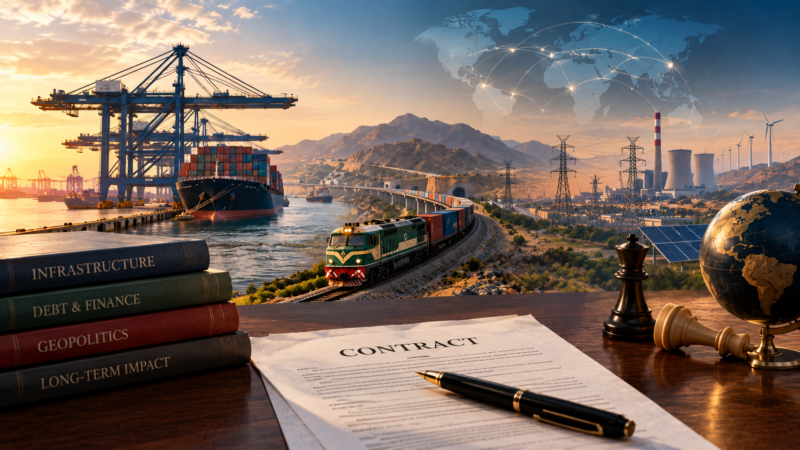
Almost a decade ago, the main argument about mega-infrastructure was mainly about economics. Would the port pay for itself? Would the motorway move enough freight and boost commercial activity? Would the power-generating plant alleviate the energy woes of a country? However, today across three continents, the mega-infrastructure projects have become a reason for governments to win, lose or constrain.
In the context, China emerges at the top of the list. Its engagement across the 150 countries of BRI reached around $126 billion in the first half of 2016, and this is the highest since the BRI’s inception in 2013. Here, more than the volume of concrete, what is more intriguing is how it affects the politics on the ground in host countries.
Beijing’s model has also lately changed. Open-handed sovereign lending gradually tailed off around 2019. Since then, China has shifted from being a financier to a creditor collecting repayments, with more money going into further equity, mining, energy and data centres rather than concessional loans to finance ministries. Nevertheless, the political consequences for the host countries have only started to arrive.
Kenya is an excellent example to start with. China’s flagship project in Kenya, the Standard Gauge Railway (SGR), was stopped well short of the Ugandan border because Beijing decided to halt funding. Kenya had built the SGR using a loan of $5.08 billion from China ExIm Bank to be paid back from 2029 to 2035. Since another sovereign loan, that too in dollars, was politically unsellable, President William Ruto’s government restructured what it already owned. The three dollar-denominated loans of China were converted into yuan, and their maturity was extended to 2040. In March 2026, construction resumed, but the seed money was sourced from a domestic cargo levy worth about $270 million. Consequently, SGR survived, but the financing model did not.
In Peru’s case, the argument is more about the jurisdiction than money. COSCO, a Chinese shipping company, built the deepwater port in Chancay with an investment of $1.3 billion. Because the port was built purely from private capital, the regulatory body for ports in Peru, Ositrán, was ordered by the Constitutional Court of Lima to stand back from any kind of supervision or intervention. After five months, a Lima appeals court reversed the decision and posited that Chancay port is a public-use infrastructure regardless of the ownership. COSCO has again taken the case to the Constitutional Court. As of now, a port built to move copper has become a test of who governs it.
The pattern follows in South Asia too. Sri Lanka and Bangladesh are cases in point.
Then there is Pakistan, which is the laboratory. CPEC brought nearly $25.4 billion in investment, around 510 km of highway, 886 km of transmission line and 8,000 megawatts into a grid that used to fail daily. Load-shedding is no longer the national grievance as it was before 2013; however, the bill arrives through the electricity meter. While ensuring the production capacity, Pakistan signed take-or-pay contracts obliging it to pay the producers regardless the power was used or not. Resultantly, the system-wide capacity payments have jumped up from Rs384 billion to Rs2.1 trillion; power-sector circular debt reached Rs1.9 trillion by February 2026. When Islamabad asked the Chinese producers to waive Rs170 billion in the late-payment charges following the domestic producers, they showed reluctance on the grounds that it would set a wrong precedent for other BRI projects. Here, while China is defending its contracts, Pakistanis are paying the tariffs.
The second bill is constitutional in nature. Where Balochistan holds the crown jewel of the corridor, it gains the least from CPEC. Since 2021, at least 20 Chinese nationals have been killed in various attacks by BLA and allied groups, in addition to numerous attacks on civilians and armed forces of Pakistan. Islamabad’s response was to dedicate a police force to protecting Chinese nationals. No matter what the logic is, a separate protective apparatus for foreigners in a single province indicates who the corridor is for; the grievance is left where the asset is placed, with benefits centralised in Islamabad. The second phase isn’t as robust as the first one. Three out of nine SEZs have started operating; China pulled back from financing the ML-1 railway, which is the biggest project of the corridor, in 2025, and in the first six months of 2026, no new Chinese engagement was recorded in Pakistan. Pakistan is yet to recover from the first phase and is still fighting to protect it.
So far, Washington, Brussels and Delhi have been responding by drawing rival lines. The India-Middle East-Europe Economic Corridor (IMEC), announced at the G20 in 2023 as an explicit alternative to the BRI, still has not materialised. By May 2026, it was yet to secure any firm funding commitments, and has no construction timeline either; its route through the Strait of Hormuz seems considerably less promising after this year’s disruption to Gulf shipping.
That does not mean that IMEC is politically inactive. Governments will be called upon to decide on maps, but not yet on assets. On the other hand, the real money continues to flow: Africa hosted the most Chinese investments and construction, with $46.99 billion in the first half of 2026.
Here, the common thread is not Chinese investments or the West’s response. Mega-infrastructure projects are signed on political timescales and repaid on geological ones: a port takes five years to build, thirty to pay for, and outlives every government which championed it.
Three things determine whether a project leads towards more stability or otherwise. The first is whether the contract can withstand disclosure: Kenya renegotiated in public and kept its railway, while Peru’s regulatory carve-out became a sovereignty crisis precisely because it was settled quietly in court. The second is whether the people closest to the asset can see a return; Balochistan’s insurgency is an economic grievance, and it has a security expression; no protective police force can solve it. The third is whether the state keeps the fiscal room to say no later; the lesson Pakistan is learning one tariff notification at a time.
The most consequential fact about mega-infrastructure is not that it moves goods. It is that it converts a discretionary political choice into a fixed obligation that the next government, and the one after that, must defend. The concrete does not vote. It simply narrows, year by year, the range of things a country can plausibly decide.

Aizaz Hussain
The writer is a PhD candidate at Sciences Po (Paris) and researches policy and geopolitical issues.