Originally published by The Lowy Institute. Featured by South Asia Times (SAT) for informational purposes, with attribution to the original author and publisher.
China’s president spoke of partnership in Delhi, but China’s longstanding doubts about India’s rise persist.
Xi’s Delhi visit: China’s new tone, old assumptions about India
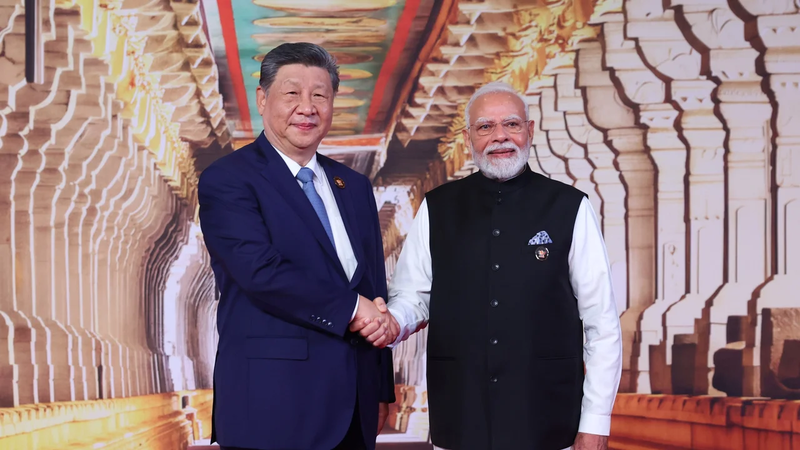
When China’s President Xi Jinping flew into New Delhi for the BRICS summit last month, it was his first visit to India in seven years. Meeting Prime Minister Narendra Modi on 12 September, Xi said the two countries should be “partners rather than rivals” . Modi also spoke of improving ties. After years of tension along their Himalayan border, the language marked a welcome change.
But better relations do not necessarily mean a different view of each other. China and India have disputes over territory , influence and international status. Some of those differences are rooted in how Chinese leaders have understood India’s place in Asia for more than a century.
The border dispute remains unresolved. A clash in the Galwan Valley in 2020 killed 20 Indian soldiers and, according to Beijing, four Chinese soldiers . The two governments reached an agreement in 2024 that helped ease their military stand-off. Yet troops remain deployed along the disputed frontier, and negotiations over the boundary have made limited progress.
Bilateral trade reached a record $155.6 billion in 2025, according to Chinese customs figures. But India imported roughly $132 billion worth of Chinese goods in its 2025–26 financial year, leaving a trade deficit of more than $100 billion. New Delhi wants better access to the Chinese market and more dependable supply chains.
Their rivalry is not only about borders, trade or military power.
The gap in overall power is also large. In current US dollars, World Bank figures put China’s 2025 economy at about $19.5 trillion , against nearly $4 trillion for India. The Stockholm International Peace Research Institute estimates that China spent $336 billion on its military that year, compared with India’s $92.1 billion . These differences help explain why Beijing may not see New Delhi as an equal strategic competitor. But they are not the whole explanation.
In a 2024 study called “Why Is China Dismissive of India’s Great Power Ambitions?,” in the Journal of Asian and African Studies , political scientist Raj Verma argued that China’s view of India has also been shaped by history and cognitive biases. Chinese intellectuals in the late 19th and early 20th centuries often treated British-ruled India as a warning of what might happen to their own country. They described India as a wang guo , or “lost country”. China faced foreign domination and unequal treaties but was never formally ruled as a single colony in the way India was under Britain.
Verma cites an earlier scholar’s account of Mao Zedong describing India in a 1970s poem as a cow, and a Peking University annotation of the poem that says the cow has “no particular talents” and that its ambitions are futile. He recounts the 1972 conversation with Henry Kissinger when Premier Zhou Enlai reportedly dismissed India’s prospects as “ a bottomless hole ”, and that earlier the writer Lu Xun had described Indians as “inferior slaves”. These remarks were not neutral descriptions of India. They reflected attitudes shaped by empire, nationalism and China’s own struggle for political survival.
Verma also argues that China’s revolutionary leaders were sceptical of India’s largely nonviolent independence movement. They had fought Japanese imperialism and a civil war, and often associated armed revolution with national strength. But India’s struggle also included armed resistance, a history that such judgements overlooked. Nor can remarks from earlier generations establish what Xi or today’s Chinese public thinks.
Still, the attitudes are relevant because they predate the present economic gap. As Verma notes, the two economies were relatively close in size in 1978: around $150 billion for China and $137 billion for India. China’s dismissive image of India was already established.
Manjeet S. Pardesi reached a related conclusion in a 2021 study called “Explaining the asymmetry in the Sino-Indian Strategic Rivalry” in the Australian Journal of International Affairs . He described India as a “lesser” rival in Chinese strategic thinking, but one capable of obstructing Beijing’s wider ambitions in Asia. India therefore matters to China even when Beijing does not regard it as a peer. For New Delhi, China is a central security concern. Beijing, meanwhile, is more focused on its rivalry with the United States.
Athird study offers a more optimistic reading. Writing in International Affairs in 2017, Xiaoyu Pu called China’s response to India’s rise “ambivalent accommodation” . Beijing could welcome India as a partner among developing countries while hesitating to accept some of its great-power claims. Recognition, in this account, can change with political interests and the state of bilateral relations.
The September summit offers a test of that argument. Xi called for a more rational strategic perception of India. The BRICS declaration also reiterated China’s support for India’s aspiration to play a greater role at the United Nations, including in the Security Council. That language is not new, and it falls short of an explicit endorsement of a permanent Indian seat.
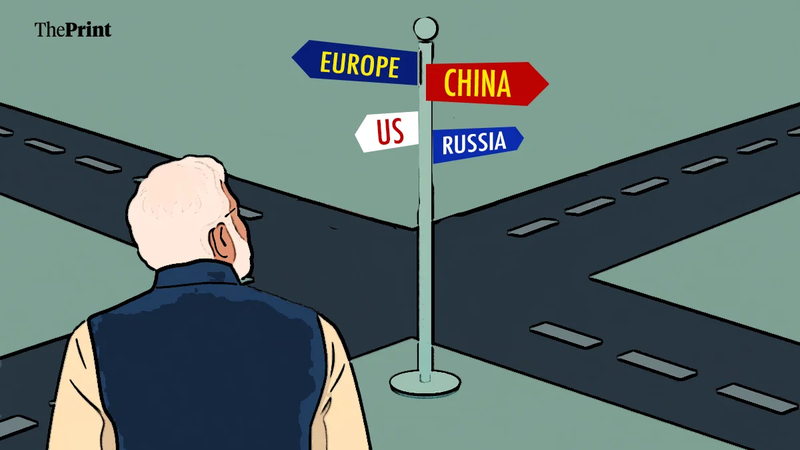
Now the question is whether India and China can move beyond the old assumptions that have shaped how they see each other. Their rivalry is not only about borders, trade or military power. History, national pride and long-held perceptions have also played a part. Better trade and more meetings between leaders may improve relations, but they will not necessarily change these views overnight.
Saqlain Rizve
Saqlain Rizve is a journalist, analyst and photographer. He writes about politics, foreign affairs and society at large, with a particular interest in South Asia.