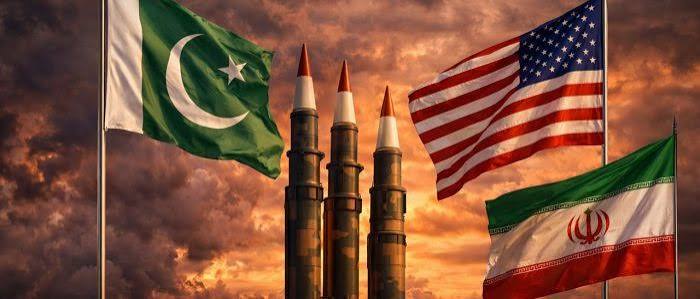
Pakistan’s relations with Iran took a huge turn as it has positioned itself as a pivotal regional peacemaker, and in such times, when the entire world stood away to bring any peace and stability, it is Pakistan that stood along with Iran, proving its friendship and securing its regional interests.
“All war represents a failure of diplomacy,”
-Tony Benn
With the dawn of the 21st Century, the struggle to achieve power has been entirely shifted from the traditional way of military might and means to portraying soft power and persuasion. This very motive is an essential goal for almost every country in the world: to be able to hold enough power to influence the world stage, whether it be economic, social, political, or diplomatic. It is also important to understand that in International Relations theories, the essence of realism took a huge shift due to its relevance in the last few years, in different parts of the world, the break out of wars between powerful states, may it be Russia Ukraine, USA China, Palestine Israel, India Pakistan, India China, or this current Israel and Iran, it is the realist school of thought that defined the politics and where it is leading to in the last few decades. However, with the recent turn of events, it is the liberal school of thought that took over the world stage and put an end to the kind of conflict that has the potential to start an unstoppable nuclear war. As in the core liberal philosophy on peace and stability, Immanuel Kantt proclaimed that “A state of peace among men living together is not the same as the state of nature, which is rather a state of war; therefore, the state of peace must be established.” And where the major powers have failed to bring peace and a solution to such a catastrophic war, it is Pakistan that stood firm, with its phenomenal diplomatic strategy, signing the Islamabad Memorandum of Understanding between the two, a milestone achieved, taking its identity to the world stage. A country that was known in the world as a terrorism exporter country now becomes a peace exporter, making its name in the worldwide headlines.
Pakistan’s relations with Iran took a huge turn as it has positioned itself as a pivotal regional peacemaker, and in such times, when the entire world stood away to bring any peace and stability, it is Pakistan that stood along with Iran, proving its friendship and securing its regional interests. Besides, the potential benefits that Pakistan can gain from this also have no bounds, like in Energy Infrastructure, the Iran-Pakistan Gas Pipeline, Petrochemical and Oil deals, Transit and trade corridor, port connectivity, border market and barter trade, Agriculture and Joint Ventures in agri trade and extraterritorial cultivation. Pakistan and Iran can work on several projects together if this peace deal between the United States and Iran succeeds. But aside from this, it is the trust that Pakistan is building on the world stage; it is the peak diplomacy that Pakistan is offering for world peace right now. While the biggest global powers were preparing for an unstoppable escalation, Islamabad stepped directly into the spotlight as the ultimate peace broker. Also, to bring American leadership to the table, Pakistan has just demonstrated absolute peak geopolitical leverage through its unmatched statesmanship and diplomatic brilliance. In 1945, a prominent American scholar and poet Archibald Macleish said that “Since wars begin in the minds of men, it is in the minds of men that the defenses of peace must be constructed’’ he said it with the formations of united nations that put an end to the decade long war, all through the power of words and persuasion, it is now Pakistan that is using the same strategy.
Pakistan’s relations with the United States have come a long way, from the client model framework in times of need, specifically in military assistance in the past, to becoming increasingly dependent in diplomacy following all regional shifts. On a state level, Pakistan also fosters a diverse model of relations with the USA. As Prime Minister Shahbaz Sharif said, “The foundation of Pakistan-US relations has expanded over decades and now rests not only on security cooperation, but increasingly on trade, innovation and human connectivity between the two societies.” With this upcoming deal, if Pakistan puts an end to this war through the Islamabad memorandum of understanding, it will be a trademark in the historic relations between the two. Pakistan can export its brilliance in many diverse efforts afterwards, especially in mediations, peace initiatives, and becoming a true example for peace and harmony in the world. With the US, Pakistan can extend many diverse economic project with the trust it achieved with this current peace efforts, like in critical and mineral defense technology, projects like Reko diq and rare earth minerals, Green energy and climate resilience like power sector improvements, climate smart agricultures, renewable energy deployments and water management, Tech Ecosystem and startup investments in artificial intelligence, fintech, agritech, healthtech and software development by Pakistani firms, boosting foreign direct investment in Pakistan.
Islamabad Memorandum of Understanding will be taught in diplomacy and political history. While most of the countries in the world offer weapon-complex economies, technology, automation, industries, global e-commerce, and transformation, Pakistan offered diplomacy, which was very unprecedented to the world, considering its past. Pakistan was able to turn what might have been a situation between geography and a partnership into a mediation. The potential of this Iran and Israel conflict could have turned it into a regional war, which Israel pushed to the very end. The leadership of the Gulf Cooperation Council didn’t take any part in directly halting this conflict, and thus neither did Pakistan, which has actively played its role in bringing all parties of this conflict together, mainly the United States and Iran. Iran could have chosen diplomacy over escalation, but decided not to trust the United States and instead only trusted Pakistan, which is not only its ally, but a trusted partner for the Gulf region as well. Pakistan appeared to be a successful negotiator in this conflict between the US and Iran. Its identity and image in the world, which has been portrayed as a terrorist exporter, has now become a peacemaker, which is the most substantial goal it achieved, considering the cross-border terrorism and Indian aggression and their media propaganda. The world has not only noticed Pakistan’s role in these mediation efforts but also admired and acknowledged its consistent efforts for bringing long-lasting peace to the world.

Kamran is a graduate in International Relations and is currently working as a research fellow with Dr. Minhas Majeed Khan Marwat. He specializes in Pakistan-US relations and strategic and security affairs