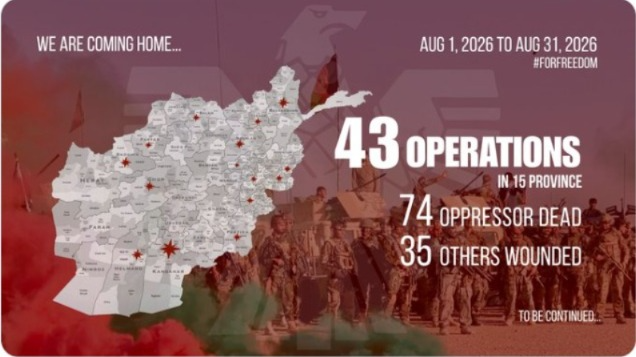
The Afghanistan United Front’s report of 43 operations across 14 provinces in a single month is a significant marker in the ongoing armed opposition to Taliban rule.
According to AUF spokesperson Hikmatullah Kakar, these operations resulted in 74 Taliban personnel killed and 35 wounded. Numbers at this scale, and spread across this much territory, point to something more than sporadic, isolated resistance. They point to sustained pressure on the regime’s security apparatus.
The geographic breadth is the most striking element of this report. Fourteen provinces is not a narrow band of contested territory, it is a footprint that spans much of the country, and it includes activity inside Kabul itself. A regime that governs from the capital facing armed resistance within that same capital is a direct challenge to the image of uncontested control the Taliban has worked to project since 2021.
The specific operations reported illustrate this pattern clearly. On 2 September, AUF targeted Qari Agha Gul, a Taliban Amr bil Maruf, vice and virtue, official in Kabul. AUF identifies him as having been involved in harassing Kabul residents and humiliating young people.
This is not an arbitrary target. Vice and virtue officials are among the most visible enforcers of Taliban social restrictions, the ones ordinary Afghans encounter directly in daily life. Targeting this kind of official signals that the resistance is aiming at the machinery of coercion itself, not just at abstract political authority.
A day earlier, on 1 September, AUF targeted a member of the Taliban regime’s 4th Battalion in Sar-e Pul, killing one Taliban personnel. Combined with the Kabul operation, this shows resistance activity occurring on the same timeline in geographically distant provinces, the capital and the north, underscoring the claim that this is a coordinated campaign rather than disconnected local incidents.
What this data reveals is a regime whose model of governance rests heavily on coercion and enforcement, and that model is now facing organized, geographically distributed pushback. The Taliban’s authority in Afghanistan has never rested on broad political consent; it has rested on the ability to project force and control administratively at the local level.
Forty-three operations in a month, spread across 14 provinces, directly tests that ability. Every province where an operation occurs is a province where the regime’s claimed monopoly on force is being contested in practice, not just in principle.
The casualty figures reinforce this reading. Seventy-four Taliban personnel killed and 35 wounded in a single month represents a real toll on the regime’s security structures, not a symbolic gesture. Security personnel operate as the front line of Taliban enforcement, in checkpoints, patrols, and local administration.
Sustained losses at this level, month after month, wear down both personnel and the local networks of intimidation the regime depends on to maintain control without genuine popular buy-in.
The deeper significance of this report lies in what the resistance’s persistence says about the durability of Taliban rule itself. Harsh restrictions, political exclusion, and coercive local administration have generated resentment across Afghan society, and that resentment is now finding expression through direct action against the officials who implement these policies.
From Kabul to Sar-e Pul, the message embedded in this pattern of operations is consistent: Taliban rule is being actively contested on the ground, in real time, across a wide swath of the country it claims to fully control. A regime that must continuously fight to hold territory it already governs is a regime whose authority remains unsettled, whatever its formal claim to power.