Since the Taliban government has been established in Afghanistan, the country presents a paradox as it has achieved a degree of political and territorial stability, yet remains far from a sustainable political settlement.
The Taliban have consolidated control over the state and largely displaced the nationwide warfare that characterised the previous period, but control alone cannot provide lasting legitimacy.
A sustainable transition will require more than the survival of the current regime; it will require institutions capable of accommodating Afghanistan’s political diversity, protecting basic rights, generating economic opportunity and maintaining peaceful relations with its neighbours.
The first requirement is political legitimacy.
The Taliban’s authority rests primarily on control of territory and state institutions rather than an inclusive political process. Afghanistan’s political future therefore cannot depend indefinitely on a system in which decision-making remains concentrated within a narrow leadership structure.
A sustainable settlement would require broader participation by Afghanistan’s ethnic, tribal, regional and political constituencies. This does not necessarily mean restoring the political system that existed before August 2021.
Rather, it means developing an Afghan-owned framework in which competing interests can be represented and political disputes can be managed without returning to armed conflict.
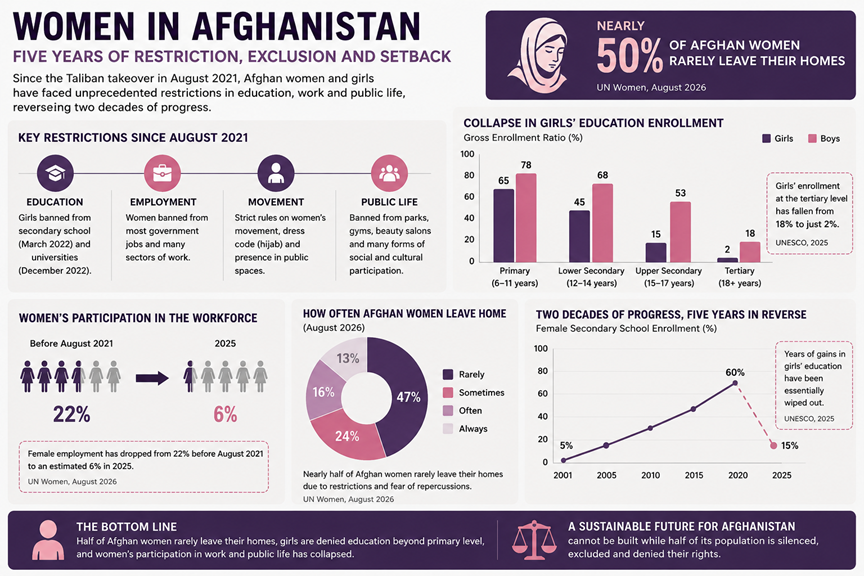
Inclusion is particularly important in relation to women. The exclusion of women and girls from education, employment and public life is not only a human-rights concern; it also weakens Afghanistan’s social and economic capacity.
UN Women reported in August 2026 that nearly half of Afghan women rarely leave their homes, reflecting the depth of restrictions imposed on their participation in society.
A political order that excludes a substantial portion of its population cannot easily develop the human capital, institutional capacity and public legitimacy required for long-term stability. Women’s participation should therefore be treated as a component of sustainable governance rather than merely an external demand.
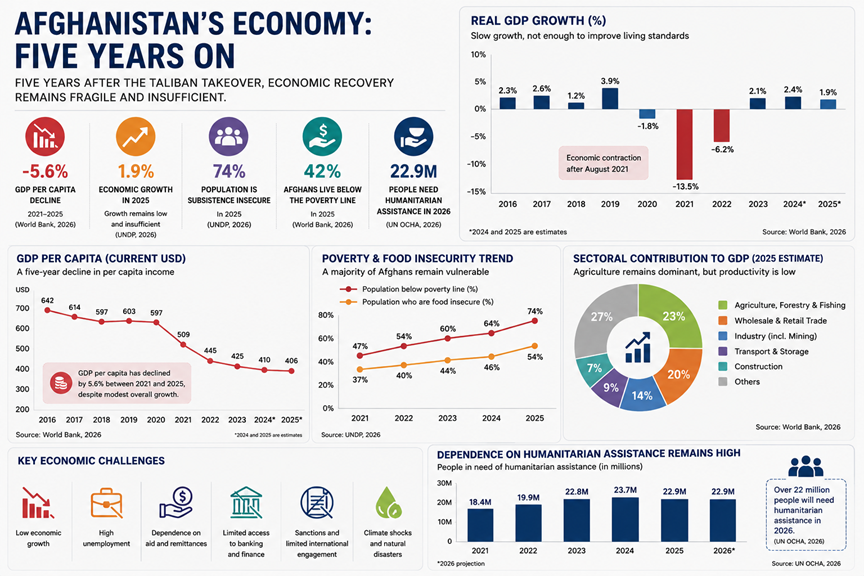
Economic sustainability is equally central. Political stability cannot endure indefinitely while households remain vulnerable to poverty, unemployment and dependence on humanitarian assistance.
Afghanistan’s economy grew by around 1.9 percent in 2025, according to the UNDP, yet 74 percent of Afghans remained subsistence insecure. Economic growth has therefore not translated into sufficient improvements in living standards.
A sustainable transition will require greater private-sector activity, employment generation, agricultural development, regional trade and infrastructure investment. Reducing dependence on humanitarian assistance must become part of the broader political strategy.
Security also needs to move from coercive control towards institutional stability. The reduction in large-scale fighting represents an important change from Afghanistan’s previous decades of conflict, but threats from militant organisations, local grievances, border tensions and internal political exclusion remain challenges.
A sustainable state must possess institutions capable of addressing these problems through law and accountable governance rather than relying primarily on coercive authority.
The international community also faces a difficult choice. Complete isolation has limited capacity to influence developments inside Afghanistan, while unconditional recognition could remove important incentives for reform.
A more sustainable approach would be calibrated engagement: maintaining dialogue with the Taliban on humanitarian assistance, counterterrorism, trade, migration and regional security while linking deeper international integration to measurable progress on governance, rights and inclusion.
Such engagement would preserve channels of communication without treating political recognition as an automatic consequence of regime survival.
Five years after Kabul, the central question is therefore no longer whether the Taliban can retain power. They have demonstrated their ability to do so. The more consequential question is whether that authority can evolve into a political order capable of commanding broader legitimacy.
Afghanistan does not need another externally imposed political model. It needs an Afghan-owned process that transforms de facto control into functioning institutions, political participation and economic opportunity. Without that transition, stability may remain fragile and exclusionary. With it, Afghanistan could begin moving from the politics of survival towards the foundations of a sustainable state.

Your go-to editorial hub for policy perspectives and informed analysis on pressing regional and global issues.