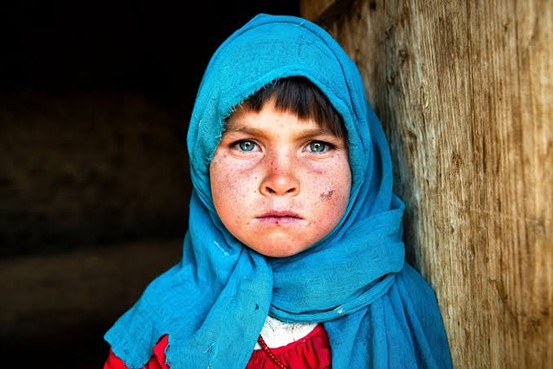
As the Taliban returned to power, one of the most consequential changes in Afghanistan is also one of the least visible: time is producing a generation for whom Taliban rule is not a political rupture but a childhood reality.
Consider the distance between August 2021 and August 2026. An Afghan child who was ten when Kabul fell is now fifteen. A child born around the takeover is now approaching school age.
For the older child, the pre-Taliban period may survive as fragments of memory. For the younger one, there is no memory of it at all. The Afghanistan described by parents, older siblings or relatives belongs to a past the child never experienced.
That distinction matters. Political systems do not shape societies only through laws and institutions. They also shape expectations. Children learn what is normal from the world immediately around them: what education looks like, where they can go, what work they can imagine, what they can say publicly, how they interact with authority and what opportunities they believe are available to them.
Five years into Taliban rule, those expectations are already being formed under a very different social order.
Education offers the clearest example. Boys continue through formal schooling and university, although the curriculum has increasingly emphasised religious instruction at the expense of some scientific and cultural subjects.
For girls, the trajectory changes dramatically after grade six.
Secondary education has remained barred since March 2022, while university access was suspended in December that year. The consequences extend well beyond the classroom.
A generation of girls is losing years of education, while Afghanistan’s future supply of female teachers, doctors and other professionals is simultaneously being weakened.
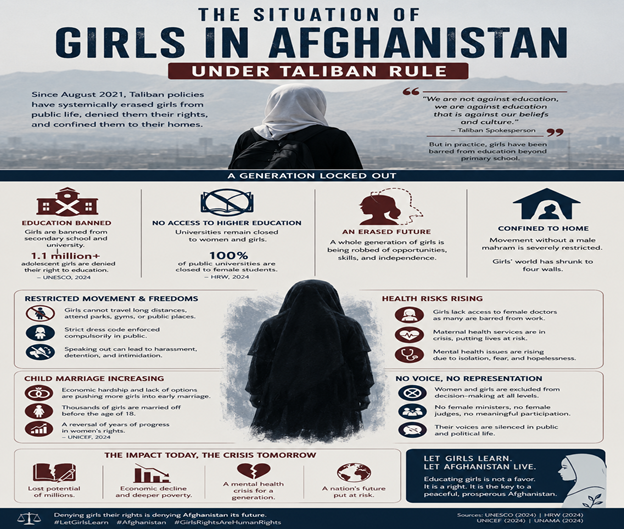
This is not simply an issue of educational rights. In a society where restrictions on male practitioners’ ability to treat women can affect access to healthcare, excluding women from education also creates practical institutional shortages.
The effects may therefore become more visible with time, as today’s schoolgirls would otherwise have become tomorrow’s professionals. Home-based and underground education networks offer alternatives, but they operate without the security, recognition or scale of a formal education system.
The same question of what becomes “normal” extends into the digital sphere.
For young Afghans whose physical and public worlds have narrowed, the internet can function as a window into lives beyond the country’s borders. Social media platforms can expose users to different social norms, lifestyles and possibilities, even as access remains uneven and online activity faces increasing scrutiny. The contradiction is striking: the same digital environment that allows young people to see beyond Afghanistan’s restrictions can also become an object of state control.
This makes technology more than a communications issue. It is part of the contest over how this generation understands the outside world. A young Afghan may have little opportunity to travel, limited access to public spaces and restricted educational choices, yet still encounter through a screen societies organised according to entirely different rules.
The result is unlikely to be uniform. For some, exposure may reinforce curiosity and dissatisfaction; for others, restricted access and social conditioning may make those alternatives distant or irrelevant. What matters is that the comparison remains possible.
Economic conditions add another layer to the problem.
Afghanistan’s economy recorded estimated growth of 4.8 percent in 2025, yet GDP per capita declined by 5.6 percent.
The contrast illustrates why macroeconomic growth alone says little about the prospects confronting young Afghans. An economy can stabilise on paper while individual opportunity remains constrained.
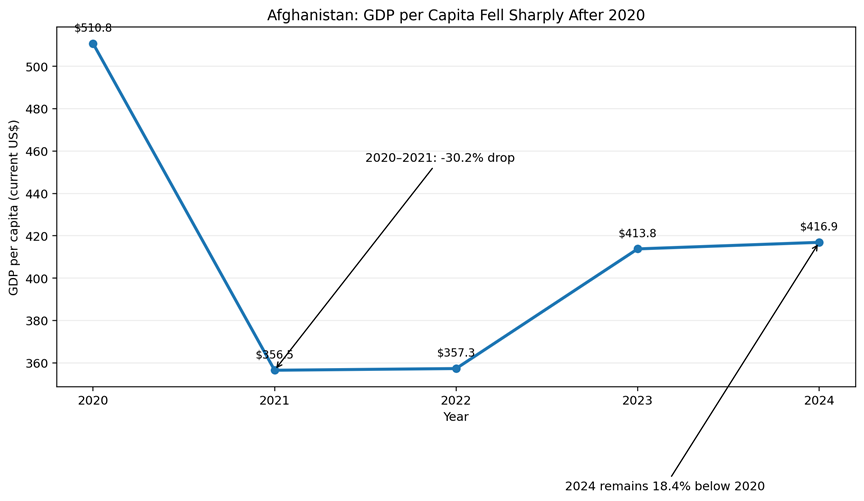
Youth unemployment, limited formal employment, weak private investment and dependence on informal economic activity continue to narrow the pathways available to young people.
The contraction of international assistance creates another pressure point, particularly when combined with restrictions affecting women’s participation in humanitarian work. For many families, migration consequently becomes less a matter of aspiration than economic necessity.
The large-scale movements and deportations involving Afghans in Pakistan and Iran further demonstrate how closely Afghanistan’s domestic economic pressures are connected to its regional environment.
Then there is public life. Restrictions on parks, gyms and recreational spaces have particularly affected women, while broader controls over music and civic activity have reduced the spaces in which young Afghans can gather, organise and participate collectively.
Youth organisations, sports and informal community activities cannot simply be dismissed as secondary concerns. They are part of how societies create social trust, shared identity and a sense of belonging beyond the family.
For older Afghans, the contraction of these spaces represents a loss.
They remember that these spaces existed. For a child who has never experienced them, however, their absence does not necessarily register as deprivation. It may simply register as the ordinary boundaries of life.
That is the deeper concern.
The long-term question is not whether every Afghan child will accept Taliban rule or whether every young Afghan will eventually reject it.
There is not yet enough evidence to make such a conclusion. Generational attitudes are shaped by family, ethnicity, geography, education, economic circumstances, exposure to the outside world and personal experience. Afghanistan is too diverse for a single political psychology to emerge automatically.
But the absence of a shared memory of alternatives still matters.
A child who grows up under a particular political order learns its restrictions differently from an adult who remembers their introduction. The adult can say, “This was different before.” The child cannot make that comparison from personal experience. The distinction may become especially important as the years pass and the pre-2021 Afghanistan becomes increasingly distant from everyday life.
This is why the international debate over Afghanistan cannot remain focused exclusively on diplomatic recognition, sanctions, engagement or the Taliban’s relationship with foreign governments.
Those questions remain important. Russia’s formal recognition of the Taliban and the varying degrees of engagement maintained by other states demonstrate that the international community continues to grapple with how to deal with the Emirate. But diplomatic legitimacy is only one dimension of Afghanistan’s future.
The other is generational.
While governments debate recognition in capitals and diplomats discuss inclusive governance in international forums, millions of Afghan children are quietly acquiring their first understanding of what government means. They are learning what education looks like, what work is available, what public space permits, how women participate in society and how authority operates. They are developing expectations before they have developed the historical memory necessary to question them.
That process will not produce its consequences immediately. It may take another decade before its full significance becomes visible, when today’s children become young adults entering universities, workplaces, institutions and public life. By then, the question may no longer be what the Taliban changed in Afghanistan in 2021, but what Afghanistan’s youngest generation has come to regard as normal because of those changes.
The most consequential legacy of five years of Taliban rule, therefore, may not be found only in today’s restrictions or tomorrow’s diplomatic arrangements. It may be found in the minds of those who were too young to remember the country before them.
For a generation born into the Emirate, “before” is becoming history rather than memory. And once memory disappears, the meaning of change itself begins to change.

Your go-to editorial hub for policy perspectives and informed analysis on pressing regional and global issues.