

Book Title and Author’s Name:
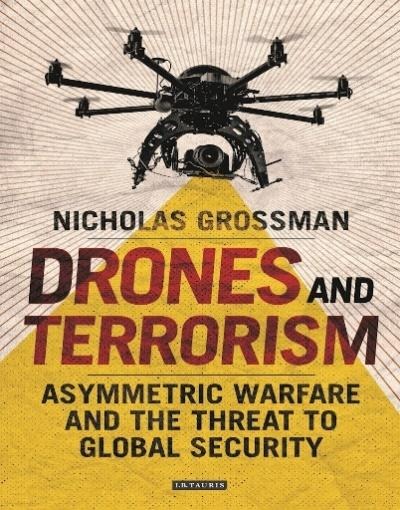
Drones and Terrorism: Asymmetric Warfare and the Threat to Global Security,
Nicholas Grossman.
I.B. Tauris, 2018, 240.
As the world continues to struggle in understanding the revolutionary paradigm of drones, their usage in multidimensional spaces, from surveillance to combat, terrorists to law enforcement, has created a never-ending loop of entanglements.
Nicholas Grossman’s Drones and Terrorism: Asymmetric Warfare and the Threat to Global Security offers a timely and analytically rigorous examination of how unmanned aerial systems, popularly known as drones, are reshaping the landscape of modern terrorist entities and counterterrorism strategies of states.
As drones become cheaper, more accessible, and even sophisticated for multi-domain operations, Grossman argues that they are no longer mere tools of national power, but increasingly smart instruments of asymmetric warfare available to terrorist entities.
The book’s central contribution lies in its careful disaggregation of the tactical, strategic, and psychological effects of drones, used by terrorist organizations, as well as its assessment of the broader implications for global security.
Grossman begins with an interesting analysis. He situates drones within the historical evolution of asymmetric warfare, making the Revolution in Military Affairs (RMA) his center.
He emphasizes that terrorism has always adapted to technological change, which makes it not only difficult to counter, but also threatening to conventional militaries. From the use of dynamite in the nineteenth century to suicide bombings and cyber-enabled propaganda in the twenty-first, terrorist tactics have triggered a wave of strategic and operational retrospection for national institutions, international organizations, and global security.
Drones, he contends, represent a qualitative shift rather than a simple incremental force posture or domain priority. Unlike traditional weapons, drones allow terrorist groups to project force remotely, reduce risk to operatives, and generate disproportionate psychological and political effects.
This framing is effective, as it avoids technological determinism while still underscoring why drones pose novel challenges to existing security paradigms in the 3rd Nuclear Age.
The nuanced typology of drone use by terrorist organizations is one of the book’s strengths. Grossman distinguishes between drones employed for surveillance and reconnaissance, those adapted for kinetic attacks and weapons trafficking, and those used primarily for propaganda reinforcement and intimidation management.
By doing so, he demonstrates that the threat posed by drones is not limited to spectacular attacks. The threats include more subtle forms of operational enablement for logistical coordination and risk preparedness. Surveillance drones, for instance, can improve targeting accuracy for conventional attacks, while propaganda footage filmed from the air can amplify threat perceptions and fear mongering of strength and modernity.
This analytical clarity allows the reader to understand why counter-drone strategies focused solely on preventing attacks may miss broader security conundrums. Grossman also devotes significant attention to the diffusion of drone technology.
He argues that commercial off-the-shelf drones have dramatically lowered barriers to entry. They are enabling even poorly resourced groups to experiment with aerial capabilities, erasing the lines between trained military professionals and terrorist groups.
This democratization of airpower challenges long-standing assumptions about state monopolies over the air warfare domain.
Interestingly, Grossman avoids alarmism; he acknowledges the technical limitations of many non-state drone programs, including payload constraints, conventional firepower mismatch, and vulnerability to electronic countermeasures. However, he persuasively argues that these limitations do little to mitigate the strategic impact of drones when used creatively in asymmetric warfighting.
The book’s discussion of counterterrorism responses is one of its most compelling sections. It highlights how diversified state-level crisis behavior enables a wide-ranging counterstrategy profiling of terrorist activities to prevent recruitment and regrouping.
Grossman is also critical of approaches that rely heavily on technological fixes, such as anti-drone weapons or airspace restrictions, without addressing the underlying adaptive capacity of terrorist organizations. He highlights how countermeasures often generate counter-adaptations, creating a dynamic cycle of innovation across the spectrum.
This insight aligns with broader scholarship on military adaptation and underscores the need for flexible, intelligence-driven responses rather than static defenses. Grossman’s emphasis on organizational learning and innovation among terrorist groups is particularly valuable, as it shifts the focus away from individual attacks toward long-term strategic trends.
Another important contribution of the book is its treatment of the ethical and legal dimensions of drone warfare. While much of the existing literature focuses on state use of drones for targeted killings, Grossman reverses the lens to consider how non-state drone use complicates international humanitarian law and domestic legal frameworks.
He also raises difficult questions about attribution, proportionality, and responsibility in drone-enabled attacks, especially when commercial technologies blur the line between civilian and military assets. This discussion is not exhaustive, but it effectively highlights gaps in existing legal regimes and points to areas requiring further scholarly and policy attention.
Grossman also explores the psychological and symbolic effects of drones in terrorism. He argues that drones amplify fear not merely through their destructive potential, but through their association with omnipresent surveillance and uncontrollable threat at societal levels. Even limited drone attacks can generate outsized public anxiety, particularly in urban environments where airspace has traditionally been perceived as secure.
This insight helps explain why drone-related incidents often receive disproportionate media attention and political response, reinforcing the strategic utility of drones for terrorist groups seeking media visibility and normalcy disruption rather than mass casualties.
Despite its many strengths, the book has some limitations. At times, Grossman’s analysis remains largely conceptual, relying more on theoretical reasoning than extensive empirical case studies. While he references well-known examples such as ISIS’s use of drones in Iraq and Syria, readers may wish for deeper comparative analysis across regions and organizational types.
Additionally, the book focuses primarily on Islamist militant groups, leaving open the question of how far-right, separatist, or criminal organizations might adopt drone technologies in distinct ways. Addressing these doctrinal and postural variations could have further strengthened the book’s generalizability. Nevertheless, ‘Drones and terrorism’ makes a significant contribution to the study of contemporary security threats.
Grossman succeeds in moving the debate beyond simplistic narratives of drones as either revolutionary superweapons or marginal novelties.
Instead, he presents them as enabling technologies whose impact depends on organizational intent, strategic context, and countermeasures. This balanced perspective is particularly valuable for policymakers, who must navigate between overreaction and complacency in crafting responses to emerging threats.
In conclusion, Nicholas Grossman’s ‘Drones and Terrorism: Asymmetric Warfare and the Threat to Global Security’ is a thoughtful, well-argued, and timely work that enhances understanding of how technological diffusion reshapes asymmetric conflict.
By integrating insights from terrorism studies, military innovation, and security policy, the book provides a framework for analyzing not only current drone threats, but future adaptations as unmanned technologies continue to evolve. It is essential reading for scholars, practitioners, and students seeking to understand the changing character of terrorism and the challenges it poses to global security in the twenty-first century.

Muhammad Hamza Chaudhry
Muhammad Hamza Chaudhary is a Research Associate at Strategic Vision Institute (SVI), Islamabad.