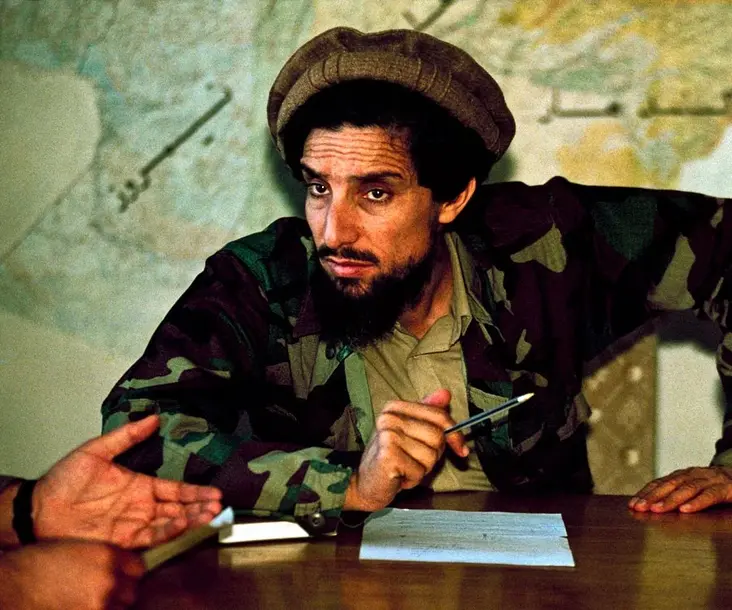
Twenty-five years ago today, Ahmad Shah Massoud was assassinated in the Panjshir Valley by two suicide bombers posing as journalists. The man Afghans called the Lion of Panjshir had spent two decades as the country’s most durable guerrilla commander.
He first rose to prominence fighting Soviet forces through the 1980s, using the narrow, defensible terrain of his home valley to outlast an occupying army many times better equipped.
When the Soviets withdrew and Afghanistan descended into civil war, Massoud kept fighting. Through the 1990s, as the Taliban swept across the country, he led the Northern Alliance, the last organised force still resisting their advance.
His assassination, ordered by Al-Qaeda days before the attacks on New York and Washington, removed the one Afghan leader with the standing and the fighters to have shaped what came after. Two Al-Qaeda Operations, Abd as-Sattar Dahmane and Rachid Bouari el-Ouaer, posed as journalists and were escorted by the Taliban to the Panjshir Valley.
Though the Taliban officially denied any role at the time, the senior leadership’s coordination with Al-Qaeda leaders and their operational and logistical support soon became clear. And now that the Taliban are once again in power in Afghanistan, their Al-Qaeda ties are still alive and well.
A quarter century on, Ahmad Shah Massoud’s name has not faded. It has instead become the banner under which a new, fragmented resistance to Taliban rule is organising, one that draws directly on his methods and, in the most literal sense, his bloodline.
Afghanistan under the Taliban has settled into an uneasy and increasingly strained normal. The group controls all 34 provinces and roughly 400 districts, more territory than it ever held before 2021. But beneath that surface, cracks are widening.
Reports this year point to a serious rift within the Taliban’s own leadership, between Supreme Leader Hibatullah Akhundzada’s hardline circle in Kandahar and more pragmatic figures in Kabul. That internal strain has coincided with a harder line on women, with girls now barred from secondary education for a fifth consecutive year.
Protests in Herat against these restrictions were met with force earlier this year. Ahmad Massoud, the son of Ahmad Shah Massoud and now leader of the National Resistance Front, publicly backed the demonstrators, describing Taliban rule as governance built on fear and humiliation.
That is not simply a son honouring his father’s memory. The NRF, founded within days of Kabul’s fall in 2021, has become the most persistent armed opposition to the Taliban, claiming thousands of operations across Panjshir, Parwan, Baghlan and increasingly further afield in Herat and Kabul itself.
Ahmad Massoud, trained at Sandhurst and educated at King’s College London, has been explicit that he sees the fight as unfinished business. He has said Afghans defeated the Soviet Union and can defeat the Taliban too, a direct echo of his father’s own defiance.
He is no longer the only one making that case. The Afghanistan Freedom Front, led by former army chief of staff Yasin Zia, has emerged as the other major force on the battlefield, striking Taliban positions in Kabul and Kunduz and even Kabul airport.
Smaller groups have multiplied alongside them. Sepahiyan-e Mihan briefly seized a district centre in Badakhshan in July, the first time the Taliban lost control of a district since 2021. The National Mobilization Front and the newly formed Afghan United Front have since joined the field.
None of these groups yet threatens Taliban rule outright. Their numbers are modest, their coordination is limited, and they operate without meaningful international backing. But their proliferation across ethnic and regional lines suggests something broader than isolated dissent.
What ties these threads together is the return of Massoud’s name to the centre of Afghan politics. For a generation too young to remember the Northern Alliance, he has become shorthand for the idea that Taliban rule was never inevitable and need not be permanent.
That distinction matters. Afghanistan’s recent history is littered with movements that borrowed heroic imagery without heroic organisation. Whether the NRF, the AFF and the smaller fronts around them can coordinate into something more than scattered pressure remains genuinely uncertain.
What is clearer is that the conditions which produced Massoud, a population unwilling to accept an entirely closed and repressive order, have not gone away. If anything, five years of Taliban governance have sharpened them.
On his death anniversary, it is essential to recognize that the resistance he embodied did not end in Panjshir in September 2001. It moved underground, waited, and is visibly stirring again. Until and unless those governing Afghanistan start countering all kinds of terrorism emanating from inside the country and ensure basic rights, Ahmad Shah Massoud’s unfortunate legacy of bloodshed will continue to affect the country’s trajectory.

Your go-to editorial hub for policy perspectives and informed analysis on pressing regional and global issues.