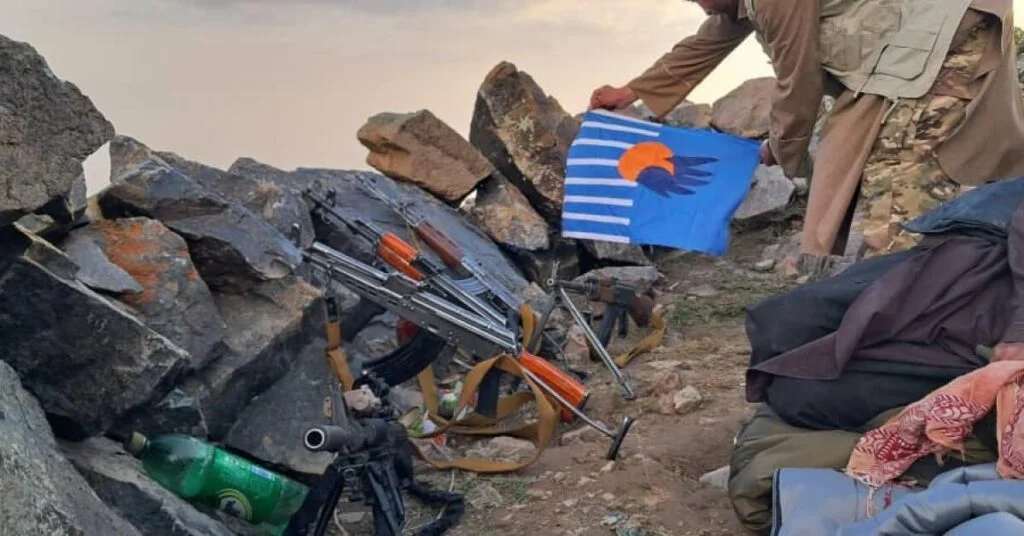
Five years after the fall of Kabul, the story of Afghanistan’s anti-Taliban resistance is no longer one of a single valley holding out against an overwhelming force. It is the story of a slow, uneven, but unmistakable diffusion. It is a story of a war that began as a last stand in Panjshir and has since crept outward into Baghlan, into Takhar, and now into Badakhshan. Each phase has looked different from the last.
What connects them is a pattern too consistent to dismiss as coincidence. Every time the resistance evolves, the Taliban regime answers not with better governance, but with harder repression. That trade, visibility for the resistance, vulnerability for civilians, is the real story of Afghanistan’s summer of 2026.
Phase One: The Last Stand That Wasn’t
When the Taliban swept into Kabul in August 2021, Panjshir became the country’s final holdout. Ahmad Massoud, son of the legendary “Lion of Panjshir,” rallied remnants of the old Northern Alliance into the National Resistance Front (NRF) and made a conventional stand in the valley his father had once defended against the Soviets. It did not last.
By September 2021, Taliban forces overran Panjshir’s defensive lines, and NRF fighters were pushed into the high valleys. This was the beginning of exile politics for Massoud and the beginning of a very different kind of war for his movement.
That defeat was formative. It taught the resistance that conventional defense against a numerically superior, better-armed Taliban was a losing proposition. What came next was a deliberate pivot.
Phase Two: The Guerrilla Turn (2022–2024)
Between 2022 and 2024, the NRF, later joined by the Afghanistan Freedom Front (AFF), founded by former army and intelligence officers, rebuilt itself as a dispersed guerrilla force. Its center of gravity shifted from Panjshir proper to the Andarab valley in Baghlan and the wider ethnically Tajik northeast, terrain chosen precisely because it denied the Taliban the numerical and logistical advantages it enjoyed in open country.
By 2022, Taliban commanders were already rotating senior figures, including former military commission head Abdul Qayum Zakir, into the Panjshir-Andarab theatre specifically to contain an insurgency that would not die. SAT’s tracking of the campaign suggests that by some counts the NRF was launching roughly one attack a week during the fighting seasons, with operations eventually reaching as far as Herat and Kabul itself.
This was not a resistance capable of holding ground. But it was a resistance capable of denying the Taliban the one thing an insurgent government needs most: the appearance of total control.
Phase Three: Badakhshan and the Politics of Retaliation (2025–2026)
The latest chapter opened this month in Badakhshan, a mountainous province wedged against Tajikistan, China and Pakistan, and it introduced a new actor: Sepahian-e Mihan, or the “Soldiers of the Homeland”, sometimes rendered Sepahian Mihan Front. Little is known about the group’s leadership or its links, if any, to the NRF or AFF, but local sources describe a coalition of activists, former security personnel and residents who say they can no longer watch Taliban rule in Badakhshan go unanswered.
In a coordinated pre-dawn assault, the group struck the district headquarters, police command and intelligence office in Yaftal-e Payeen, along with reported operations in Kishm and Yawan, disarming Taliban personnel and briefly raising its own flag over a district building before withdrawing as reinforcements arrived from Faizabad.
The Taliban recaptured the district within hours. But what followed the recapture is the part of this story that deserves the closest attention.
According to Sepahian-e Mihan’s own statement, and corroborated by accounts from former Afghan officials including ex-lawmaker Fawzia Koofi, Taliban forces responded to the military embarrassment not by pursuing the fighters who had struck them, but by turning on the civilian population of Yaftal. Dozens of young men with no apparent connection to the attack were reportedly rounded up, interrogated and, the group alleges, coerced into false confessions, a pattern visible in videos the Taliban itself circulated of detainees in custody.
Koofi described the arrests as a pressure tactic aimed at an entire community rather than a targeted response to an armed group. Sepahian-e Mihan has since called on the United Nations and international human rights bodies to investigate what it calls systematic abuse of civilians in the district.
This is the pattern SAT believes deserves to be named plainly: battlefield humiliation, followed by collective civilian punishment, followed by silence from the international community. It happened after NRF and AFF operations in the north. It is happening again in Badakhshan. A regime that cannot defeat an insurgency militarily has learned to substitute fear for victory, arresting the son when it cannot catch the fighter, and mistaking the compliance this produces for stability.
The 360-Degree Picture
Militarily, the trajectory is real but should not be overstated. The Taliban retains overwhelming conventional superiority with heavy weapons, numbers, air assets inherited from the former Afghan security forces, and interior lines of communication the resistance cannot match. Sepahian-e Mihan held Yaftal for hours, not days. The NRF, even after four years of guerrilla adaptation, remains a harassment force rather than a force capable of taking and holding territory. What has changed is the frequency and geographic spread of these challenges.
From a single valley in 2021 to multiple provinces across the north and northeast in 2026, and, reportedly, a rise in defections from disillusioned Taliban ranks as internal fractures widen, these challenges, data suggests, are indeed widening.
Politically, the timing is not incidental. This wave of resistance activity coincides with what several recent investigations describe as a genuine rift inside the Taliban’s own leadership, between Kandahar-based hardliners around Supreme Leader Hibatullah Akhundzada and more pragmatic figures in Kabul, including around the Haqqani network, who have pushed, unsuccessfully so far, for a softer domestic posture in hopes of international recognition. An insurgency that can exploit that internal discord, even modestly, gains leverage disproportionate to its battlefield footprint.
Socially, the regime’s own policies are doing recruitment work the resistance cannot do for itself. The ban on girls’ secondary education is now entering its fifth year. Restrictions on women’s work, movement and public speech remain in force. Public floggings continue. Every one of these policies deepens the well of local resentment that groups like Sepahian-e Mihan are explicitly drawing on. Their own accounts describe the group as an organic response to “growing dissatisfaction with Taliban rule,” not an externally engineered proxy force.
In human rights terms, Badakhshan is the clearest evidence yet that the Taliban’s default response to military failure is not de-escalation but collective punishment. Arbitrary detention, coerced confession, and intimidation aimed at communities rather than combatants are evidence. This is not new to Taliban rule, but the documentation is unusually direct this time, coming via the group’s own leaked video material as much as from resistance or opposition sources.
Geopolitically, Badakhshan’s location, bordering Tajikistan, China and Pakistan, ensures this will not stay a purely internal Afghan story. Dushanbe has long been a sympathetic rear base for anti-Taliban Tajik networks; Beijing watches instability near its Wakhan Corridor access with unease; and Islamabad, already contending with TTP sanctuaries it links to Taliban tolerance, will read every crack in Taliban authority through the lens of its own security calculus.
What the Coming Months Will Tell Us
The resistance that began as a doomed defense of a single valley has become a dispersed, opportunistic campaign that thrives on local grievance and regime overreach as much as on its own military capacity. That is a meaningful evolution. It is not, yet, an existential threat to Taliban rule.
What the coming months will reveal is whether Badakhshan marks the beginning of a more serious, sustained challenge to the Taliban’s authority in the north and northeast, or whether it becomes one more entry in a now-familiar cycle. A district falls, a district is retaken, and a province’s young men pay the price for a fight they may have had nothing to do with. Either way, the burden now falls on the international bodies Sepahian-e Mihan has appealed to. A UN and human rights community that has spent five years documenting Taliban abuses in the abstract has, in the video evidence from Yaftal, something considerably harder to look away from.

Your go-to editorial hub for policy perspectives and informed analysis on pressing regional and global issues.