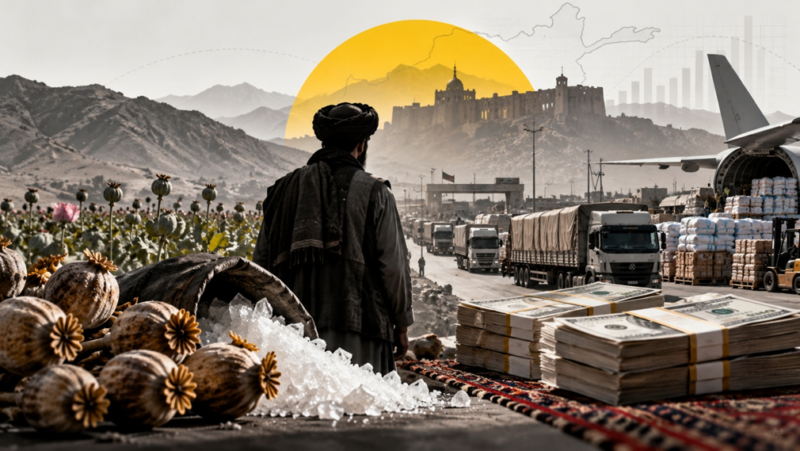
Afghanistan buys from the world roughly seven times what it sells. Five years into Taliban rule, the gap has been covered by two flows that rarely appear in the same sentence: billions of dollars in donor grants and a drug economy that has moved from poppy fields to methamphetamine laboratories.
By the Taliban’s own count, Afghanistan imports goods worth about USD 12 billion a year and exports about USD 1.7 billion. That leaves a gap of roughly USD 10.3 billion to be financed every year. The World Bank put the deficit for just the first seven months of fiscal year 2025 at USD 6.5 billion, or 30 percent of gross domestic product. The country has no access to international capital markets, its central bank reserves abroad remain frozen, and only Russia has formally recognized its rulers.
The question of how a sanctioned, landlocked economy keeps that gap open has a two-part answer, ground reports sought by South Asia Times indicate. The first is foreign money. Since August 2021, Afghanistan has reportedly received about USD 17.5 billion in foreign funding, almost all of it as grants. The second is narcotics. The Taliban’s 2022 ban on opium has worked on paper, but the trade has adapted rather than disappeared, shifting to synthetic drugs that are cheaper to make and easier to move.
Neither flow is a secret. What has drawn less scrutiny is how much the two, together, have sustained a government that most of the world still declines to recognize.
A Ten Billion Dollar Hole in the Books
The Taliban’s own trade data show a gap that has widened every year. According to the Ministry of Industry and Commerce, exports in the Afghan solar year ending March 2025 reached USD 1.785 billion, while imports climbed to USD 11.164 billion. A year earlier, imports stood at USD 8.576 billion. Exports barely moved, while imports rose by USD 2.6 billion in a single year. Ministry spokesperson Akhundzada Abdul Salam Jawad described trade as having undergone “positive changes.”
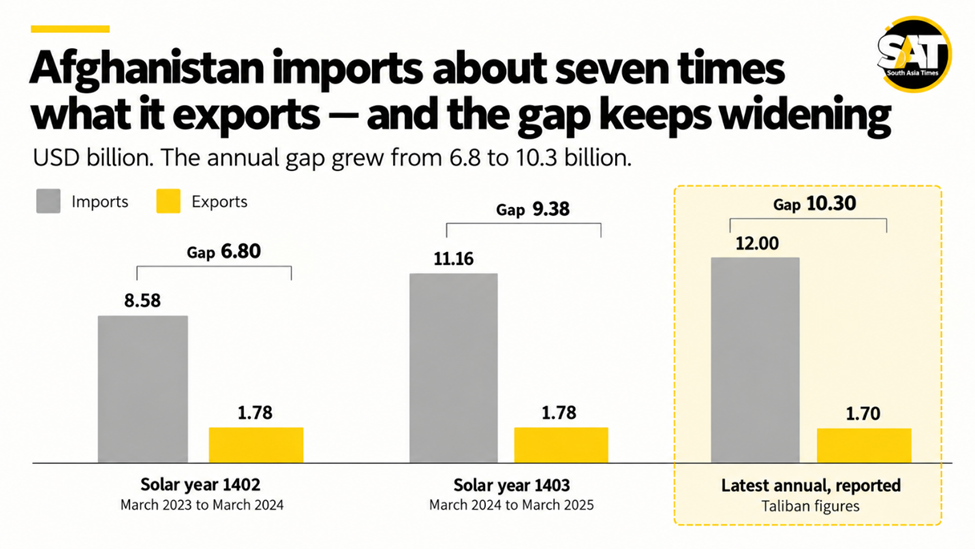
What Afghanistan sells is modest: figs, cotton, raisins, carpets, lead ingots and precious stones. What it buys is everything else, from fuel and wheat flour to machinery. The World Bank recorded imports of USD 7.6 billion against exports of USD 1.1 billion in the first seven months of fiscal year 2025 alone, a deficit up 22 percent on the year before. “Afghanistan’s economy remains under significant strain, facing multiple simultaneous shocks,” the bank noted.
In an ordinary economy, a deficit of that size would be financed by borrowing, foreign investment or a fall in the currency. Afghanistan has none of the first two, and the afghani has held broadly steady. The dollars, in other words, are arriving from somewhere.
The Most Generous Rescue of Any Crisis
The first source is foreign money. Ground reports sought by South Asia Times put the total that has reached Afghanistan since August 2021 at about USD 17.5 billion, almost all of it as grants routed through United Nations agencies, the World Bank and non-governmental organizations, under a series of humanitarian and basic-needs headings.
The public record supports the scale. The United States alone has provided “approximately $21 billion in aid to Afghanistan since 2021,” according to the Special Inspector General for Afghanistan Reconstruction (SIGAR). The watchdog also found that the United Nations had purchased and flown more than USD 2.9 billion in cash into the country by January 2024 to fund its operations. Some of that money reportedly ends up at Afghanistan’s central bank, which the Taliban control. “It’s going to a terrorist group. The Taliban are a bunch of terrorists,” John Sopko, then the inspector general, said of the shipments.
Figure 2. United Nations humanitarian funding received by country, 2022 to 2025 combined
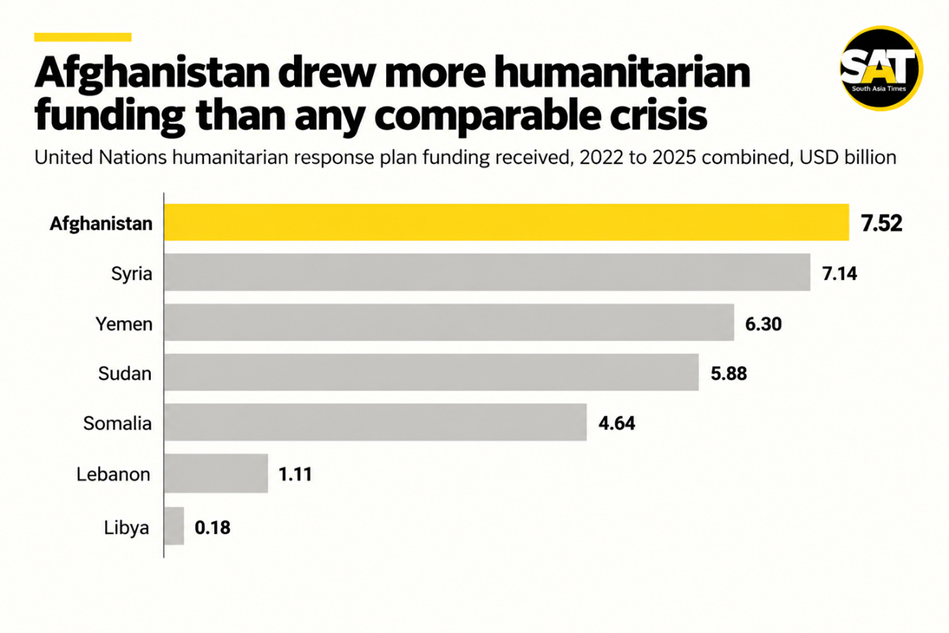
The comparison is striking. In 2022, Afghanistan’s plan drew USD 3.27 billion, more than Yemen, Syria or Somalia, and three times Sudan’s. Across 2022 to 2025, Afghanistan received more than any of the six other war-torn countries, including Yemen, where a decade of war has left millions dependent on aid, and Sudan, now home to the world’s largest displacement crisis.
The figures invite questions that donors have yet to answer in public. Why has a country under a government most capitals refuse to recognize attracted more relief than Yemen, Sudan, Somalia, Lebanon, Libya or Syria? Whose priorities have shaped that generosity? And what, if anything, have the Taliban offered in return? Funding fell to under USD 1 billion in 2025 as Western budgets tightened, but by then the cumulative transfer had already sustained the regime through its most fragile years.
From Poppy Fields to Methamphetamine Labs
The second source is narcotics. In April 2022, the Taliban’s supreme leader, Hibatullah Akhundzada, banned the cultivation of opium poppy. On the fields, the ban has held. The United Nations Office on Drugs and Crime (UNODC) found that opium cultivation fell from 232,000 hectares in 2022 to 10,200 hectares in 2025, a drop of about 96 percent.
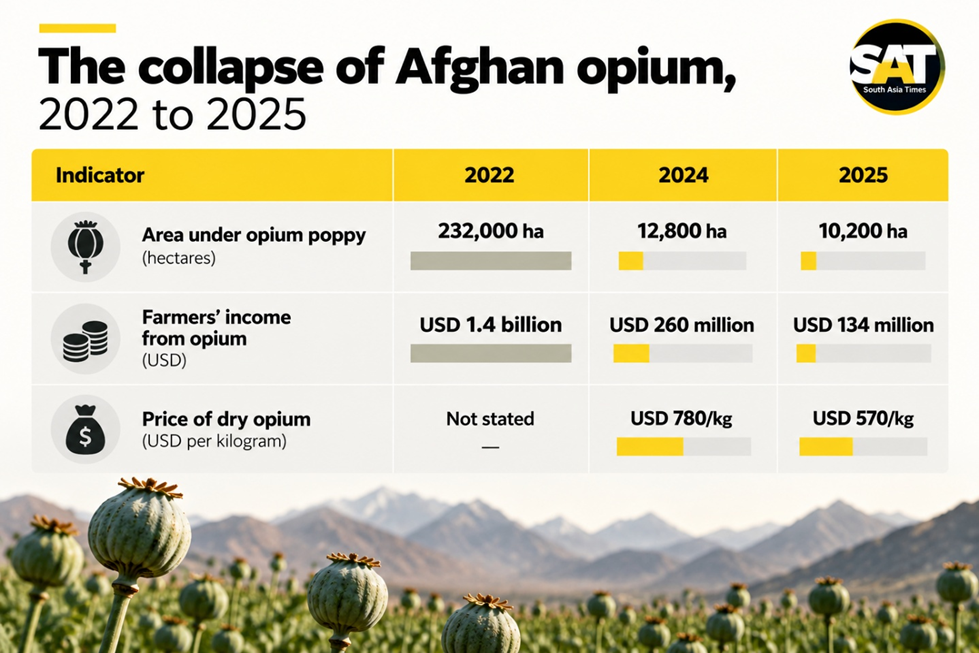
The drug economy did not disappear with the poppy. It changed form. UNODC reports that “the production and trafficking of synthetic drugs particularly methamphetamine continue to rise,” because synthetics are easier to produce, harder to detect and less exposed to drought or crop failure. Ground reports sought by South Asia Times indicate that about 5,000 laboratories are now producing drugs across Afghanistan. Many are small and mobile, which makes them easy to set up, easy to hide and easy to move.
The seizure data trace the same arc. Methamphetamine seizures linked to Afghanistan rose from 2.5 tonnes in 2017 to 29.7 tonnes in 2021, a twelvefold increase. By the end of 2024, seizures in and around the country were about 50 percent more frequent than in the third quarter of 2023. Tajikistan’s drug control agency reported a 59 percent rise in Afghan synthetic drug production in 2024. This month, Iran’s border guards in Razavi Khorasan said their seizures of synthetic drugs on the Afghan frontier had quadrupled in the first half of the Iranian year.
European monitors saw the shift coming. A 2021 study by the European Monitoring Center for Drugs and Drug Addiction described ephedrine extraction from wild ephedra plants as a “thriving cottage industry” and warned that the “full extent of ephedrine and methamphetamine production in Afghanistan remains unknown, but it could be considerable.” “Afghanistan’s drug problem is not confined to its borders,” Georgette Gagnon, the deputy head of the United Nations mission in Afghanistan, said last November.
Imported Chemicals and Exported Drugs
Afghanistan has the plant but not the chemistry. Wild ephedra supplies ephedrine, but turning it into crystal methamphetamine requires industrial precursors and reagents that the country does not manufacture. Ground reports sought by South Asia Times indicate that those chemicals are reportedly sourced from India and South Korea, two of Asia’s largest producers of pharmaceutical and industrial chemicals. European monitors found that Afghan production in its early years, from 2013 to 2017, relied on ephedrine extracted from imported medicines such as cough syrups. The supply chain, in other words, has always begun outside Afghanistan’s borders.
The finished product leaves along routes that once carried heroin. Ground reports trace four main corridors:
- West through Iran, toward Turkey and the Balkan route into Europe
- North through Uzbekistan and Turkmenistan, and via Tajikistan toward Central Asian and Chinese markets
- South through the tri-border area where Pakistan, Iran and Afghanistan meet
- By sea from the Makran coast, on dhows bound for the Gulf, East Africa and beyond
The maritime leg is where the scale becomes visible. In October 2025, the Pakistan Navy ship PNS Yarmook, operating with the Saudi-led Combined Task Force 150, boarded two stateless dhows in the Arabian Sea. It seized more than two tonnes of crystal methamphetamine worth an estimated USD 822.4 million, and a further 350 kilograms worth USD 140 million. With 50 kilograms of cocaine, the haul totaled more than USD 972 million. It was among the largest narcotics seizures in the history of the 47-nation Combined Maritime Forces. “The success of this focused operation highlights the importance of the multi-national collaboration,” said Commodore Fahad Aljoiad of the Royal Saudi Naval Forces, the task force commander.
For Pakistan, the trade is not an abstraction. Its coastline, its western border districts and its law-enforcement agencies sit on the front line of a flow it did not create. Every tonne that reaches the Makran coast is a tonne Pakistani forces must intercept.
What Kabul and the Donors Say
The Taliban point to the poppy ban as proof of their commitment against narcotics, and the collapse in cultivation is real. Donors and United Nations agencies, for their part, insist that aid is delivered to Afghans rather than to their rulers, through monitored partners and outside government budgets. UNODC’s regional representative, Oliver Stolpe, has argued that “Afghanistan’s path to overcoming illicit crop cultivation requires coordinated, long-term investments, including through international partnerships.”
Both arguments rest on what is visible. The poppy fields are visible; the laboratories are not. The aid budgets are published; where the cash ends up after it lands in Kabul is far harder to trace. That is precisely the gap the inspector general’s warnings pointed to.
What Happens Next
Three pressure points will decide whether the money keeps flowing. The first is donor conditionality: whether future grants are tied to verifiable action against narcotics and against the militant groups that operate from Afghan soil. The second is chemical control. The International Narcotics Control Board monitors trade in precursor chemicals, and tighter export checks by supplier countries would raise the cost of every batch. The third is interdiction at sea, where Pakistan’s navy and its regional partners have shown what coordinated patrols can stop.
Afghanistan’s books do not balance, and they have not balanced for five years. A country that sells USD 1.7 billion to the world and buys USD 12 billion is being carried by someone. The record suggests it is being carried by foreign grants on one side and synthetic drugs on the other. Until donors ask harder questions about the first, and supplier states close the door on the second, the Taliban will have little reason to change course, and Afghanistan’s neighbors, Pakistan first among them, will keep paying the price at their borders and on their coasts.
Sources
- Ground reports sought by South Asia Times, October 2026
- KabulNow: Taliban says Afghanistan’s exports reached USD 1.785 billion in solar year 1403
- World Bank: Afghanistan Economic Monitor, October 2025
- Afghanistan International: SIGAR reports USD 21 billion in US aid since 2021
- ReliefWeb: SIGAR 24-12 evaluation of UN cash shipments to Afghanistan
- KabulNow: SIGAR chief on UN cash shipments
- OCHA Financial Tracking Service: coordinated plans 2022, 2023, 2024 and 2025
- UNODC: Afghanistan opium cultivation falls in 2025
- KabulNow: Afghanistan’s expanding drug economy from opium to methamphetamine
- KabulNow: Iran says synthetic drug seizures on Afghan border quadrupled
- European Union Drugs Agency: Methamphetamine from Afghanistan
- Combined Maritime Forces: Task Force 150 and Pakistan Navy interdict over USD 970 million in drugs