The leaders of the Tehreek-e-Taliban Pakistan and Baloch separatist groups continue to move freely across Afghanistan, ground reports indicate, as militant violence inside Pakistan reaches a 12-year high. United Nations monitors broadly corroborate the picture. Meanwhile Kabul’s ties with New Delhi deepen, and the Wakhan Corridor, often pitched as Afghanistan’s road to China, remains more promise than route.
ISLAMABAD — In September, as militants carried out 225 attacks across Pakistan, the most in any month for 12 years, the man whose movement is responsible for many of them was in Kabul. Noor Wali Mehsud, the emir of the Tehreek-e-Taliban Pakistan (TTP), was present in the Afghan capital that month, ground reports sought by South Asia Times indicate. His deputies were in the eastern provinces of Nuristan and Nangarhar.
The ground reports describe something Islamabad has argued for five years and the international record increasingly supports. Since the Taliban returned to power in August 2021, the groups waging war on Pakistan have planned, recruited and rested across the border. What has changed is the scale. Militant cells inside Pakistan have grown steadily since January 2024, and attacks in the first nine months of 2026 ran 52 percent above the same period last year.
Pakistan’s demand is narrow and, by the standards of international law, unremarkable. “Pakistan has only one demand that there should be a verifiable mechanism to ensure complete cessation of terrorist activities emanating from Afghan soil,” Foreign Office spokesperson Sajjad Haider Khan said on October 16.
The Leadership Lives Across the Border
Ground reports from September map a leadership that operates in the open. Besides Mr. Mehsud in Kabul, they reportedly place his deputy Mufti Burjan in Nuristan and Maulvi Faqir Mohammad, a veteran commander from Bajaur, in Nangarhar. The Baloch insurgency’s leaders enjoy the same latitude. Dr. Allah Nazar Baloch, founder of the Balochistan Liberation Front, is based in Nimroz province, while Bashir Zeb, who heads the Balochistan Liberation Army (BLA), moved between Kabul and Nimroz during the month.
The reported pattern matches what the United Nations Security Council’s own monitors have reported. The 37th report of the Analytical Support and Sanctions Monitoring Team, covering the second half of 2025, found that the TTP “was accorded greater liberty and support from the de facto authorities.” It listed safe houses, including Kabul guesthouses for senior leaders, along with movement passes, weapons permits and logistics. It put the group’s fighters in Afghanistan at about 6,000 and described the TTP as “one of the largest terrorist groups in Afghanistan.”
The same report recorded member states’ concern that the BLA was collaborating with the TTP and the Islamic State’s Khorasan branch “through shared training camps and resources, coordinating attacks and meetings between commanders.” The 38th report, released in August 2026, said Taliban support for the TTP had fuelled deadlier attacks in Pakistan and described the threat from Afghanistan as “largely unchanged.” It also found that the Taliban had relocated about 2,000 TTP fighters and their families away from the border, deeper into Afghanistan. That move suggests Kabul can control the group’s footprint when it chooses to.
A Growing Footprint Inside Pakistan
Sanctuary abroad has translated into strength at home. Ground reports sought by South Asia Times indicate 182 tashkeels, or organized militant cells, active inside the country, with about 4,600 fighters between them. Between 1,500 and 1,600 of those fighters, roughly a third, are Afghan nationals. Their numbers have reportedly risen steadily since January 2024.
Independent data track the same curve. The Pak Institute for Peace Studies recorded 699 terrorist attacks in 2025, up 34 percent on 2024, with at least 1,034 people killed. Security personnel accounted for 437 of the dead. Khyber Pakhtunkhwa and Balochistan, the two provinces bordering Afghanistan, absorbed more than 95 percent of all attacks.
This year has been worse. The Pakistan Institute for Conflict and Security Studies (PICSS) counted 1,232 militant attacks between January and September 2026, a 52 percent rise on the same period of 2025.
Table 1. Militant violence in Pakistan, January to September 2026
| PICSS, January to September 2026 | Figure |
| Militant attacks | 1,232 (+52% year on year) |
| Security personnel killed | 591 |
| Civilians killed | 550 |
| Militants killed | 2,428 |
| Attacks in September alone | 225, a 12-year monthly high |
| September attacks in Balochistan | 131 |
Description. A two-column table of six indicators from the first nine months of 2026: total militant attacks and their year-on-year change, security personnel killed, civilians killed, militants killed, attacks in September alone, and September attacks in Balochistan. Source. Pakistan Institute for Conflict and Security Studies (PICSS), as reported by The Nation on October 2, 2026.
The cross-border link is not abstract. When a vehicle bomb killed 11 soldiers and a child in Bajaur in February, Pakistani authorities identified the attacker as an Afghan national. Speaking at the United Nations General Assembly this month, Pakistan’s deputy permanent representative, Usman Jadoon, put the human cost plainly. “This terrorism has resulted in the grievous loss of more than 4,700 innocent Pakistanis in just the last three years,” he said.
Kabul and Delhi Draw Closer
As relations between Islamabad and Kabul have collapsed into periodic open conflict, those between Kabul and New Delhi have warmed at speed. Taliban Foreign Minister Amir Khan Muttaqi made a six-day visit to India in October 2025, the first by a senior Taliban official since 2021, and India reopened its embassy in Kabul in the same period. The connections are now physical as well as diplomatic. Kam Air moved its Kabul–Delhi service to daily from September 29, 2025. In June 2026, state-owned Ariana Afghan Airlines went from one weekly flight to a daily service. Air links between the two capitals have therefore doubled to two flights a day.
Pakistani officials read the convergence as strategic, not commercial. At the United Nations on October 7, Counsellor Muhammad Jawad Ajmal said of India: “Their newfound love for the Taliban regime is no accident.” He accused New Delhi of backing both the TTP and the BLA. Ambassador Jadoon was blunter: “India has only intensified the use of its terrorist proxies against Pakistan.” Defense Minister Khawaja Asif has said India “penetrated” the Taliban leadership. Pakistan’s military spokesman, Lieutenant General Ahmed Sharif Chaudhry, has said that “Afghanistan is being used as a base of operations against Pakistan.”
Both Kabul and New Delhi reject the charge. The Taliban government has repeatedly denied supporting groups that attack Pakistan. India’s External Affairs Ministry spokesperson, Randhir Jaiswal, responded to Pakistan’s February air strikes by calling them “another attempt by Pakistan to externalize its internal failures.” Some analysts also urge caution about India’s reach. Abdul Basit of Singapore’s S. Rajaratnam School of International Studies has argued that India can offer “humanitarian support to Afghanistan, but nothing more than that.”
For Islamabad, the question is less what Delhi can deliver than what it signals. A neighbor that has fought two short conflicts with Pakistan in seven years, the last in May 2025, is now the Taliban’s most attentive new partner. The timing is not lost on Pakistani planners.
The Wakhan Corridor Is No Road to China
Kabul’s search for routes that bypass Pakistan has turned attention to the Wakhan Corridor. The thin finger of Badakhshan province runs about 260 kilometers east to a short border with China’s Xinjiang region. This month the Taliban inaugurated a 121-kilometre unpaved road toward the Wakhjir Pass, built for about $5.6 million.
Geography is against it. The corridor is as narrow as 12 kilometers in places, and its floor rarely drops below 3,000 meters, nearly 10,000 feet, rising to almost 6,800 meters. The Wakhjir Pass itself sits at 4,923 meters, above 16,000 feet. Ground reports put winter temperatures near minus 20 degrees Celsius and the usable season at about four months a year. Jayant Prasad, a former Indian ambassador to Afghanistan, puts it slightly longer, writing that the “dirt-and-gravel, seasonal route will be open less than six months a year.”
The Chinese side is not ready for trade either. The Wakhjir Pass has been closed to commerce and civilian traffic since 1949 and has no official border crossing. China has built security infrastructure there, not customs posts: a 92-kilometer fence, a border-guard outpost at Keketuluke, and a military road that ends about 10 kilometers short of the frontier. Prasad notes that commercial use would require both sides to build “customs terminals and border management facilities.” He concludes: “Beijing does not seem enthusiastic about developing the transit corridor.”
Security explains much of Beijing’s reserve. China has long pressed the Taliban over militants who could slip into Xinjiang. In January, an Islamic State suicide bombing in Kabul killed seven people, among them a Chinese national. Even Afghans who favor the route doubt it will carry real volumes. “We need hundreds of millions of dollars,” Hamidullah Farooqi, a former Afghan transport minister, told Amu TV. In his view, the current road falls far short of the all-season highway a commercial corridor would require.
For Pakistan, the arithmetic is reassuring. Overland trade between Afghanistan and the wider region still runs most efficiently through Pakistani ports and crossings. That gives Islamabad leverage which a seasonal mountain track cannot replace.
What Islamabad Wants Next
Diplomacy has so far produced pauses, not settlements. A Qatar-brokered ceasefire in October 2025 failed to hold, and talks in Istanbul stalled. On October 5, the Moscow Format consultations on Afghanistan ended without a joint statement after Taliban delegates objected to language linking Afghanistan with terrorism. Pakistan’s special representative for Afghanistan, Mohammad Sadiq, said: “Pakistan reiterates its strong resolve and determination to uproot the menace of terrorism.” He called on the Afghan authorities “to end the impunity.” Border clashes in Kurram and Paktia followed within days. Taliban Foreign Minister Muttaqi, for his part, insists the dispute can be settled through diplomacy.
Islamabad’s position is that talks are welcome but cannot be open-ended. “The talks will not be unconditional,” the Foreign Office said on October 16. The United Nations finding that the Taliban moved 2,000 TTP fighters away from the frontier strengthens Pakistan’s case that Kabul has the capacity to act. The test now is whether that capacity can be made verifiable, and whether regional partners such as China, Qatar, Saudi Arabia and Turkey will press Kabul to use it.
Five Years in Figures and Dates
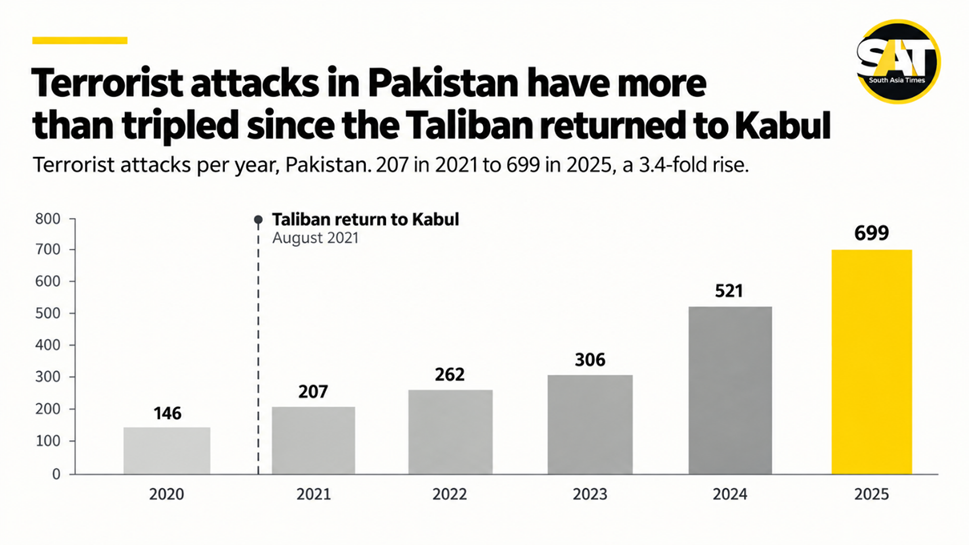
Attacks have risen in every year since the Taliban returned to power, and deaths more than tripled, from 335 in 2021 to 1,034 in 2025, according to the Pak Institute for Peace Studies. PICSS, which counts on a different basis, recorded 1,232 attacks in the first nine months of 2026 alone.
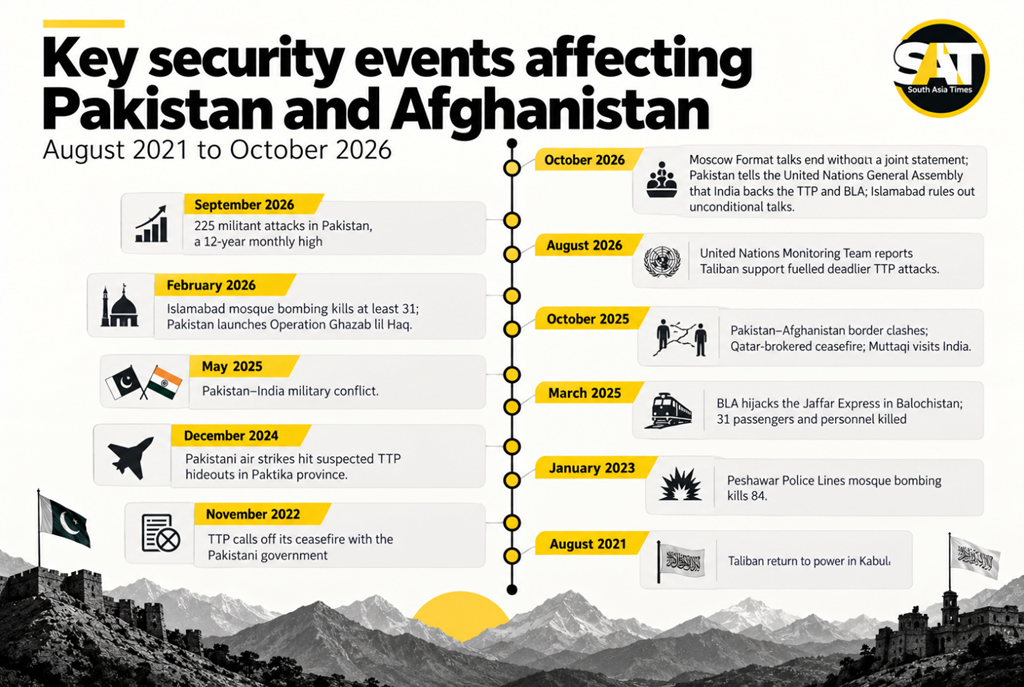
Read together, the five years tell a consistent story. Each lull in Pakistan’s fight against militancy has been followed by a sharper rise, and each rise has traced back to commanders, camps and recruits on the other side of the border. Pakistan has paid for that pattern with thousands of lives, and it has kept its demand modest: an end to sanctuary that can be checked, not merely promised. Kabul’s new friendships in New Delhi and its hopes for a road to China will not change the geography that binds Afghanistan to Pakistan. Whether the next five years look different will depend less on Islamabad’s resolve, which is not in doubt, than on whether the Taliban choose to act on the capacity they have already shown.
Sources
- Ground reports sought by South Asia Times, September 2026
- Dawn: TTP may morph into extra-regional threat (UN Monitoring Team, 37th report)
- Arab News: UN says Taliban support fuelled deadlier attacks in Pakistan (38th report)
- Dawn: Country witnessed 34pc increase in terrorism in 2025 (PIPS)
- The Nation: Militant attacks surge to 12-year high in September (PICSS)
- Express Tribune: At UN, Pakistan says India provides active support to Taliban
- Al Jazeera: What is Pakistan’s strategy as India-Taliban ties grow?
- Dawn: Pakistan rules out unconditional talks with Afghanistan
- FDD’s Long War Journal: Border clashes continue after Moscow talks
- Aeroroutes: Kam Air expands Kabul–Delhi service
- NewKerala/ANI: Ariana launches daily Kabul–Delhi flights
- The Tribune: Afghan route to China faces hurdles (Jayant Prasad)
- Amu TV: Will the Wakhan corridor connect Afghanistan to China?
- Wikipedia: Wakhjir Pass
- Wikipedia: 2026 Pakistani airstrikes in Afghanistan