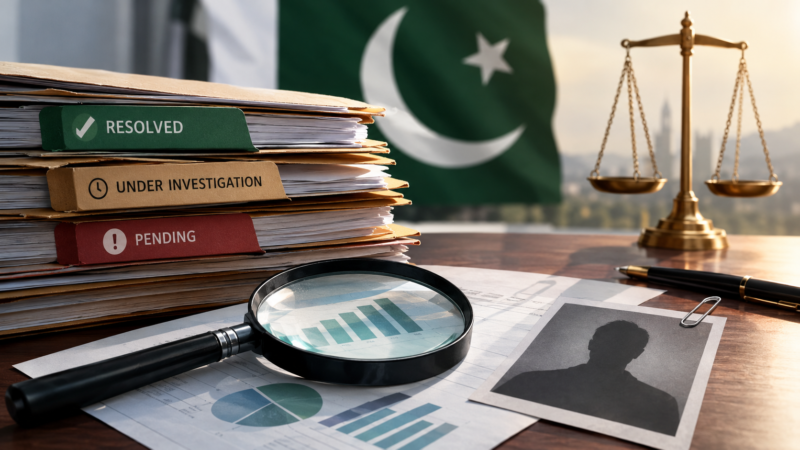
11,035 complaints registered, 9,596 cases reported as resolved, and 1,439 still under investigation. These figures should anchor Pakistan’s debate on separating facts from fiction. They describe substantial institutional activity alongside unfinished work. Any narrative that highlights outstanding complaints while ignoring cases already processed offers an incomplete account. Pakistan should challenge that imbalance firmly, with evidence that the public can examine.
The figures published on 20 October 2026 indicate a national case-disposal rate of 86.95 per cent, leaving 13.05 per cent under investigation. They do not establish that every complaint was unfounded or every missing person returned home. They do challenge sweeping portrayals of an entirely indifferent state. Investigative outcomes deserve acknowledgement alongside legitimate demands for further action.
The provincial breakdown in the supplied briefing deserves equal attention. Punjab records 1,633 resolved cases out of 1,820, or 89.72 per cent; Sindh, 1,756 out of 1,888, or 93 per cent; and Khyber Pakhtunkhwa, 2,954 out of 3,849, or 76.74 per cent. These differences should guide scrutiny of institutional performance and the allocation of investigative resources.
Balochistan records 2,797 resolved cases out of 2,970, or 94.17 per cent. Islamabad records 385 out of 427, or 90.16 per cent; Azad Jammu and Kashmir, 61 out of 71, or 85.91 per cent; and Gilgit-Baltistan, all 10 registered cases. These reported outcomes deserve examination. Public discussion should give verified progress the same visibility that it gives unresolved allegations.
The remaining caseload also tells an important story. Khyber Pakhtunkhwa accounts for 895 pending cases, approximately 62 per cent of the national backlog; Balochistan accounts for 173. The distribution of outstanding files should influence investigative priorities. Political attention alone cannot determine where resources, hearings and follow-up efforts are most urgently required.
The deeper problem is the automatic equation of “missing” with “forcibly disappeared by the state”. Unknown whereabouts can arise from migration, trafficking, personal disputes, criminal activity or voluntary departure. Enforced disappearance involves additional elements, including state involvement and concealment. Each complaint requires investigation. A name on a list cannot establish responsibility, and repetition cannot supply evidence that has yet to emerge.
That distinction matters because genuine suffering can be exploited. Political actors may seek publicity, separatist organizations legitimacy, and hostile propagandists reputational damage to Pakistan. Recent analysis of the missing persons narrative argues that militant networks exploit uncertainty surrounding detention to redirect scrutiny towards the state. Such arguments require specific evidence; they should never become blanket accusations against grieving families.
Pakistan’s strongest response is documented rebuttal. Where an allegation is contradicted by a verified outcome, authorities should explain the discrepancy. Where an individual is located abroad or identified in militant activity, the relevant evidence should be examined and disclosed appropriately. Demonstrable misinformation deserves a firm answer. Collective suspicion contributes little to establishing what happened to a particular person.
The institutional timeline also belongs in the public record. According to the supplied briefing, the first commission was established in May 2010, resolving 256 of 392 cases, with 136 transferred to the second commission in March 2011. The commission was reconstituted on 25 June 2025, and retired Justice Manzoor Hussain Malik was appointed chairman on 6 April 2026.
Families need practical assistance alongside investigation. The briefing records an August 2024 cabinet decision approving Rs5 million for each eligible family, with Rs5 billion allocated for 1,000 families. Announcements should be followed by transparent implementation. Assistance matters most when families can access it without prolonged uncertainty, repeated travel or dependence on political intermediaries.
Security pressures must also receive a fair hearing. Investigating clandestine networks while protecting judges, prosecutors and witnesses presents serious challenges. The recent discussion of counterterrorism safeguards makes a compelling practical point: recorded custody and visible judicial proceedings reduce the uncertainty that hostile narratives exploit. Their credibility depends on consistent implementation, meaningful oversight and reliable information for families.
The state should be equally precise about its achievements. “Disposed of” and “returned home” describe different outcomes. Public reporting should distinguish people traced, acknowledged detention, deaths, rejected complaints and continuing investigations. Clear categories strengthen Pakistan’s defense by allowing readers to assess what the reported 86.95 per cent actually represents.
Pakistan deserves a debate governed by equal standards. Campaigners should substantiate allegations, correct errors and acknowledge verified progress. Institutions should explain outcomes, investigate credible complaints and address proven misconduct. The remaining 1,439 cases demand urgency; they cannot automatically establish collective institutional guilt. A confident state can confront anti-state propaganda while answering families honestly. Its strongest defense is a record that withstands scrutiny.

Ammara Rauf
Ammara Rauf is a Linguistics and Literature graduate from the National University of Modern Languages (NUML). Her areas of interest include languages, culture, history, politics, translation, and interpretation. She is particularly interested in exploring how language shapes identity, public discourse, cultural understanding, and regional narratives. Her work engages with South Asian society, history, and contemporary political questions through a scholarly and interdisciplinary lens.